What it is
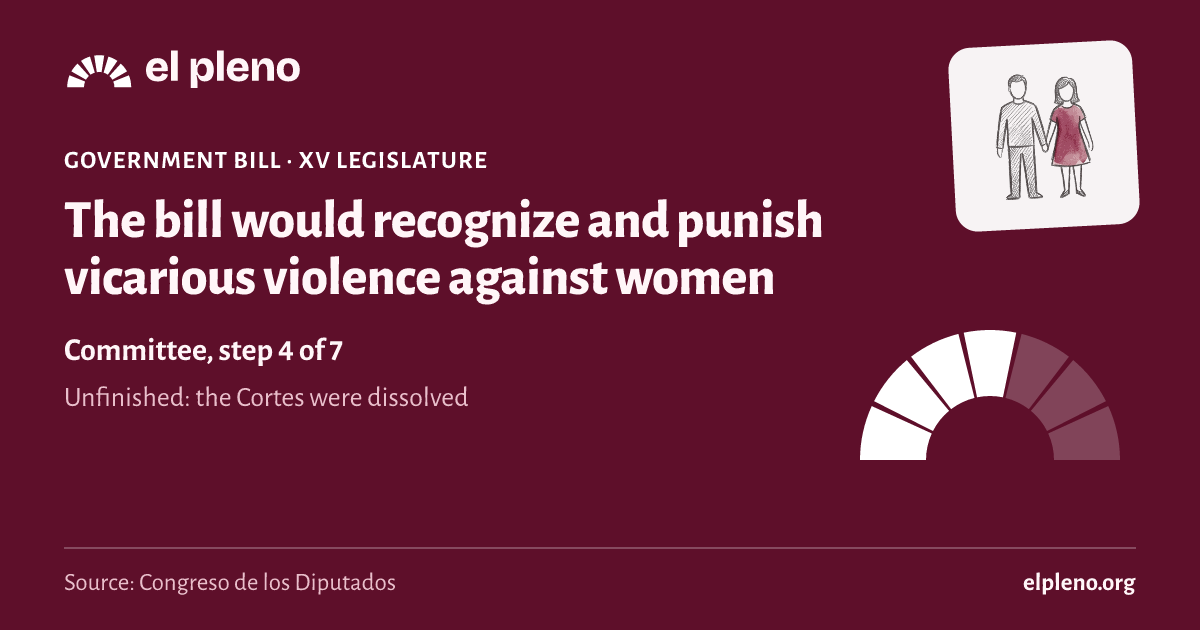
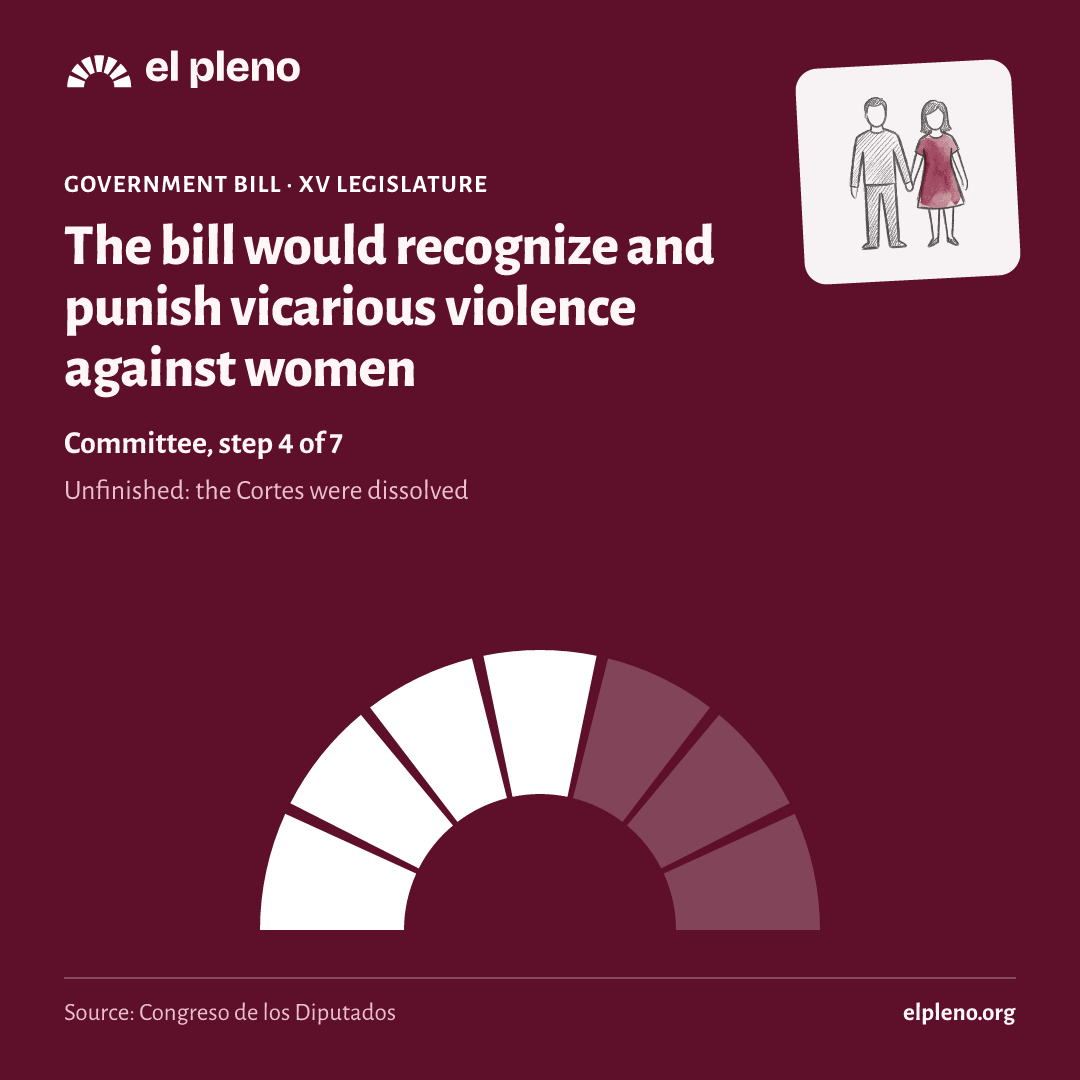
The bill would recognize and punish vicarious violence against women
Committee step 4 of 7· LapsedIt is a government bill. Introduced by the Government. It was introduced on 17 July 2026. Introduced by: Gobierno.
Official title: Organic Government bill on measures regarding vicarious violence.
Source: Congreso de los Diputados, file 121/000106· updated 11 Nov
Automatic summary, not yet reviewed
- The bill defines vicarious violence as violence exercised against a woman's children, descendants or other loved ones to cause her pain or suffering, and recognizes it as a form of gender-based violence. It also identifies as victims the women themselves, their children and descendants, and minors under their guardianship or custody.
- The bill adds vicarious violence as an aggravating circumstance of the gender-based crime, allowing higher sentences when a loved one is harmed to make a woman suffer. It also creates a new penalty barring the convicted person from publishing or spreading messages, texts or images related to the crime, applicable only to serious crimes against life, integrity, freedom or sexual freedom.
- The bill reforms the Civil Code to provide for the removal of parental authority when there is a final conviction for a serious crime against the couple's children or against the offender's wife or partner. It also allows courts to grant sole parental authority to the non-abusive parent when there are founded signs of violence, limits shared custody if it could harm the children, and requires that minors be heard before custody and visitation decisions.
- The bill strengthens training for judges and prosecutors on vicarious violence and on gender, childhood, disability and intersectional perspectives, both at the Judicial School and in entrance exams and continuing education. Judges working in gender violence or family courts would receive mandatory, periodic specialized training.
- The bill adds a minor's exposure to vicarious violence as a risk indicator in child legal protection, brings parental authority cases under a special procedural framework, and requires that vicarious violence be included in the training of teachers, health personnel and social services staff.
- The bill allows the mother of a child killed through vicarious violence to change the deceased child's surnames, and those of other minor children, to break the nominal link with the aggressor. It also prevents anyone who kills a child or loved one of the person generating a benefit from receiving Social Security survivor benefits.
Who it affects
- Women who are victims of gender-based violence: They would receive reinforced protection against vicarious violence, and their abusers could face higher sentences.
- Children and teenagers: They would have a guaranteed right to be heard in court proceedings affecting them and greater protection against visitation with the aggressor.
- Parents or partners convicted of serious crimes: They could lose parental authority, lose visitation rights, be barred from publishing content about the crime, and be denied survivor benefits.
- Judges, prosecutors, teachers, and health and social services personnel: They would receive mandatory training on vicarious violence and on gender, childhood, disability and intersectional perspectives.
- Adults with disabilities who need support: They would be recognized as possible victims of vicarious violence and would have the right to be heard in proceedings affecting them.
Words worth knowing
- Violencia vicaria (vicarious violence)
- Violence exercised against a woman's children or other loved ones to cause her harm or suffering.
- Patria potestad (parental authority)
- The set of rights and duties parents have over their minor children, such as caring for, educating and representing them.
- Guarda y custodia (custody)
- A court decision on who the minor children live with and who cares for them when parents separate.
- Delito doloso (intentional crime)
- A crime committed on purpose, with intent to do it.
- Prestaciones de muerte y supervivencia (death and survivor benefits)
- Social Security pensions paid to the relatives of a deceased person.
It summarizes the text as it was introduced. It is written by artificial intelligence and may contain mistakes: the official text is what counts. Read the official text · How we make summaries
Where it stands
How far did it get?
It took 4 of 7 steps. It reached Committee, and today it is lapsed.
- Introduced17 July 2026Someone registers the text in the Congreso.
- Admitted23 July 2026The Bureau of the Congreso accepts it and, for a members’ bill, the plenary decides whether to consider it.
- Amendments27 July 2026Groups propose changes.
- Committee21 September 2026A committee goes through the text in detail.
- Plenarynot reachedAll 350 deputies vote.
- Senatenot reachedThe Senate can pass it, amend it or veto it.
- BOEnot reachedIt is published in the Official State Gazette (BOE) and comes into force.
See the 7 official steps on a timeline
30 September 2026
How did the plenary vote?
Voted on: Vote on the amendment to the whole for return of the Private member's bill for an Organic Law on measures regarding vicarious violence, presented by the Parliamentary Group VOX.
Source: Congreso de los Diputados, vote 10 of sitting 202· updated 10 Nov
Each dot is a seat. Tap one, or use the arrow keys, to see who it is.
Your province
How did the deputies from your province vote?
And your senators: the Senate does not link its votes to this law in its open data, so we cannot put them side by side here.
Or see how most of each province voted
- A Coruña More votes against 0 yes · 8 no
- Albacete More votes against 0 yes · 4 no
- Alicante/Alacant More votes against 2 yes · 10 no
- Almería More votes against 1 yes · 5 no
- Araba/Álava More votes against 0 yes · 4 no
- Asturias More votes against 1 yes · 6 no
- Ávila More votes against 0 yes · 3 no
- Badajoz More votes against 1 yes · 4 no
- Barcelona More votes against 3 yes · 28 no
- Bizkaia More votes against 0 yes · 8 no
- Burgos More votes against 0 yes · 4 no
- Cáceres More votes against 0 yes · 4 no
- Cádiz More votes against 1 yes · 8 no
- Cantabria More votes against 1 yes · 4 no
- Castellón/Castelló More votes against 1 yes · 4 no
- Ceuta More votes against 0 yes · 1 no
- Ciudad Real More votes against 1 yes · 4 no
- Córdoba More votes against 1 yes · 5 no
- Cuenca More votes against 0 yes · 3 no
- Gipuzkoa More votes against 0 yes · 5 no
- Girona More votes against 0 yes · 6 no
- Granada More votes against 1 yes · 6 no
- Guadalajara More votes against 1 yes · 2 no
- Huelva More votes against 1 yes · 4 no
- Huesca More votes against 0 yes · 3 no
- Illes Balears More votes against 1 yes · 7 no
- Jaén More votes against 1 yes · 4 no
- La Rioja More votes against 0 yes · 4 no
- Las Palmas More votes against 1 yes · 7 no
- León More votes against 0 yes · 4 no
- Lleida More votes against 0 yes · 4 no
- Lugo More votes against 0 yes · 4 no
- Madrid More votes against 5 yes · 30 no
- Málaga More votes against 2 yes · 9 no
- Melilla More votes against 0 yes · 1 no
- Murcia More votes against 2 yes · 8 no
- Navarra More votes against 0 yes · 5 no
- Ourense More votes against 0 yes · 4 no
- Palencia More votes against 0 yes · 3 no
- Pontevedra More votes against 0 yes · 7 no
- Salamanca More votes against 0 yes · 4 no
- Santa Cruz de Tenerife More votes against 0 yes · 7 no
- Segovia More votes against 0 yes · 3 no
- Sevilla More votes against 1 yes · 11 no
- Soria More votes against 0 yes · 2 no
- Tarragona More votes against 0 yes · 6 no
- Teruel More votes against 0 yes · 3 no
- Toledo More votes against 1 yes · 5 no
- Valencia/València More votes against 2 yes · 14 no
- Valladolid More votes against 1 yes · 4 no
- Zamora More votes against 0 yes · 3 no
- Zaragoza More votes against 1 yes · 6 no
More details: how each group and each province voted
The groups
Who voted in favour and who against?
In favour, most of VOX. Against, most of Euskal Herria Bildu, Plurinacional SUMAR, Republicano, Socialista, Vasco (EAJ-PNV), Junts per Catalunya, Mixto and Popular en el Congreso. 2 deputies voted differently from their group.
By province: in 0 most voted in favour; in 52, against.
Coloured by how most of each province’s deputies voted.
- In favour: 0
- Against: 52
| Group | Seats | How it voted |
|---|---|---|
| Euskal Herria Bildu | 6 | 5 against · 1 did not vote |
| Plurinacional SUMAR | 26 | 1 in favour · 24 against · 1 did not vote |
| Republicano | 7 | 7 against |
| Socialista | 121 | 120 against · 1 did not vote |
| Vasco (EAJ-PNV) | 5 | 5 against |
| Junts per Catalunya | 7 | 6 against · 1 did not vote |
| Mixto | 9 | 1 in favour · 8 against |
| Popular en el Congreso | 137 | 137 against |
| VOX | 32 | 32 in favour |
What happens next
What happens now?
The legislature ended before it finished. To go on, someone would have to introduce it again in the new Cortes.
Sources
Where does all this come from?
- Congreso de los Diputados, file 121/000106
Official title, type, author, dates and stage.
Retrieved 11 November 2026
- Congreso de los Diputados, procedure
The date of each step, with its official wording.
Retrieved 12 November 2026
- Congreso de los Diputados, vote 10 of sitting 202
The count and every seat’s vote.
Retrieved 10 November 2026
- The data comes from the open files of the Congreso, the Senate and the BOE, unaltered.
- Each deputy’s province is the one of their seat on the day of the vote.
- We never say “passed” because of a vote: the files do not say which majority was needed.