What it is
Bill would raise state funding for long-term care benefits
Amendments step 3 of 7· LapsedIt is a government bill. Introduced by the Government. It was introduced on 14 July 2026. Introduced by: Gobierno.
Official title: Government bill on extraordinary measures for the strengthening and consolidation of the System for Autonomy and Care of Dependency (originating from Royal Decree-Law 17/2026, of June 23).
Source: Congreso de los Diputados, file 121/000104· updated 11 Nov
Automatic summary, not yet reviewed
- The bill would raise the minimum protection level the state guarantees for each beneficiary of the dependency system: 660 euros per month for grade III (severe dependency), 260 euros for grade II (major dependency) and 90 euros for grade I (moderate dependency).
- It would also set a minimum of 4,930 euros per month for people in grade III+, extreme dependency.
- It would grant budget supplements in the Ministry of Social Rights, Consumer Affairs and Agenda 2030: 2,097,652,020 euros for the guaranteed minimum in dependency and 121,000,000 euros for the agreed level, both to IMSERSO.
- These measures would not apply in the Basque Country or Navarre, due to their special concert and agreement arrangements for dependency care.
- The new amounts would apply to benefits accrued from July 1, 2026; the rest of the rule would take effect the day after publication in the official gazette (BOE).
- The Government would be empowered to issue any provisions needed to develop and carry out the rule.
Who it affects
- People with recognized dependency (grades I, II and III): They would receive a higher monthly state-guaranteed minimum.
- People in grade III+ (extreme dependency): They would have a guaranteed minimum of 4,930 euros per month.
- Families and caregivers: Better system funding, which the text says would cut waiting lists and improve care quality.
- Autonomous communities (regional governments): They would receive additional state transfers, except the Basque Country and Navarre.
Words worth knowing
- SAAD
- Sistema para la Autonomía y Atención a la Dependencia: Spain's public system that recognizes and pays benefits and services to people with dependency.
- Nivel mínimo de protección
- Minimum amount the state guarantees per dependent person, which regional governments top up.
- Nivel convenido (agreed level)
- Additional money the state contributes beyond the guaranteed minimum to fund the dependency system.
- IMSERSO
- Institute for the Elderly and Social Services, the public body that manages part of these benefits.
- Devengar
- When a benefit is deemed due, so the person has the right to collect it.
It summarizes the text as it was introduced. It is written by artificial intelligence and may contain mistakes: the official text is what counts. Read the official text · How we make summaries
Where it stands
How far did it get?
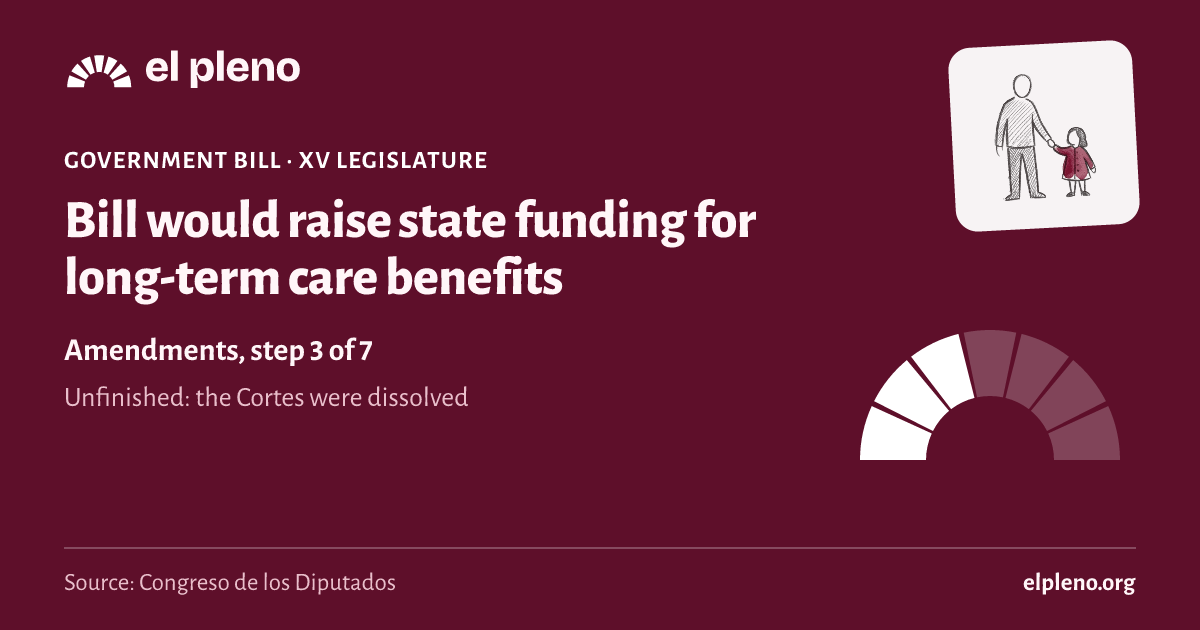
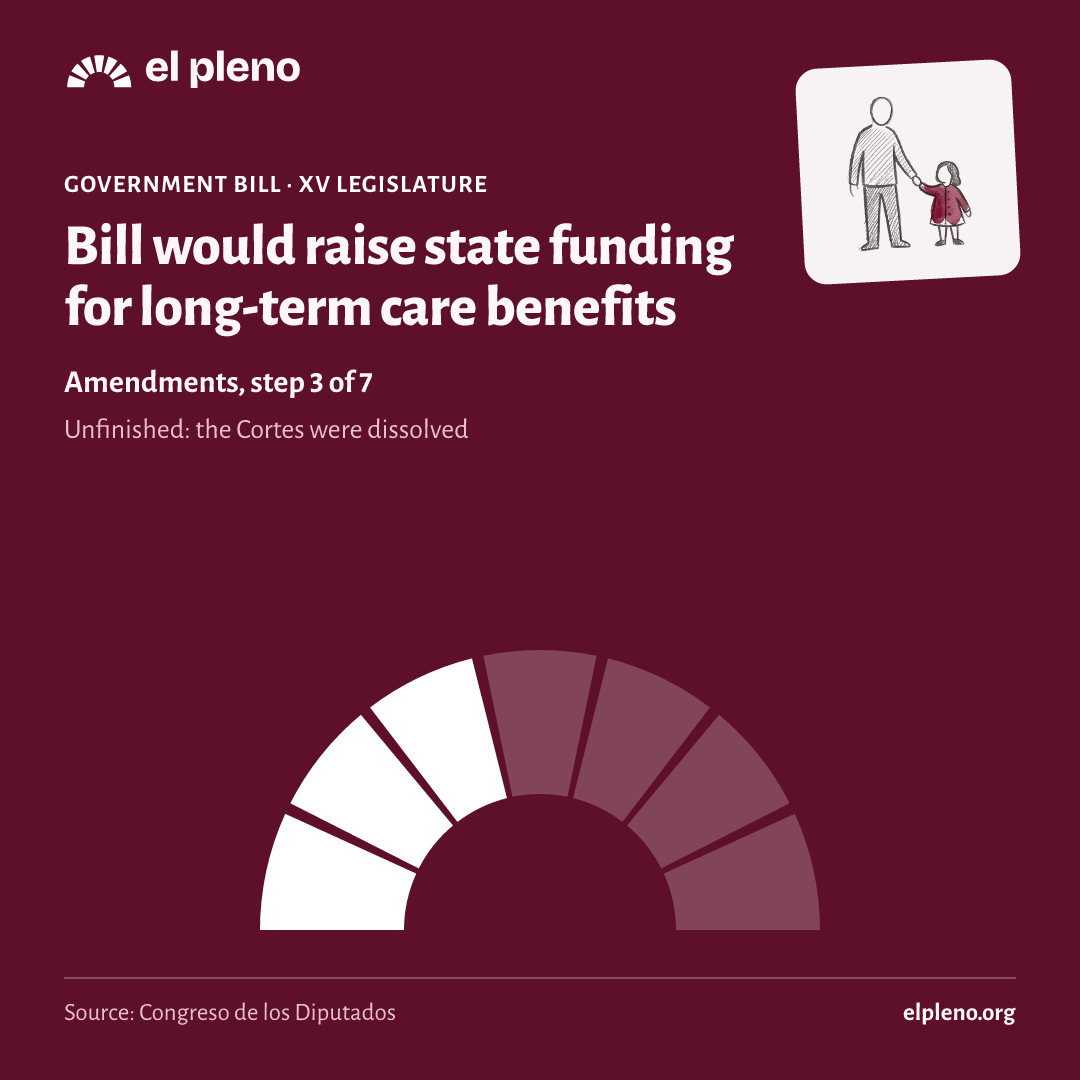
It took 3 of 7 steps. It reached Amendments, and today it is lapsed.
- Introduced14 July 2026Someone registers the text in the Congreso.
- Admitted23 July 2026The Bureau of the Congreso accepts it and, for a members’ bill, the plenary decides whether to consider it.
- Amendments27 July 2026Groups propose changes.
- Committeenot reachedA committee goes through the text in detail.
- Plenarynot reachedAll 350 deputies vote.
- Senatenot reachedThe Senate can pass it, amend it or veto it.
- BOEnot reachedIt is published in the Official State Gazette (BOE) and comes into force.
See the 5 official steps on a timeline
Was there a plenary vote?
We have no plenary vote linked to this law in the Congreso’s data.
What happens next
What happens now?
The legislature ended before it finished. To go on, someone would have to introduce it again in the new Cortes.
Sources
Where does all this come from?
- Congreso de los Diputados, file 121/000104
Official title, type, author, dates and stage.
Retrieved 11 November 2026
- Congreso de los Diputados, procedure
The date of each step, with its official wording.
Retrieved 12 November 2026
- The data comes from the open files of the Congreso, the Senate and the BOE, unaltered.
- Each deputy’s province is the one of their seat on the day of the vote.
- We never say “passed” because of a vote: the files do not say which majority was needed.