What it is
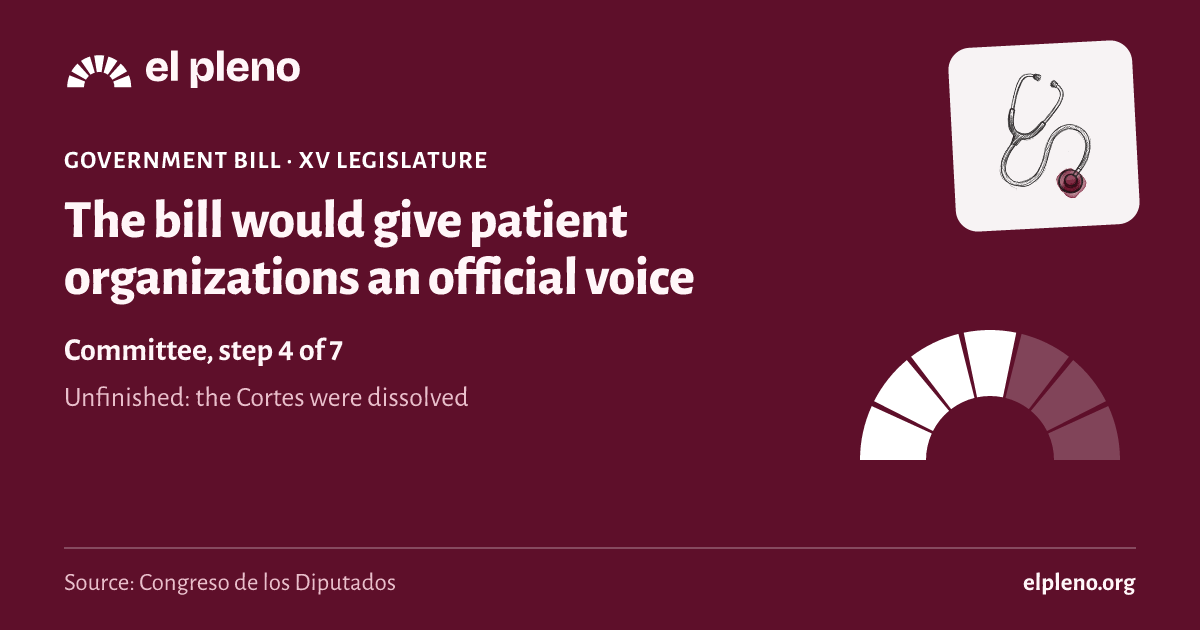
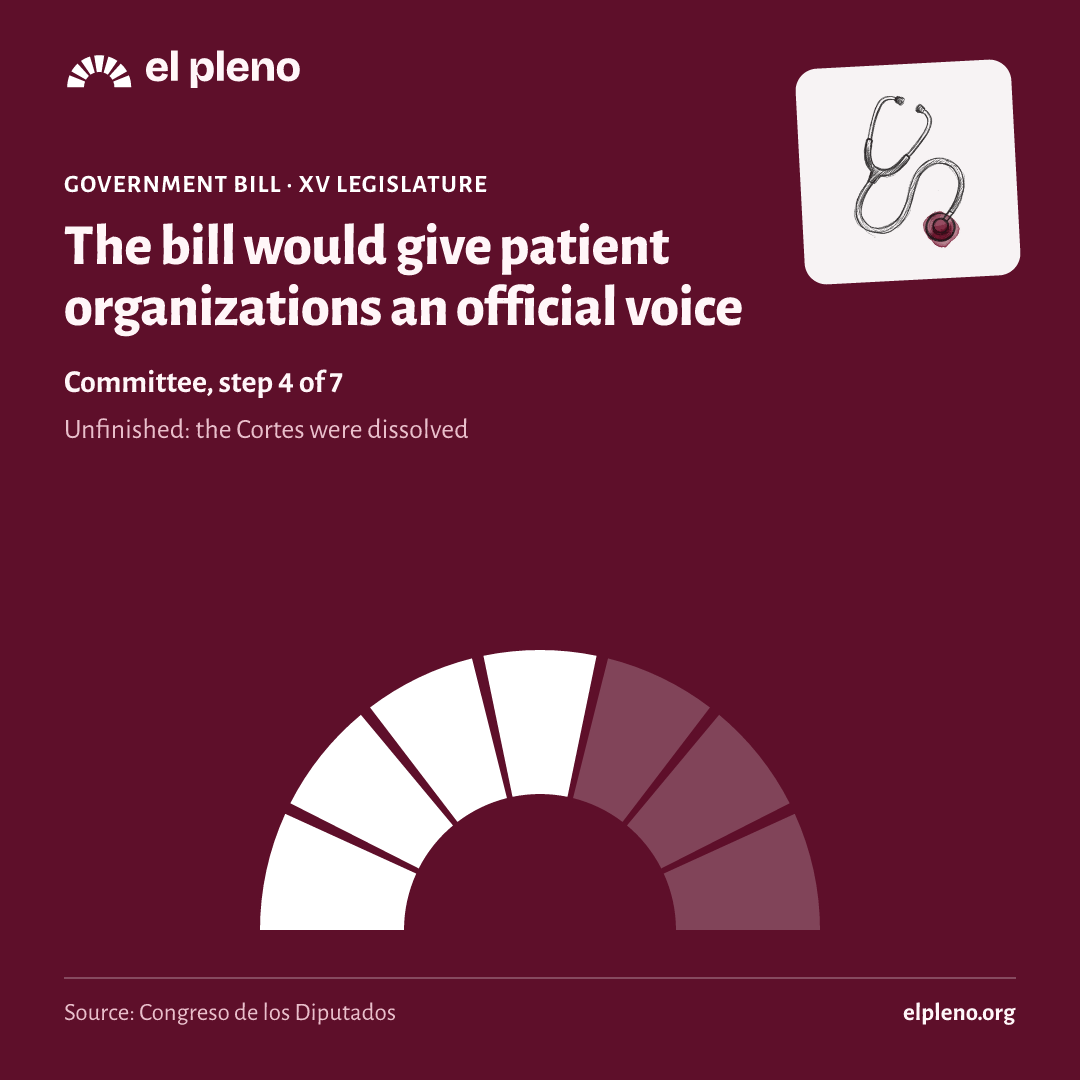
The bill would give patient organizations an official voice
Committee step 4 of 7· LapsedIt is a government bill. Introduced by the Government. It was introduced on 11 June 2026. Introduced by: Gobierno.
Official title: Government bill on Patient Organizations.
Source: Congreso de los Diputados, file 121/000098· updated 11 Nov
Automatic summary, not yet reviewed
- The bill would regulate the participation of state-wide patient organizations before the State Administration, define support measures, and develop their rights.
- It would apply to state-wide patient associations, federations, confederations and unions, registered in the National Register of Associations and active in more than one autonomous community or city.
- The organizations would gain rights before the Administration: receiving information, taking part in health strategies and plans, accessing public funding, training, and equal treatment regardless of size or condition.
- The Administration would have to publish relevant information, take the organizations' input into account, and guarantee that participation processes are accessible to everyone.
- It would create a Patient Participation Board and a State Census of Patient Organizations, and recognize their role in bodies such as the Advisory Committee of the National Health System.
- It would amend Law 16/2003 so that eight representatives of patient organizations join the Advisory Committee of the Interterritorial Council, and the law would take effect twenty days after publication in the official state gazette.
Words worth knowing
- Sistema Nacional de Salud
- Spain's public health system, coordinated between the central state and the autonomous communities.
- Comité Consultivo
- Advisory body to the Interterritorial Council, where the state and the autonomous communities coordinate health policy.
- Enfermedades raras
- Rare diseases, those affecting very few people and often needing specific care and resources.
- Accesibilidad universal
- Universal accessibility: everyone, including people with disabilities, can use a service or understand information.
- Orden ministerial
- A ministerial order, a rule issued by a ministry to work out the details of a law.
It summarizes the text as it was introduced. It is written by artificial intelligence and may contain mistakes: the official text is what counts. Read the official text · How we make summaries
Where it stands
How far did it get?
It took 4 of 7 steps. It reached Committee, and today it is lapsed.
- Introduced11 June 2026Someone registers the text in the Congreso.
- Admitted16 June 2026The Bureau of the Congreso accepts it and, for a members’ bill, the plenary decides whether to consider it.
- Amendments19 June 2026Groups propose changes.
- Committee10 September 2026A committee goes through the text in detail.
- Plenarynot reachedAll 350 deputies vote.
- Senatenot reachedThe Senate can pass it, amend it or veto it.
- BOEnot reachedIt is published in the Official State Gazette (BOE) and comes into force.
See the 7 official steps on a timeline
Was there a plenary vote?
We have no plenary vote linked to this law in the Congreso’s data.
What happens next
What happens now?
The legislature ended before it finished. To go on, someone would have to introduce it again in the new Cortes.
Sources
Where does all this come from?
- Congreso de los Diputados, file 121/000098
Official title, type, author, dates and stage.
Retrieved 11 November 2026
- Congreso de los Diputados, procedure
The date of each step, with its official wording.
Retrieved 12 November 2026
- The data comes from the open files of the Congreso, the Senate and the BOE, unaltered.
- Each deputy’s province is the one of their seat on the day of the vote.
- We never say “passed” because of a vote: the files do not say which majority was needed.