What it is
Raising pensions by 2.7% in 2026
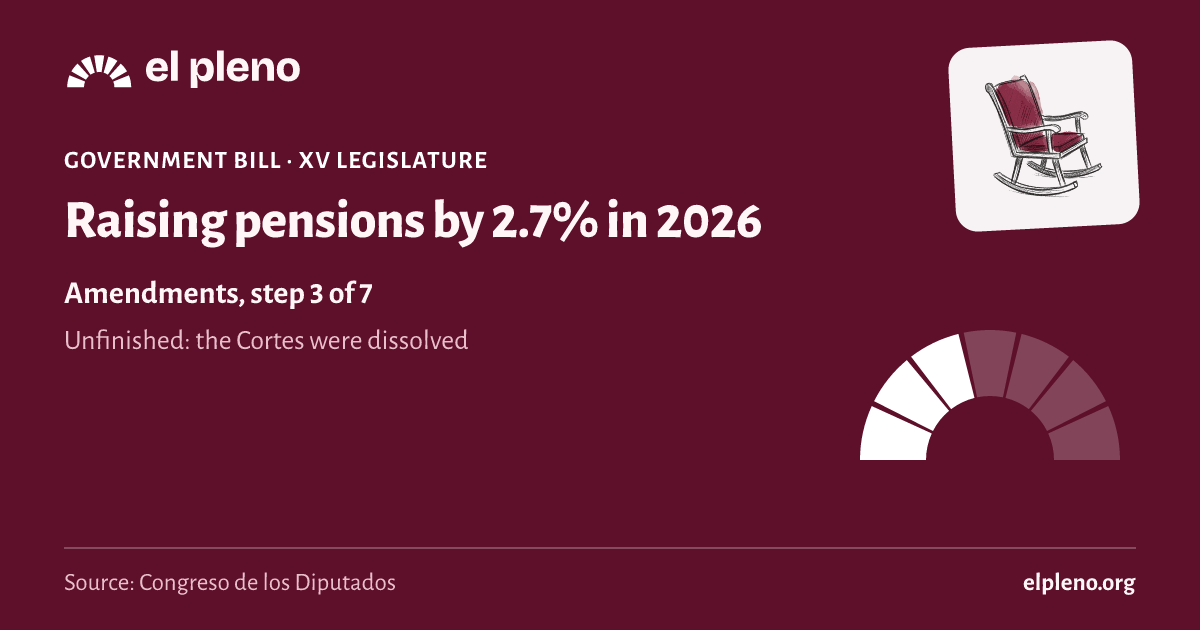
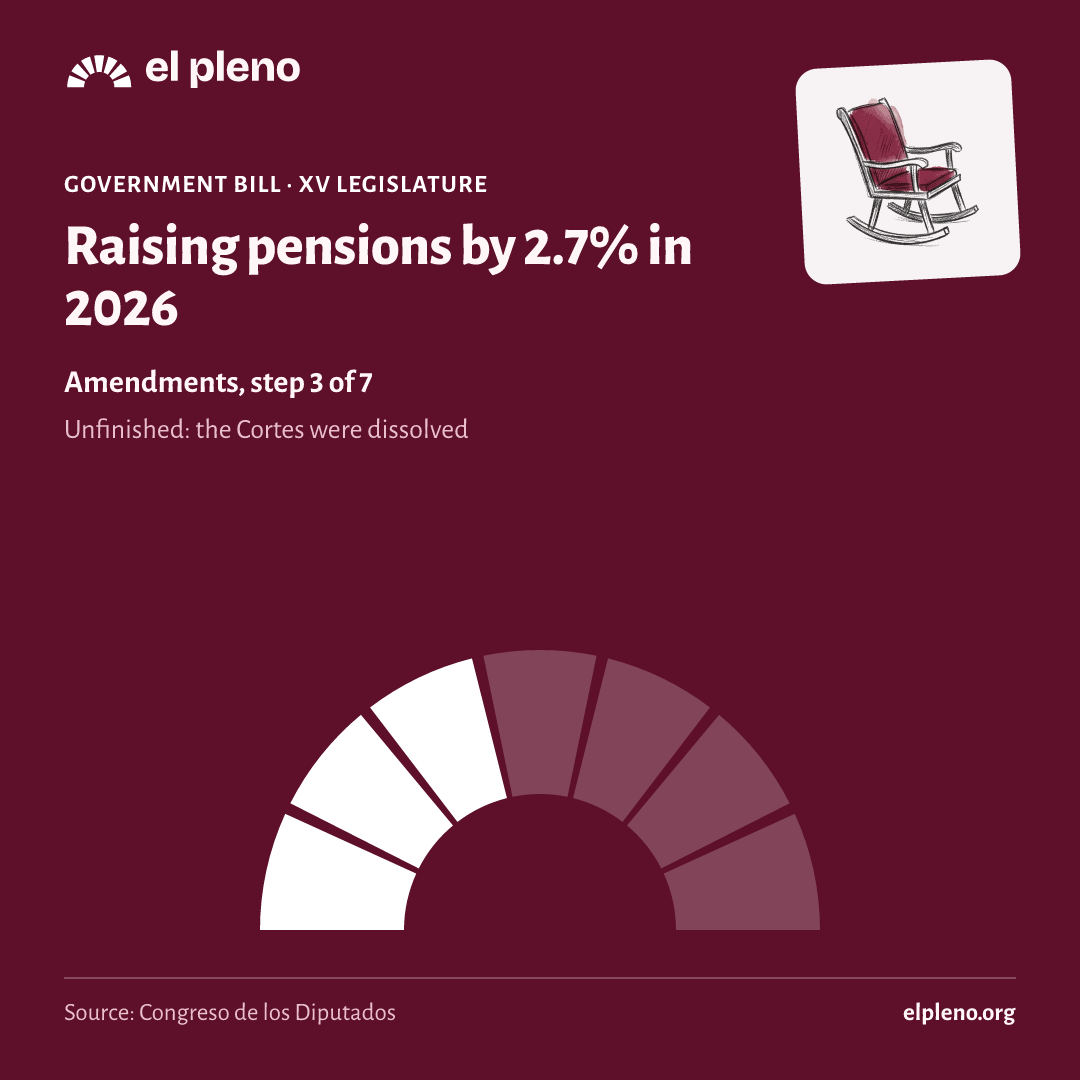
Amendments step 3 of 7· LapsedIt is a government bill. Introduced by the Government. It was introduced on 26 February 2026. Introduced by: Gobierno.
Official title: Government bill for the revaluation of public pensions and other urgent measures in the field of Social Security (originating from Royal Decree-Law 3/2026, of February 3).
Source: Congreso de los Diputados, file 121/000086· updated 11 Nov
Automatic summary, not yet reviewed
- The bill would raise contributory Social Security pensions and Clases Pasivas pensions by 2.7% starting January 1, 2026, to keep their purchasing power. It would also update non-contributory pensions, SOVI pensions, family benefits and other aid.
- It sets the maximum amount of public pensions granted in 2026 at €3,359.60 per month (€47,034.40 per year).
- The supplement to reduce the gender gap in contributory pensions would be €36.90 per month in 2026. The annexes list minimum pension amounts and income limits for receiving supplements.
- It updates Social Security contributions: the maximum contribution base would be €5,101.20 per month, the Intergenerational Equity Mechanism rate would be 0.90 percentage points, and the additional solidarity contribution would be updated. Self-employed contribution tables from 2025 would stay in place, with the maximum base of brackets 11 and 12 updated.
- It removes the requirement for unemployment benefit recipients to file an income tax return, because it created administrative burdens and could force them to pay taxes or lose deductions. It also adds the rate table for workplace accident and occupational disease contributions to the consolidated Social Security Law, adapted to the new business activity classification (CNAE-2025).
- It sets an additional contribution of 10.60% for forest firefighters and forest and environmental agents, mostly paid by the employer. The rule would take effect the day it is published in the BOE, with its main articles applying from January 1, 2026.
Who it affects
- Recipients of Social Security and Clases Pasivas pensions: Would see their pensions raised by 2.7%, with minimum amounts updated.
- Self-employed workers: Would keep their 2025 contribution tables and could recover 50% of contributions above €17,323.68 when working both self-employed and for an employer.
- People receiving unemployment benefits: Would no longer have to file an income tax return because of receiving the benefit.
- Forest firefighters and forest and environmental agents: An additional 10.60% contribution would apply, split between employer and worker.
- Companies and self-employed workers: Their workplace accident and occupational disease contributions would be calculated with the new table adapted to CNAE-2025.
Words worth knowing
- Revalorización
- Pension increase meant to offset rising prices so pensioners do not lose purchasing power.
- Pensión contributiva
- A pension you qualify for by having previously paid Social Security contributions through work.
- Base de cotización
- The amount on which Social Security contributions are calculated.
- Clases Pasivas
- The pension system for civil servants, generally predating the current Social Security system.
- Real decreto-ley
- A rule with the force of law that the Government can pass urgently and that Congress must later validate.
It summarizes the text as it was introduced. It is written by artificial intelligence and may contain mistakes: the official text is what counts. Read the official text · How we make summaries
Where it stands
How far did it get?
It took 3 of 7 steps. It reached Amendments, and today it is lapsed.
- Introduced26 February 2026Someone registers the text in the Congreso.
- Admitted10 March 2026The Bureau of the Congreso accepts it and, for a members’ bill, the plenary decides whether to consider it.
- Amendments13 March 2026Groups propose changes.
- Committeenot reachedA committee goes through the text in detail.
- Plenarynot reachedAll 350 deputies vote.
- Senatenot reachedThe Senate can pass it, amend it or veto it.
- BOEnot reachedIt is published in the Official State Gazette (BOE) and comes into force.
See the 5 official steps on a timeline
Was there a plenary vote?
We have no plenary vote linked to this law in the Congreso’s data.
What happens next
What happens now?
The legislature ended before it finished. To go on, someone would have to introduce it again in the new Cortes.
Sources
Where does all this come from?
- Congreso de los Diputados, file 121/000086
Official title, type, author, dates and stage.
Retrieved 11 November 2026
- Congreso de los Diputados, procedure
The date of each step, with its official wording.
Retrieved 12 November 2026
- The data comes from the open files of the Congreso, the Senate and the BOE, unaltered.
- Each deputy’s province is the one of their seat on the day of the vote.
- We never say “passed” because of a vote: the files do not say which majority was needed.