What it is
Bill to update the right to correct false information in media and platforms
Amendments step 3 of 7· LapsedIt is a government bill. Introduced by the Government. It was introduced on 16 January 2026. Introduced by: Gobierno.
Official title: Government Organic bill regulating the right of rectification.
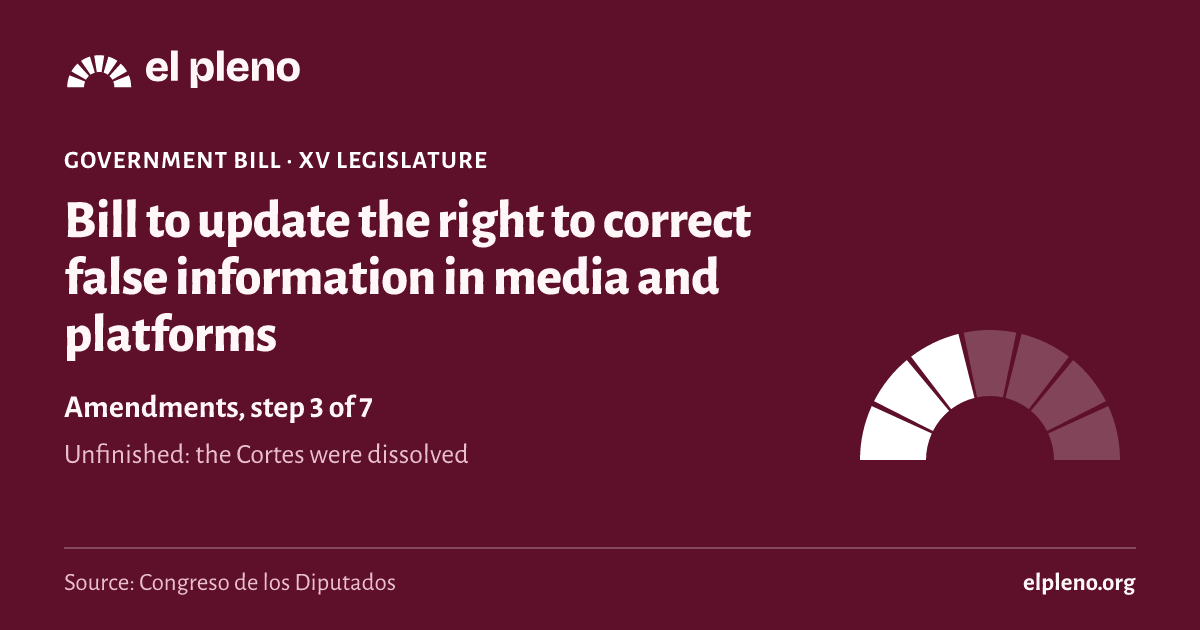
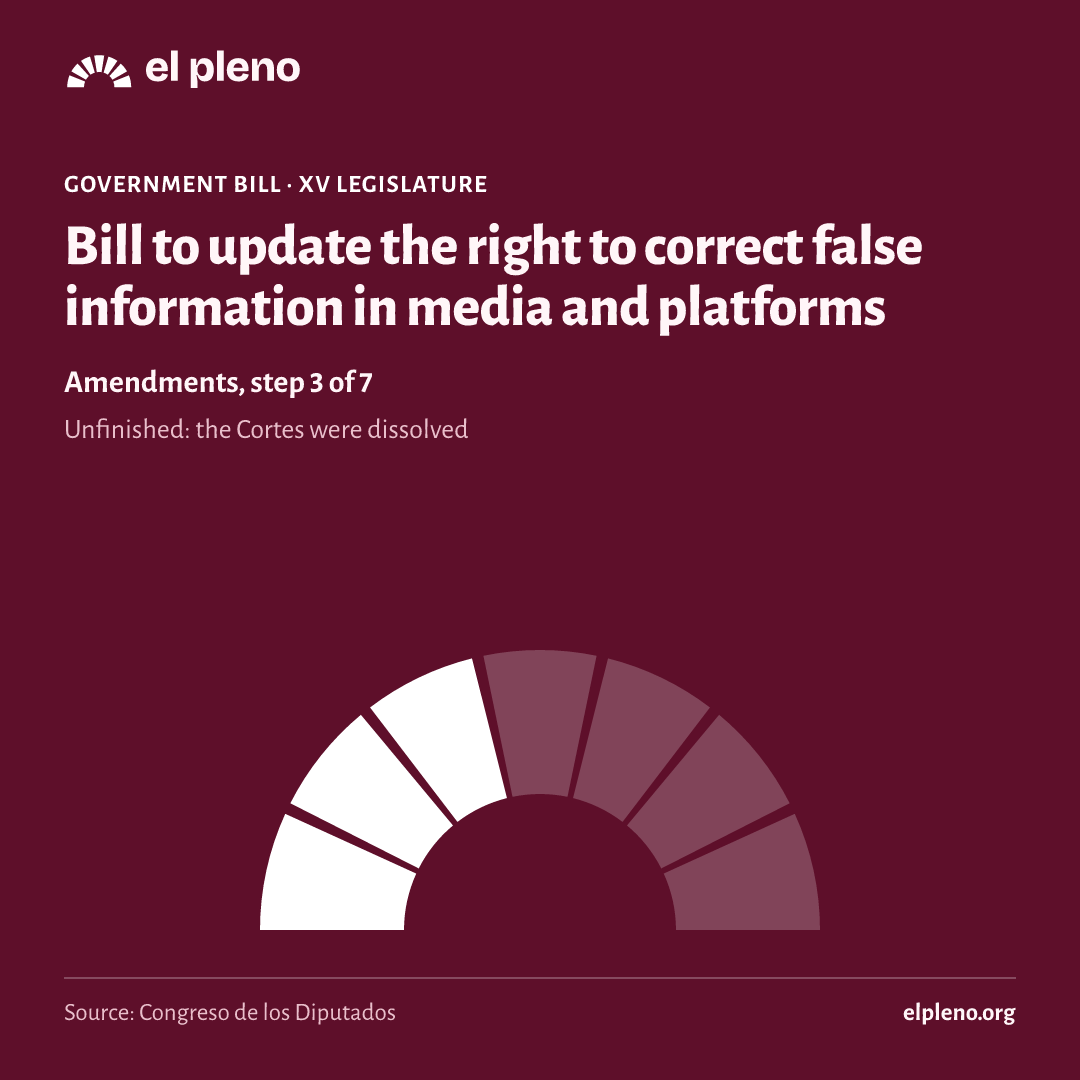
Source: Congreso de los Diputados, file 121/000083· updated 11 Nov
Automatic summary, not yet reviewed
- The bill would allow anyone to request correction of information about facts that affect them and that they consider inaccurate, published by media outlets or by users of special relevance on online platforms. A user of special relevance is one with 100,000 or more followers on a single platform, or 200,000 or more across all platforms.
- It extends the deadlines for requesting a correction: ten calendar days in the general case and twenty for digital media and platform users. Digital media would have to provide a free, visible and accessible mechanism for submitting these requests.
- The media outlet or user would have to publish the full correction within three calendar days, with prominence similar to the original information and free of charge. For digital media and platforms, a visible notice next to the original story with a link to the correction would also be required, and if the information spread across several channels, the correction would have to be published in all of them.
- If the correction is not published or is published improperly, the affected person could go to the court of their home within seven working days. The verbal hearing would take place without a lawyer or court representative, without a written answer to the claim, and the ruling could order publication of only part of the correction, removing non-essential opinions.
- People with disabilities and minors over sixteen could exercise the right themselves, and if the person concerned has died, their spouse, closest relatives or a person designated by the deceased could do so.
- The bill would repeal Organic Law 2/1984 and align the rules on the right of correction in the Organic Law on the General Electoral Regime and in the Personal Data Protection Law. It would enter into force two months after publication in the Official State Gazette.
Who it affects
- Anyone named in information they consider inaccurate in media outlets or online platforms.: They could request that their version of the facts be published through the same channels.
- Traditional and digital media outlets.: They would have to publish corrections within three days, free of charge, and digital media would have to offer a mechanism to receive them and display a correction notice in their archives.
- Online platform users with 100,000 or more followers on one platform, or 200,000 across all platforms.: They could be required to publish corrections to the content they control and must publicly state how the right can be exercised against them.
- Courts.: They would handle the action through a fast verbal hearing, without a lawyer or court representative and without a written answer.
Words worth knowing
- Derecho de rectificación (right of correction)
- The right of anyone named in a news story to make their version of facts they consider inaccurate public, through the same outlet that published it.
- Plataforma en línea (online platform)
- A digital service where users upload and share content, such as social networks or video networks, as defined by the European Union Digital Services Act.
- Juicio verbal (verbal hearing)
- A short, simple court proceeding where the parties present their case orally before the judge at a hearing.
- Demanda sucinta (summary claim)
- A brief, simplified court claim that can be filed without a lawyer or court representative.
- Días naturales (calendar days)
- All consecutive days, including weekends and holidays, unlike working days, which exclude holidays.
It summarizes the text as it was introduced. It is written by artificial intelligence and may contain mistakes: the official text is what counts. Read the official text · How we make summaries
Where it stands
How far did it get?
It took 3 of 7 steps. It reached Amendments, and today it is lapsed.
- Introduced16 January 2026Someone registers the text in the Congreso.
- Admitted27 January 2026The Bureau of the Congreso accepts it and, for a members’ bill, the plenary decides whether to consider it.
- Amendments30 January 2026Groups propose changes.
- Committeenot reachedA committee goes through the text in detail.
- Plenarynot reachedAll 350 deputies vote.
- Senatenot reachedThe Senate can pass it, amend it or veto it.
- BOEnot reachedIt is published in the Official State Gazette (BOE) and comes into force.
See the 5 official steps on a timeline
Was there a plenary vote?
We have no plenary vote linked to this law in the Congreso’s data.
What happens next
What happens now?
The legislature ended before it finished. To go on, someone would have to introduce it again in the new Cortes.
Sources
Where does all this come from?
- Congreso de los Diputados, file 121/000083
Official title, type, author, dates and stage.
Retrieved 11 November 2026
- Congreso de los Diputados, procedure
The date of each step, with its official wording.
Retrieved 12 November 2026
- The data comes from the open files of the Congreso, the Senate and the BOE, unaltered.
- Each deputy’s province is the one of their seat on the day of the vote.
- We never say “passed” because of a vote: the files do not say which majority was needed.