What it is
Bill proposes more aid and loans for DANA flood-hit areas
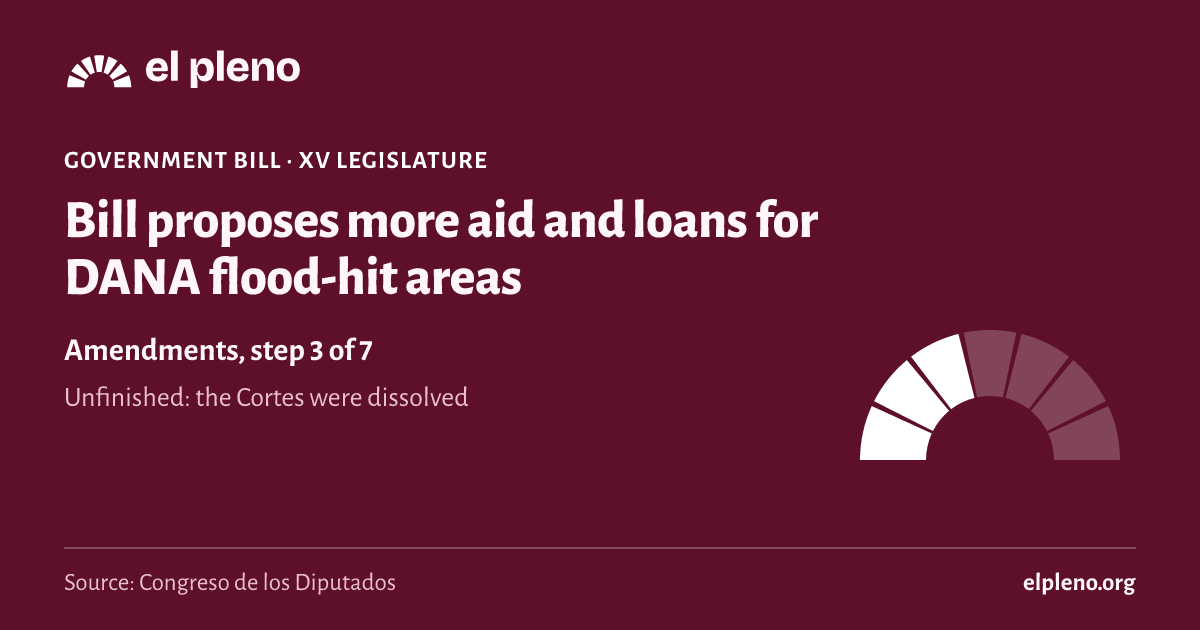
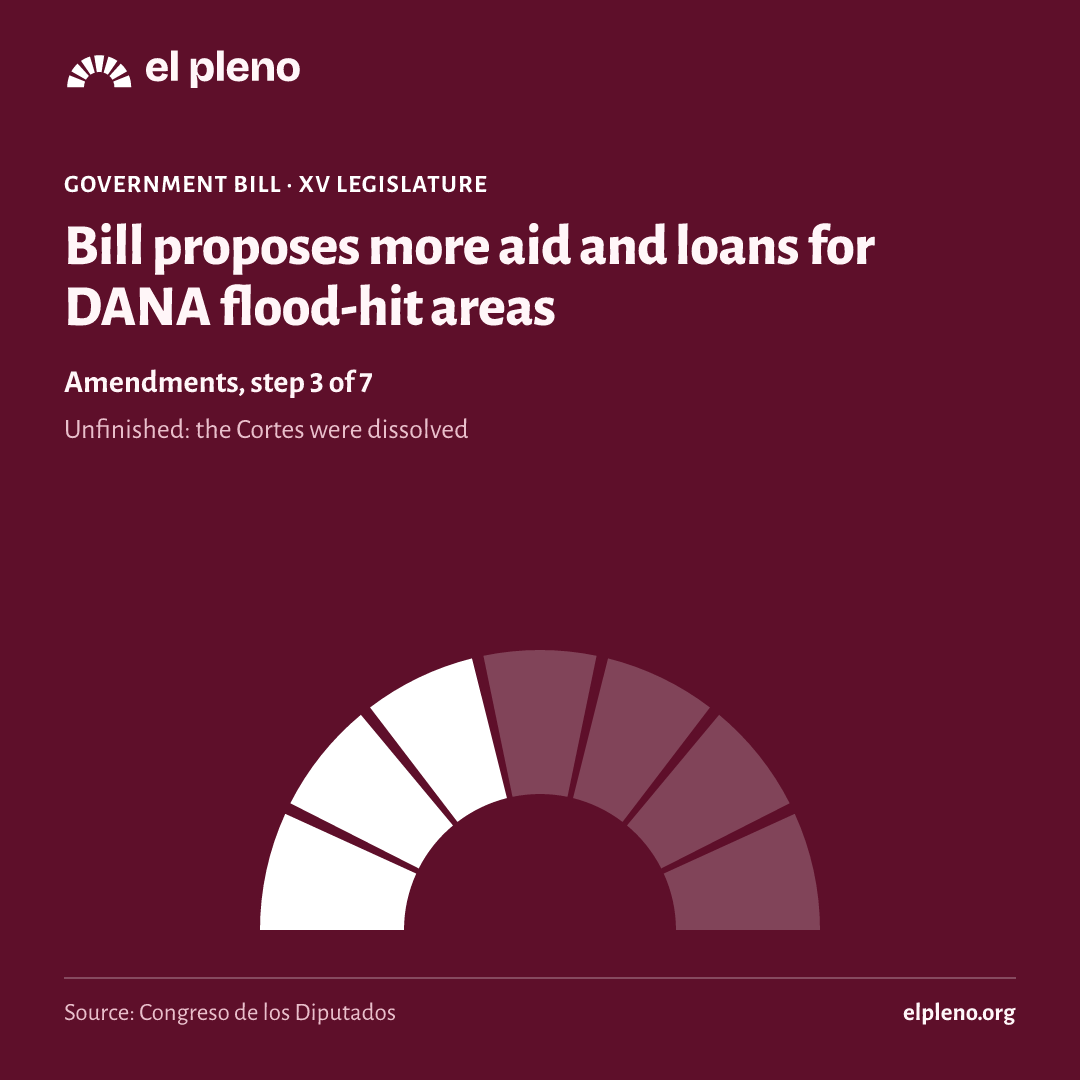
Amendments step 3 of 7· LapsedIt is a government bill. Introduced by the Government. It was introduced on 27 November 2025. Introduced by: Gobierno.
Official title: Government bill adopting urgent measures for reactivation, reinforcement, and prevention within the framework of the immediate response, reconstruction, and relaunch plan against the damage caused by the Cut-off Low (DANA) in various municipalities between October 28 and November 4, 2024 (originating from Royal Decree-Law 12/2025, of October 28).
Source: Congreso de los Diputados, file 121/000078· updated 11 Nov
Automatic summary, not yet reviewed
- The bill would create new ICO loans with a non-repayable portion (up to 30% of the loan) and interest rate subsidies for companies, through the ICO CRECIMIENTO line, of up to €750 million.
- It would create a State guarantee line, of up to €5,000 million and until December 31, 2040, to back financing for households, businesses and self-employed people affected by civil protection emergencies in areas officially declared severely hit.
- PERTE NAVAL projects located in municipalities of the province of Valencia could certify that their facilities are up and running until June 30, 2026, due to delays caused by the shortage of machinery after the DANA floods.
- For PERTE VEC aid (electric and connected vehicles), the requirement that at least 30% of the aid go to SMEs could be met by counting all groupings in the program together, instead of project by project.
- It would extend the deferral of Social Security contributions: for companies and self-employed workers in the Special Regime for Sea Workers, contributions accrued between November 2025 and January 2026; for other self-employed workers in special regimes, between December 2025 and February 2026.
- Self-employed people who were receiving the DANA cessation-of-activity benefit on January 31, 2025 could access a new extraordinary benefit for the period from February 1 to December 31, 2025, if their activity remains halted by the damage.
- It would enable subsidies of up to €60 million for affected municipalities to adapt buildings to flood risk, and would grant direct aid to the cultural sector, including €200,000 for the Salvem les Fotos project and subsidies for five Valencian cultural organizations.
- Vehicles wrecked by the DANA that are temporarily deregistered and were declared a total or partial loss would be permanently deregistered automatically, and missing vehicles could be permanently deregistered if their owner requests it with a sworn statement until December 15, 2025.
Who it affects
- Households, businesses and self-employed people in areas hit by civil protection emergencies: They could request State guarantees for financing granted by credit institutions.
- Self-employed people affected by the DANA: They could defer Social Security contributions and access a new cessation-of-activity benefit.
- Municipalities listed in the annex of Real Decreto-ley 6/2024: They could receive subsidies to adapt buildings to flood risk and extend deadlines for other aid.
- Companies in PERTE NAVAL and PERTE VEC: They would have more time and more flexible rules to justify their aid.
- Cultural organizations and families in l'Horta Sud: They would receive direct subsidies to restore cultural activity and damaged family photographs.
Words worth knowing
- Tramo no reembolsable (TNR)
- Non-repayable tranche: the part of the loan you do not have to pay back if you meet the conditions; it works like a grant.
- Aval
- Guarantee: the State's commitment to pay the debt if the person or business that borrowed the money cannot.
- DANA
- Spanish acronym for an isolated high-level low-pressure system, a weather event that brings very heavy rain.
- ZAGEPC
- Area severely affected by a civil protection emergency, a formal declaration that triggers aid.
- Novación
- Novation: changing the terms of an existing loan without losing the guarantee.
It summarizes the text as it was introduced. It is written by artificial intelligence and may contain mistakes: the official text is what counts. Read the official text · How we make summaries
Where it stands
How far did it get?
It took 3 of 7 steps. It reached Amendments, and today it is lapsed.
- Introduced27 November 2025Someone registers the text in the Congreso.
- Admitted9 December 2025The Bureau of the Congreso accepts it and, for a members’ bill, the plenary decides whether to consider it.
- Amendments12 December 2025Groups propose changes.
- Committeenot reachedA committee goes through the text in detail.
- Plenarynot reachedAll 350 deputies vote.
- Senatenot reachedThe Senate can pass it, amend it or veto it.
- BOEnot reachedIt is published in the Official State Gazette (BOE) and comes into force.
See the 5 official steps on a timeline
Was there a plenary vote?
We have no plenary vote linked to this law in the Congreso’s data.
What happens next
What happens now?
The legislature ended before it finished. To go on, someone would have to introduce it again in the new Cortes.
Sources
Where does all this come from?
- Congreso de los Diputados, file 121/000078
Official title, type, author, dates and stage.
Retrieved 11 November 2026
- Congreso de los Diputados, procedure
The date of each step, with its official wording.
Retrieved 12 November 2026
- The data comes from the open files of the Congreso, the Senate and the BOE, unaltered.
- Each deputy’s province is the one of their seat on the day of the vote.
- We never say “passed” because of a vote: the files do not say which majority was needed.