What it is
Bill would let Spanish police and customs share information with the EU
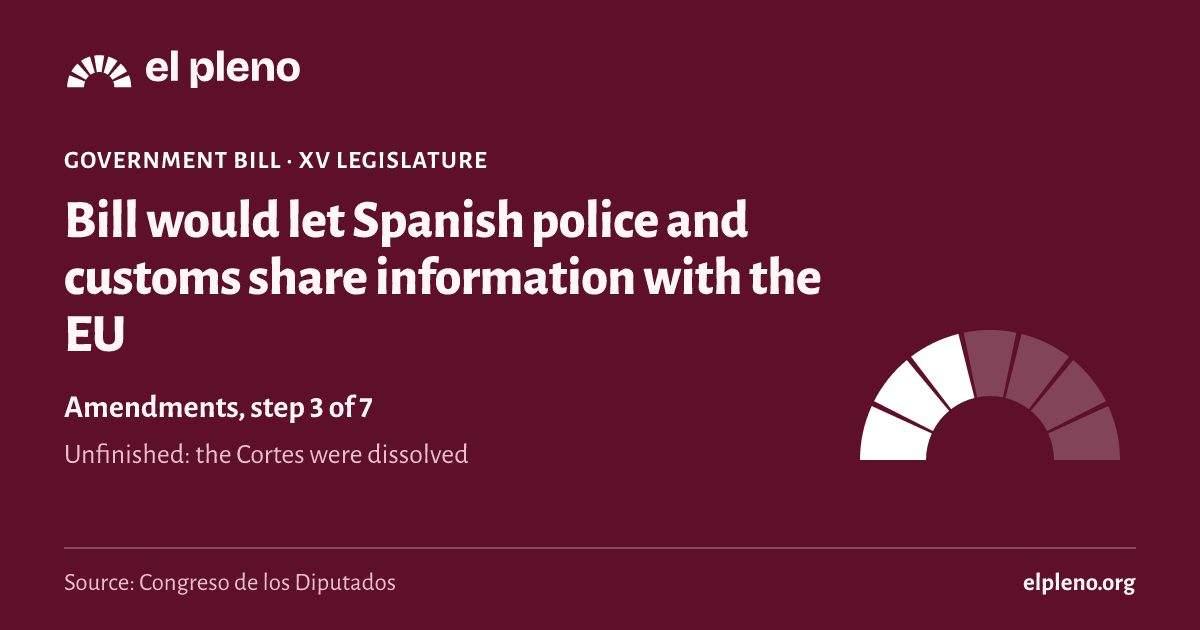
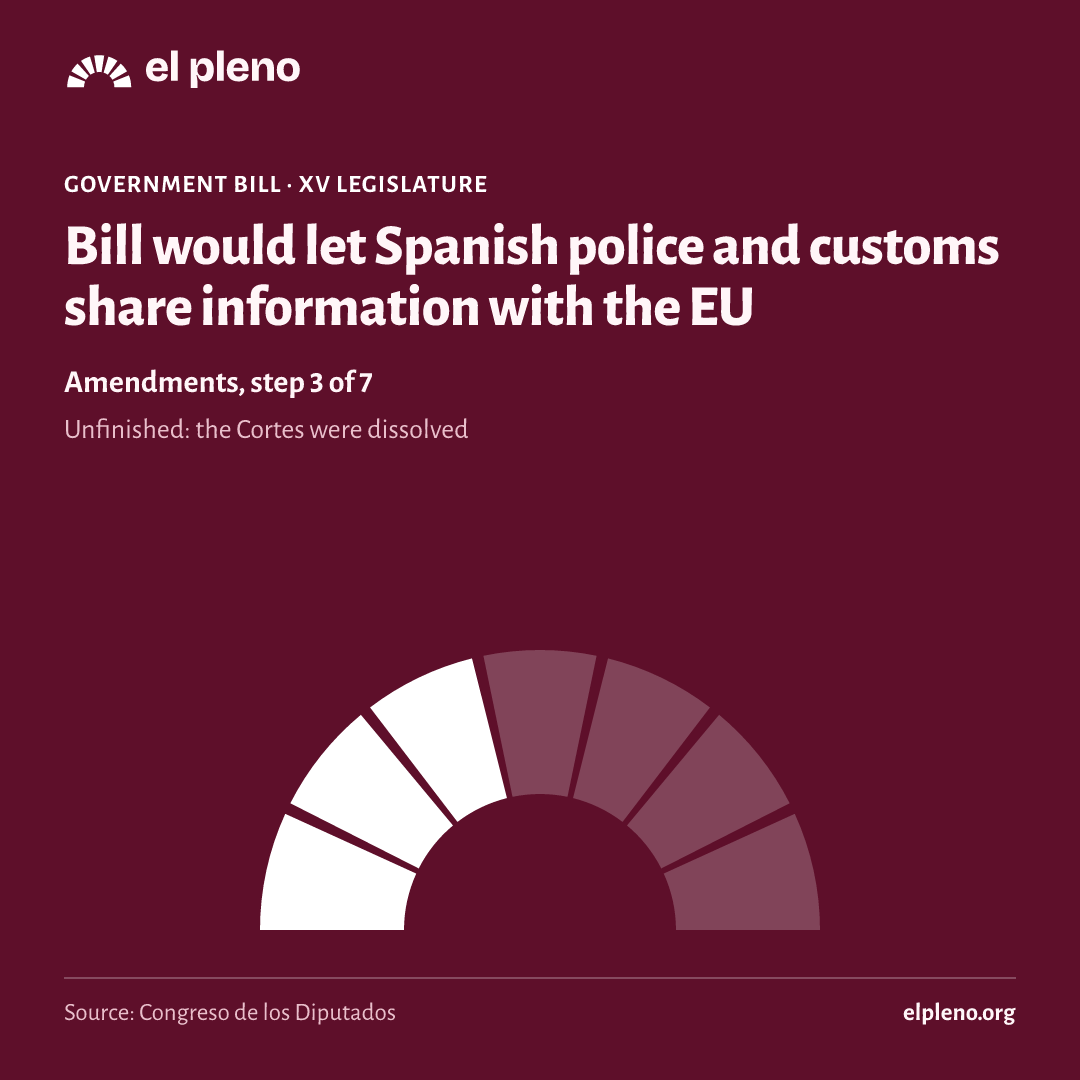
Amendments step 3 of 7· LapsedIt is a government bill. Introduced by the Government. It was introduced on 26 November 2025. Introduced by: Gobierno.
Official title: Government bill on the exchange of information between the security and customs services of the Member States of the European Union.
Source: Congreso de los Diputados, file 121/000077· updated 11 Nov
Automatic summary, not yet reviewed
- The bill would allow Spanish security and customs services to quickly exchange information with their counterparts in the European Union to prevent, detect or investigate crimes. It transposes a 2023 EU directive that replaces the previous 2010 rule.
- The competent services would be the State Law Enforcement Agencies (Fuerzas y Cuerpos de Seguridad del Estado), regional police forces with statutory crime investigation powers, and the Customs Surveillance Directorate. The State Secretariat for Security would act as the single point of contact, including the Europol National Unit, the SIRENE Office and the National Central INTERPOL Office.
- Information requests would have to show that the information is necessary and available in the other country. Response deadlines would apply: eight hours for urgent requests with directly accessible information, three days for urgent requests with indirect access, and seven days for the rest.
- Requests could only be denied on specific grounds, such as the information not being available, national security concerns, or a missing judicial authorization. If Spanish law requires judicial authorization, it would be sought as quickly as possible and the deadlines would adjust.
- Information could also be sent proactively, without a request, and for serious crimes this would be mandatory. In addition, sending copies of requests and information to Europol would be assessed case by case, with the consent of the country that originally provided it.
- An electronic case management system would be created to record requests, responses and denials, and personal data would be protected under Organic Law 7/2021. The Ministry of the Interior would send annual statistics to the European Commission before March 1.
Words worth knowing
- Punto de contacto único (single point of contact)
- State office that receives, sends and coordinates information requests with the other EU countries.
- SIENA
- Europol's secure information exchange network; Europol is the EU's law enforcement agency.
- Información de oficio (information on its own initiative)
- Information sent proactively, without another country asking for it.
- Transposición (transposition)
- The process of incorporating an EU directive into Spanish law through a dedicated law.
It summarizes the text as it was introduced. It is written by artificial intelligence and may contain mistakes: the official text is what counts. Read the official text · How we make summaries
Where it stands
How far did it get?
It took 3 of 7 steps. It reached Amendments, and today it is lapsed.
- Introduced26 November 2025Someone registers the text in the Congreso.
- Admitted9 December 2025The Bureau of the Congreso accepts it and, for a members’ bill, the plenary decides whether to consider it.
- Amendments12 December 2025Groups propose changes.
- Committeenot reachedA committee goes through the text in detail.
- Plenarynot reachedAll 350 deputies vote.
- Senatenot reachedThe Senate can pass it, amend it or veto it.
- BOEnot reachedIt is published in the Official State Gazette (BOE) and comes into force.
See the 5 official steps on a timeline
Was there a plenary vote?
We have no plenary vote linked to this law in the Congreso’s data.
What happens next
What happens now?
The legislature ended before it finished. To go on, someone would have to introduce it again in the new Cortes.
Sources
Where does all this come from?
- Congreso de los Diputados, file 121/000077
Official title, type, author, dates and stage.
Retrieved 11 November 2026
- Congreso de los Diputados, procedure
The date of each step, with its official wording.
Retrieved 12 November 2026
- The data comes from the open files of the Congreso, the Senate and the BOE, unaltered.
- Each deputy’s province is the one of their seat on the day of the vote.
- We never say “passed” because of a vote: the files do not say which majority was needed.