What it is
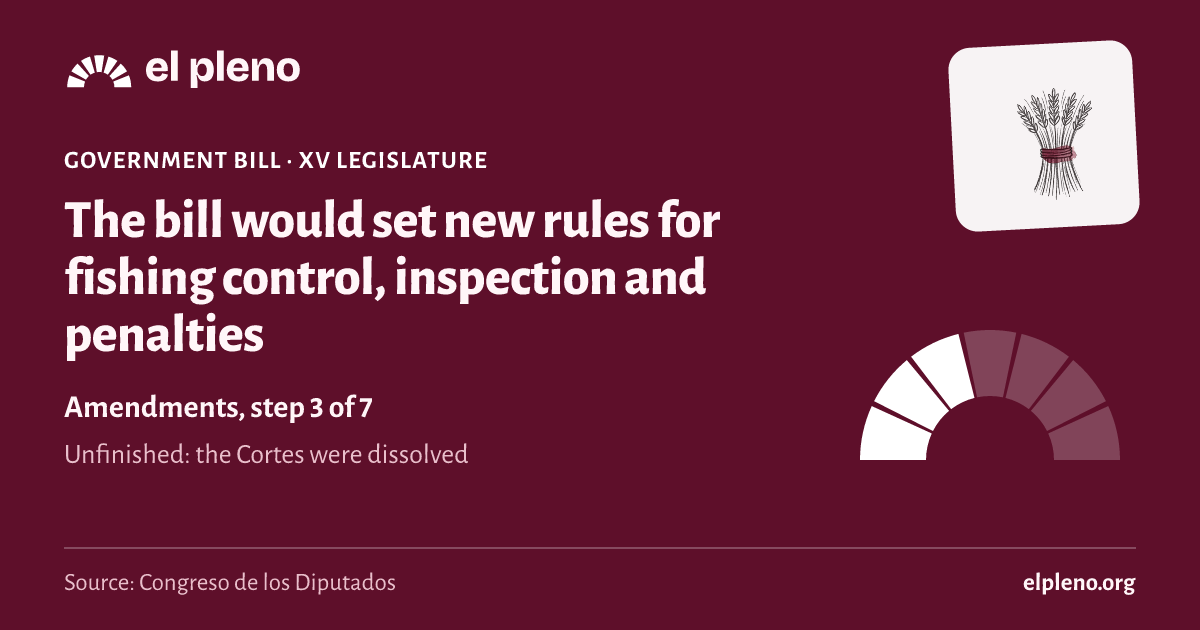
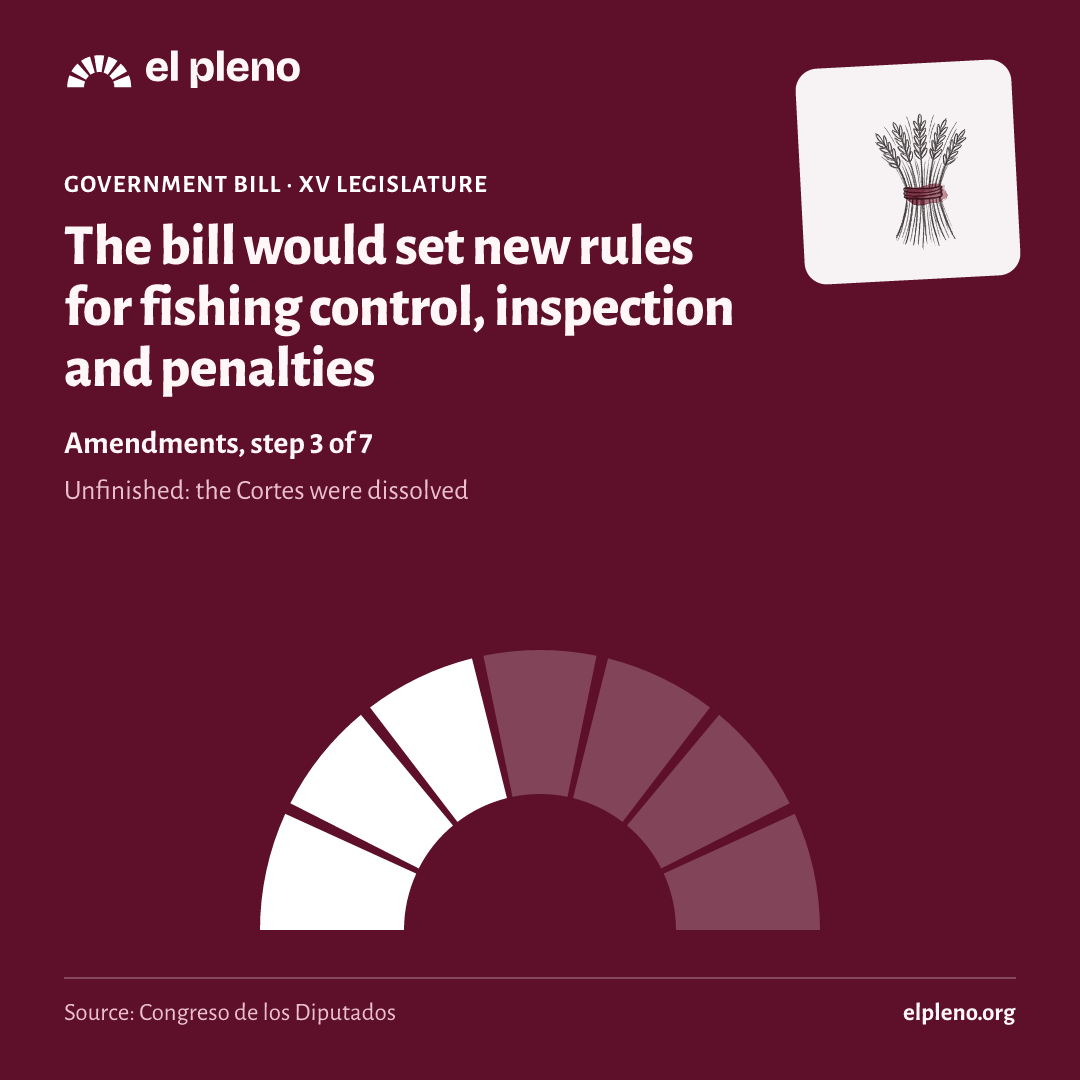
The bill would set new rules for fishing control, inspection and penalties
Amendments step 3 of 7· LapsedIt is a government bill. Introduced by the Government. It was introduced on 23 October 2025. Introduced by: Gobierno.
Official title: Government bill on the control, inspection, and sanctioning regime of maritime fishing.
Source: Congreso de los Diputados, file 121/000073· updated 11 Nov
Automatic summary, not yet reviewed
- The bill would establish control and inspection functions for marine fishing, measures against illegal, unreported and unregulated fishing, and a penalty system applied by the State Administration.
- A National Control and Inspection Plan would be created, approved by the Secretaría General de Pesca, with cooperation planned with other administrations and the fishing sector.
- Marine fishing inspectors in outer waters would be agents of the authority, and their reports would enjoy a presumption of accuracy. Other civil servants could also be authorized to inspect when needed.
- Those inspected would have to cooperate and provide the requested documents. Failing to do so would be a serious or very serious offense.
- If imported fishery products do not meet the requirements, their importation could be denied and, where applicable, the products seized.
- Offenses would be classified as minor, serious and very serious. Fines would range from €60 to €600 for minor offenses, €601 to €60,000 for serious ones, and €60,001 to €600,000 for very serious ones, with these limits able to be exceeded in certain cases.
- Besides fines, penalties would include public censure, disqualification, seizure of gear, catches or vessels, license withdrawal, loss of public aid, or removal of the vessel from the General Registry of the Fishing Fleet.
- Anyone acknowledging responsibility or paying voluntarily could get reductions of 20% (or 30% in certain cases) on financial penalties.
Who it affects
- Vessel owners, skippers and fishing crews: They would be subject to the planned controls, inspections and penalties, and in some cases would be jointly liable for the crew's offenses.
- Recreational fishers: Recreational fishing offenses would also be defined and penalized, with liability for the license holder, the organizing company and the boat owner.
- Importers and sellers of fishery products: They could face import denial and seizure of products that do not meet the requirements.
- Companies and people supporting illegal fishing from third-country vessels: Very serious offenses are planned for those taking part in transshipments with, or the operation or financing of, vessels engaged in illegal fishing.
Words worth knowing
- Pesca INDNR
- Illegal, unreported and unregulated fishing: fishing that ignores marine resource conservation rules.
- Diario electrónico de a bordo
- Mandatory electronic logbook in which the vessel records its fishing activity and sends it to the authorities.
- Artes de pesca
- Fishing gear, such as nets, hooks or traps.
- Presunción de veracidad
- What the inspector's report states is presumed true unless proven otherwise.
- Zona de protección pesquera
- A maritime zone with special rules for protecting and controlling fishing activity.
It summarizes the text as it was introduced. It is written by artificial intelligence and may contain mistakes: the official text is what counts. Read the official text · How we make summaries
Where it stands
How far did it get?
It took 3 of 7 steps. It reached Amendments, and today it is lapsed.
- Introduced23 October 2025Someone registers the text in the Congreso.
- Admitted28 October 2025The Bureau of the Congreso accepts it and, for a members’ bill, the plenary decides whether to consider it.
- Amendments31 October 2025Groups propose changes.
- Committeenot reachedA committee goes through the text in detail.
- Plenarynot reachedAll 350 deputies vote.
- Senatenot reachedThe Senate can pass it, amend it or veto it.
- BOEnot reachedIt is published in the Official State Gazette (BOE) and comes into force.
See the 5 official steps on a timeline
Was there a plenary vote?
We have no plenary vote linked to this law in the Congreso’s data.
What happens next
What happens now?
The legislature ended before it finished. To go on, someone would have to introduce it again in the new Cortes.
Sources
Where does all this come from?
- Congreso de los Diputados, file 121/000073
Official title, type, author, dates and stage.
Retrieved 11 November 2026
- Congreso de los Diputados, procedure
The date of each step, with its official wording.
Retrieved 12 November 2026
- The data comes from the open files of the Congreso, the Senate and the BOE, unaltered.
- Each deputy’s province is the one of their seat on the day of the vote.
- We never say “passed” because of a vote: the files do not say which majority was needed.