What it is
The bill would make violating EU sanctions a crime in Spain
Amendments step 3 of 7· LapsedIt is a government bill. Introduced by the Government. It was introduced on 23 October 2025. Introduced by: Gobierno.
Official title: Government Organic bill amending Organic Law 10/1995, of November 23, on the Penal Code, for the transposition of Directive (EU) 2024/1226 of the European Parliament and of the Council, of April 24, 2024, on the definition of the offenses and sanctions for the infringement of the restrictive measures of the Union, and amending Directive (EU) 2018/1673.
Source: Congreso de los Diputados, file 121/000072· updated 11 Nov
Automatic summary, not yet reviewed
- The bill would create, for the first time in the Spanish Criminal Code, a specific crime of violating European Union restrictive measures, something that did not exist as a standalone crime in Spain until now.
- It would punish with two to six years in prison and a fine making funds available to sanctioned persons or entities, failing to freeze assets, doing business with sanctioned states, trading or providing prohibited services, or evading sanctions, when the value is 100,000 euros or more. For values between 10,000 and 100,000 euros, the penalty would be one degree lower.
- Allowing sanctioned individuals to enter or pass through Spain would carry one to four years in prison. Failing to report or hiding information about funds or assets subject to sanctions would carry one to two years in prison and a fine of up to three times the value involved.
- Companies held responsible for these crimes could face fines of up to 5% of their total worldwide turnover for the previous year, or up to 1% for the offenses in Artículo 604 quater.
- Penalties would be tougher if the crime is committed within a criminal organization, by professionals or public officials, or in other listed situations. Humanitarian aid provided under international humanitarian law would not be punished, and judges could reduce the sentence for those who confess and cooperate.
- A Mixed Coordination Commission would be created to coordinate the authorities applying these sanctions, and the Criminal Chamber of the Audiencia Nacional would hear these cases. The law would take effect twenty days after its publication in the Official State Gazette.
Who it affects
- Persons and companies sanctioned by the European Union: They would be the direct targets of the restrictive measures whose violation would become a crime.
- Banks, companies and professionals handling funds, goods or services: They would have to avoid prohibited transactions with sanctioned persons or states; they could face prison and fines.
- Responsible legal entities (companies): They could face fines of up to 5% of their total worldwide turnover.
- Judges and the Audiencia Nacional: The Criminal Chamber of the Audiencia Nacional would hear these cases.
- Public administrations: They would coordinate their actions through the new Mixed Coordination Commission.
Words worth knowing
- Medidas restrictivas (restrictive measures)
- Sanctions the European Union imposes on countries, entities or people, such as freezing their funds, banning them from entering the EU, or restricting trade with them.
- Inmovilizar activos (freeze assets)
- Blocking funds or goods so their owner cannot use or move them.
- Productos de doble uso (dual-use products)
- Goods that can be used for both civilian and military purposes.
- Decomiso (forfeiture)
- A judge permanently taking away goods or money linked to a crime.
- Ley orgánica (organic law)
- A type of Spanish law reserved for major matters, such as criminal law, requiring a special vote in Congress.
It summarizes the text as it was introduced. It is written by artificial intelligence and may contain mistakes: the official text is what counts. Read the official text · How we make summaries
Where it stands
How far did it get?
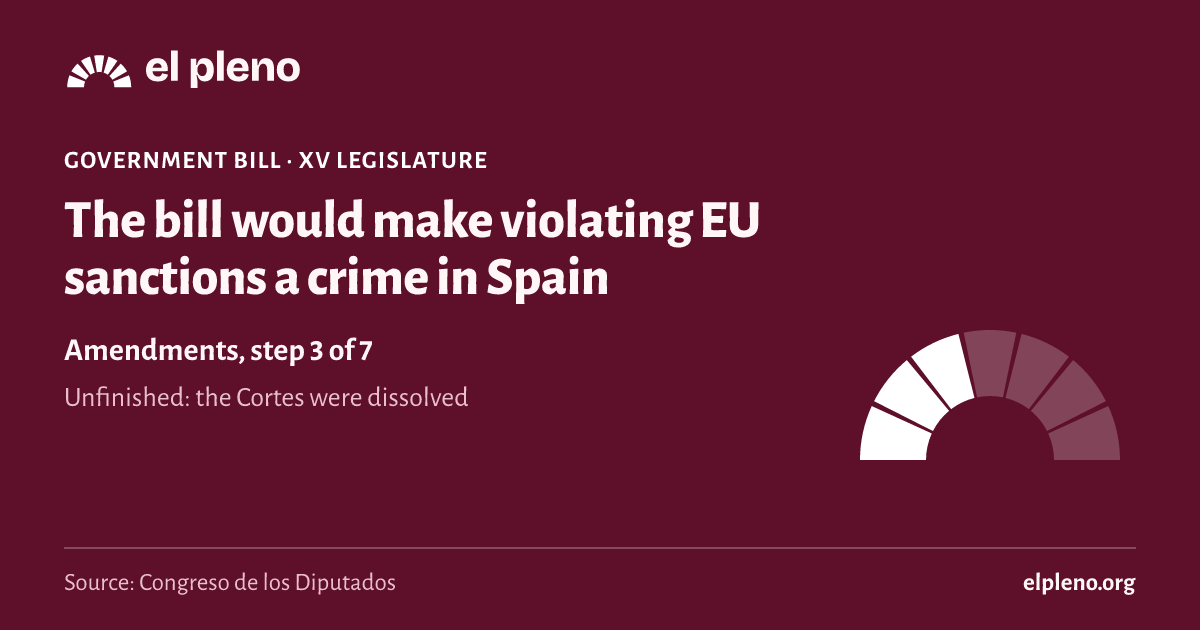
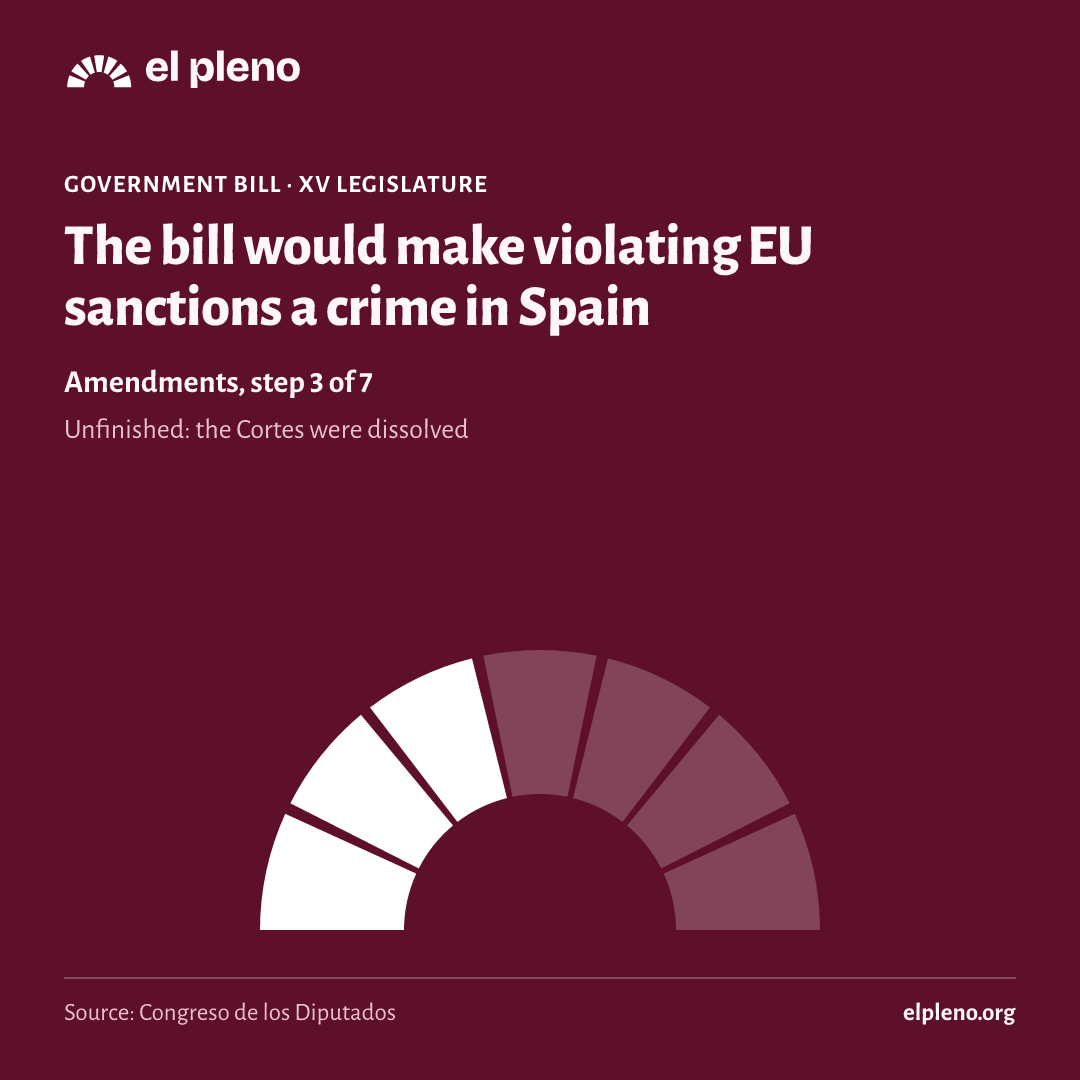
It took 3 of 7 steps. It reached Amendments, and today it is lapsed.
- Introduced23 October 2025Someone registers the text in the Congreso.
- Admitted28 October 2025The Bureau of the Congreso accepts it and, for a members’ bill, the plenary decides whether to consider it.
- Amendments31 October 2025Groups propose changes.
- Committeenot reachedA committee goes through the text in detail.
- Plenarynot reachedAll 350 deputies vote.
- Senatenot reachedThe Senate can pass it, amend it or veto it.
- BOEnot reachedIt is published in the Official State Gazette (BOE) and comes into force.
See the 5 official steps on a timeline
Was there a plenary vote?
We have no plenary vote linked to this law in the Congreso’s data.
What happens next
What happens now?
The legislature ended before it finished. To go on, someone would have to introduce it again in the new Cortes.
Sources
Where does all this come from?
- Congreso de los Diputados, file 121/000072
Official title, type, author, dates and stage.
Retrieved 11 November 2026
- Congreso de los Diputados, procedure
The date of each step, with its official wording.
Retrieved 12 November 2026
- The data comes from the open files of the Congreso, the Senate and the BOE, unaltered.
- Each deputy’s province is the one of their seat on the day of the vote.
- We never say “passed” because of a vote: the files do not say which majority was needed.