What it is
Bill to align Spanish laws with EU digital services and media rules
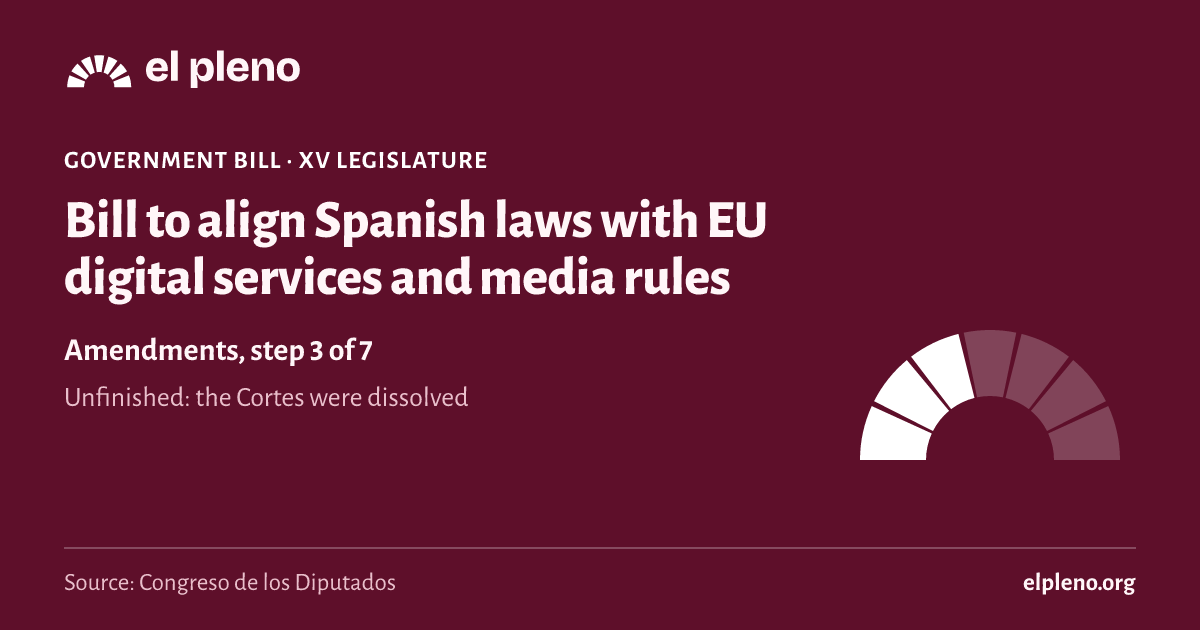
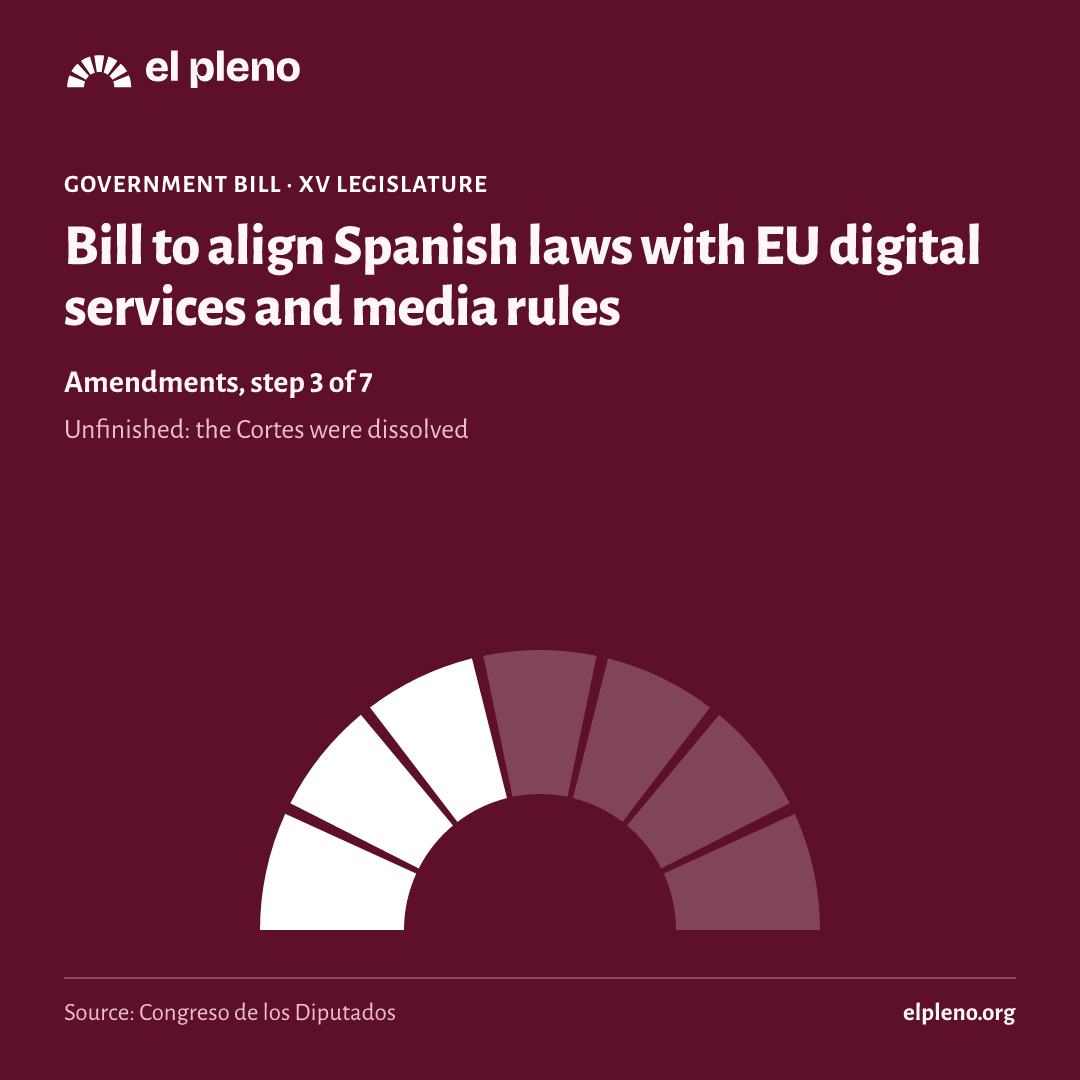
Amendments step 3 of 7· LapsedIt is a government bill. Introduced by the Government. It was introduced on 30 July 2025. Introduced by: Gobierno.
Official title: Government bill amending various legal provisions for the improvement of democratic governance in digital services and the regulation of media.
Source: Congreso de los Diputados, file 121/000068· updated 11 Nov
Automatic summary, not yet reviewed
- The bill would adapt Spanish law to two EU regulations: the digital services regulation (Regulation (EU) 2022/2065) and the media services regulation (Regulation (EU) 2024/1083).
- It would designate the National Markets and Competition Commission (Comisión Nacional de los Mercados y la Competencia) as digital services coordinator, in charge of overseeing compliance with most obligations under the digital services regulation, and the Spanish Data Protection Agency (Agencia Española de Protección de Datos) for rules on ads using special categories of data and profiling of minors.
- It would create a penalty regime for breaching the digital services regulation, with fines of up to 6% of the provider's total annual worldwide turnover for the most serious violations.
- It would repeal the articles of Law 34/2002 that regulated the conditional exemption from liability for intermediary service providers, because that framework is now directly regulated by the EU regulation.
- It would create a procedure to review media market concentrations that could significantly affect media pluralism and editorial independence. In very serious cases, the deal may be blocked or made subject to conditions.
- It would create a state register of media service providers, public and merely informative, containing data on their ownership and state advertising. Registration would not be a requirement to operate.
- It would extend the General Audiovisual Communication Law to the press, renaming it the General Audiovisual and Media Communication Law, and would define new violations, such as failing to guarantee editorial independence or breaching audience measurement rules.
- The law would take effect the day after its publication in the official state gazette (Boletín Oficial del Estado), except for some provisions on devices and audience measurement, which would take effect on May 8, 2027.
Words worth knowing
- Servicio intermediario (intermediary service)
- A service that stores, transmits or gives access to third-party content, such as online platforms, hosting services or search engines.
- Concentración (concentration)
- A transaction in which two or more media companies merge, or one buys another.
- Pluralismo de los medios (media pluralism)
- The existence of varied and independent media outlets with different editorial lines, so information does not depend on a few owners.
- Coordinador de servicios digitales (digital services coordinator)
- The public authority each EU country must designate to oversee compliance with the EU digital services regulation.
- Diligencia debida (due diligence)
- The set of care and responsible conduct obligations the law imposes on a service provider to prevent risks.
It summarizes the text as it was introduced. It is written by artificial intelligence and may contain mistakes: the official text is what counts. Read the official text · How we make summaries
Where it stands
How far did it get?
It took 3 of 7 steps. It reached Amendments, and today it is lapsed.
- Introduced30 July 2025Someone registers the text in the Congreso.
- Admitted26 August 2025The Bureau of the Congreso accepts it and, for a members’ bill, the plenary decides whether to consider it.
- Amendments29 August 2025Groups propose changes.
- Committeenot reachedA committee goes through the text in detail.
- Plenarynot reachedAll 350 deputies vote.
- Senatenot reachedThe Senate can pass it, amend it or veto it.
- BOEnot reachedIt is published in the Official State Gazette (BOE) and comes into force.
See the 6 official steps on a timeline
Was there a plenary vote?
We have no plenary vote linked to this law in the Congreso’s data.
What happens next
What happens now?
The legislature ended before it finished. To go on, someone would have to introduce it again in the new Cortes.
Sources
Where does all this come from?
- Congreso de los Diputados, file 121/000068
Official title, type, author, dates and stage.
Retrieved 11 November 2026
- Congreso de los Diputados, procedure
The date of each step, with its official wording.
Retrieved 12 November 2026
- The data comes from the open files of the Congreso, the Senate and the BOE, unaltered.
- Each deputy’s province is the one of their seat on the day of the vote.
- We never say “passed” because of a vote: the files do not say which majority was needed.