What it is
The bill proposes new rules for the State's classified information
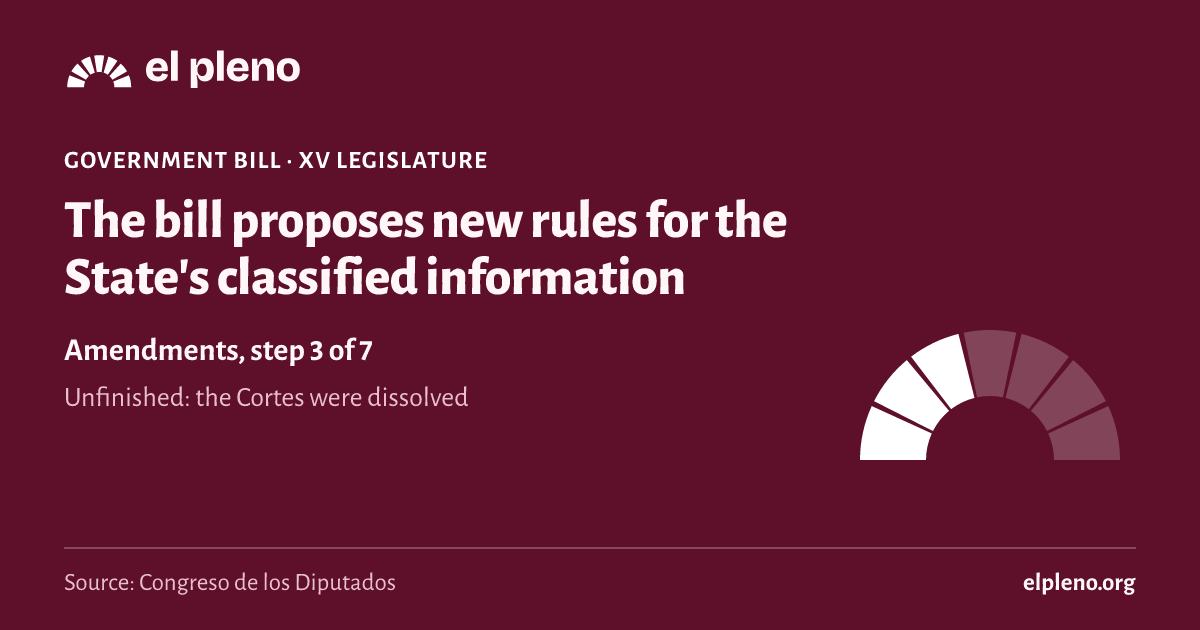
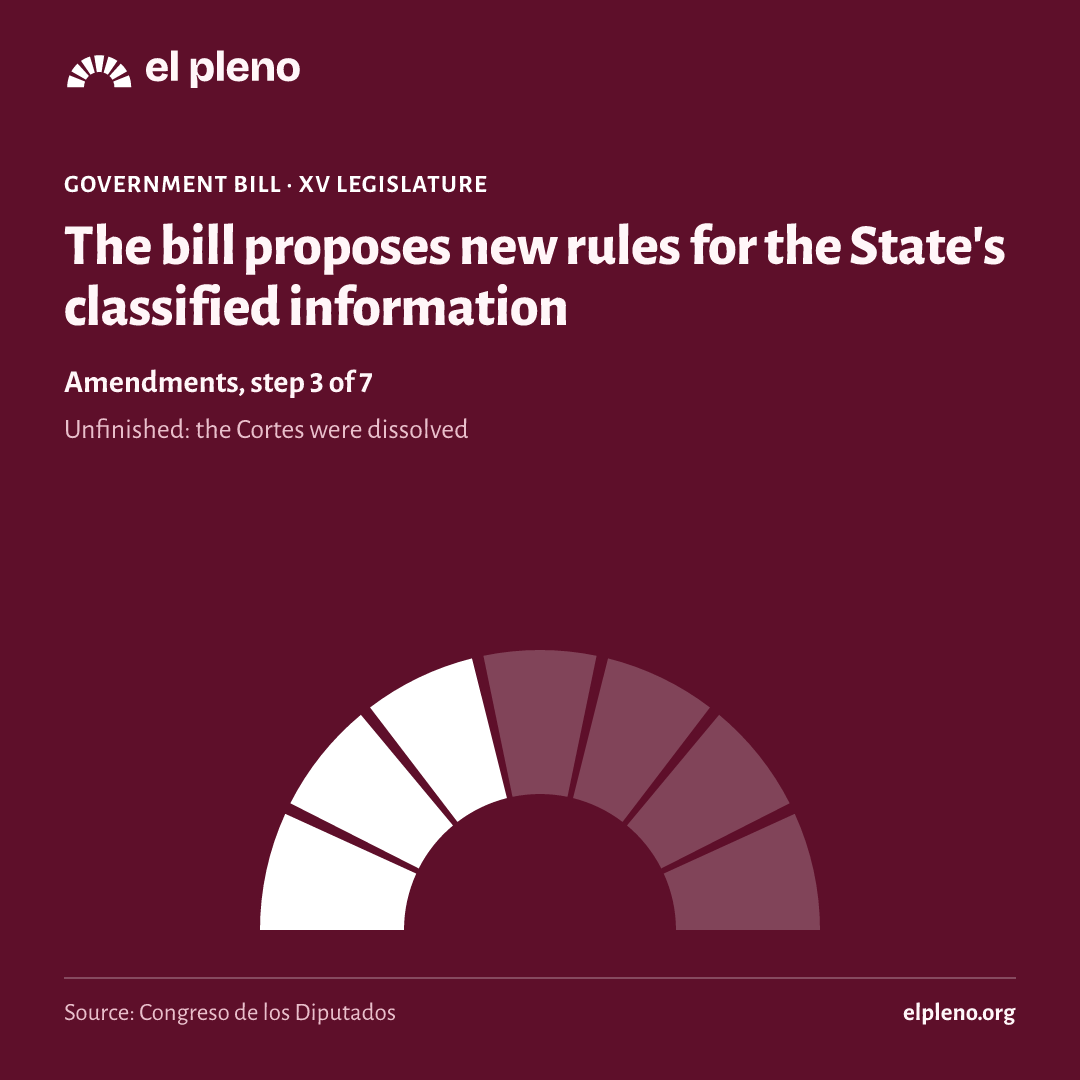
Amendments step 3 of 7· LapsedIt is a government bill. Introduced by the Government. It was introduced on 23 July 2025. Introduced by: Gobierno.
Official title: Government bill on Classified Information.
Source: Congreso de los Diputados, file 121/000067· updated 11 Nov
Automatic summary, not yet reviewed
- The bill proposes four classification categories: "Alto secreto" (top secret), "Secreto" (secret), "Confidencial" (confidential) and "Restringido" (restricted), based on the harm disclosure would cause to national security or defense.
- Classifying information as "Alto secreto" or "Secreto" would be the exclusive power of the Council of Ministers, and it could not delegate it. For "Confidencial" and "Restringido", other authorities such as the Prime Minister, ministers or senior officials would suffice.
- For the first time, maximum periods for automatic declassification would be set: 45 years for "Alto secreto", 35 for "Secreto", between 7 and 9 for "Confidencial" and between 4 and 5 for "Restringido". The first two could be extended only once.
- The bill bans classifying information about serious human rights violations and requires every classification to be exceptional, reasoned and proportionate.
- Access to classified information would require a prior clearance or authorization granted after a security check. Companies taking part in contracts involving classified information would also need clearances.
- Classification, reclassification and declassification decisions could be challenged before the Administrative Chamber of the Supreme Court, so the judiciary would oversee these decisions.
- The bill provides fines of up to €2,500,000 for very serious offenses, such as disclosing "Alto secreto" or "Secreto" information. Minor offenses would carry a fine of up to €30,000 or a warning.
- The bill repeals the 1968 Official Secrets Law and would take effect twelve months after its publication in the Official State Gazette.
Who it affects
- Public sector authorities and staff handling classified information: They would have to follow classification and declassification procedures and obtain clearances to access the information.
- Companies and professionals taking part in public contracts involving classified information: They would need a company security clearance and, where applicable, a facility security clearance.
- Anyone who comes across classified information by chance: They would have to keep it confidential, not disclose it, and hand it over to an authority or public official as soon as possible.
- Journalists and citizens with a legitimate interest: They could request declassification or review of classified information and appeal decisions to the Supreme Court.
- Congress of Deputies (Congreso de los Diputados): It could access classified information through the committee overseeing reserved funds.
Words worth knowing
- Desclasificación (declassification)
- Ending the protected status of information, so it is no longer secret and can be made public.
- Reclasificación (reclassification)
- Changing the protection category of information, up or down, within the categories set by the law.
- Habilitación Personal de Seguridad (personal security clearance)
- An official clearance given to a person after a security check, allowing access to classified information.
- Necesidad de conocer (need to know)
- The principle that only those who need the information for their position or responsibility may access it.
- Contencioso-administrativo (administrative litigation)
- A type of court challenge used to contest decisions by public administrations before the courts.
It summarizes the text as it was introduced. It is written by artificial intelligence and may contain mistakes: the official text is what counts. Read the official text · How we make summaries
Where it stands
How far did it get?
It took 3 of 7 steps. It reached Amendments, and today it is lapsed.
- Introduced23 July 2025Someone registers the text in the Congreso.
- Admitted26 August 2025The Bureau of the Congreso accepts it and, for a members’ bill, the plenary decides whether to consider it.
- Amendments29 August 2025Groups propose changes.
- Committeenot reachedA committee goes through the text in detail.
- Plenarynot reachedAll 350 deputies vote.
- Senatenot reachedThe Senate can pass it, amend it or veto it.
- BOEnot reachedIt is published in the Official State Gazette (BOE) and comes into force.
See the 6 official steps on a timeline
Was there a plenary vote?
We have no plenary vote linked to this law in the Congreso’s data.
What happens next
What happens now?
The legislature ended before it finished. To go on, someone would have to introduce it again in the new Cortes.
Sources
Where does all this come from?
- Congreso de los Diputados, file 121/000067
Official title, type, author, dates and stage.
Retrieved 11 November 2026
- Congreso de los Diputados, procedure
The date of each step, with its official wording.
Retrieved 12 November 2026
- The data comes from the open files of the Congreso, the Senate and the BOE, unaltered.
- Each deputy’s province is the one of their seat on the day of the vote.
- We never say “passed” because of a vote: the files do not say which majority was needed.