What it is
Tax breaks for major cultural and sports events
Amendments step 3 of 7· LapsedIt is a government bill. Introduced by the Government. It was introduced on 22 July 2025. Introduced by: Gobierno.
Official title: Government bill declaring various initiatives and programs as events of exceptional public interest (originating from Royal Decree-Law 8/2025, of July 8).
Source: Congreso de los Diputados, file 121/000066· updated 11 Nov
Automatic summary, not yet reviewed
- The bill would declare 27 cultural and sports initiatives as events of exceptional public interest, from the 2027 Holy Compostela Year to San Diego Comic-Con Málaga or the Rally Islas Canarias.
- All these initiatives would receive the maximum tax benefits allowed under Law 49/2002, which lets sponsors deduct part of their spending on the events.
- For the program preparing Spanish athletes for the 2028 Los Angeles Games there is a special rule: sponsorship payments count toward a tax limit and are not deductible as an expense under the corporate income tax.
- The bill sets the duration of each support program, with dates generally running from 2025 to 2027 or 2028 depending on the event.
- Expenses and activities for each event must be certified under Law 49/2002, and the competent bodies will detail the activities in plans and programs.
- The Government could issue the rules needed to implement the law, which would take effect the same day it is published in the Official State Gazette (Boletín Oficial del Estado).
Who it affects
- Companies and individuals sponsoring the declared events: They could benefit from the patronage tax incentives if they sponsor these events.
- Managers of the A.D.O. and A.D.O.P. programs: They would receive support to prepare athletes for the 2028 Games.
- Organizers of the included cultural and sports events: Their events could get stronger private funding thanks to the tax incentives.
- Members of Parliament and parliamentary groups: They can submit amendments to the bill during the period opened in Congress.
Words worth knowing
- Acontecimiento de excepcional interés público (event of exceptional public interest)
- A legal status that lets a cultural or sports event receive tax incentives to attract sponsorship.
- Mecenazgo (patronage)
- Private support, usually financial, for cultural, sports or social activities, with tax advantages for the sponsor.
- Real decreto-ley (royal decree-law)
- A rule with the force of law that the Government can pass on an urgent basis and that Congress must later validate.
- Impuesto sobre sociedades (corporate income tax)
- The tax companies pay on their profits.
It summarizes the text as it was introduced. It is written by artificial intelligence and may contain mistakes: the official text is what counts. Read the official text · How we make summaries
Where it stands
How far did it get?
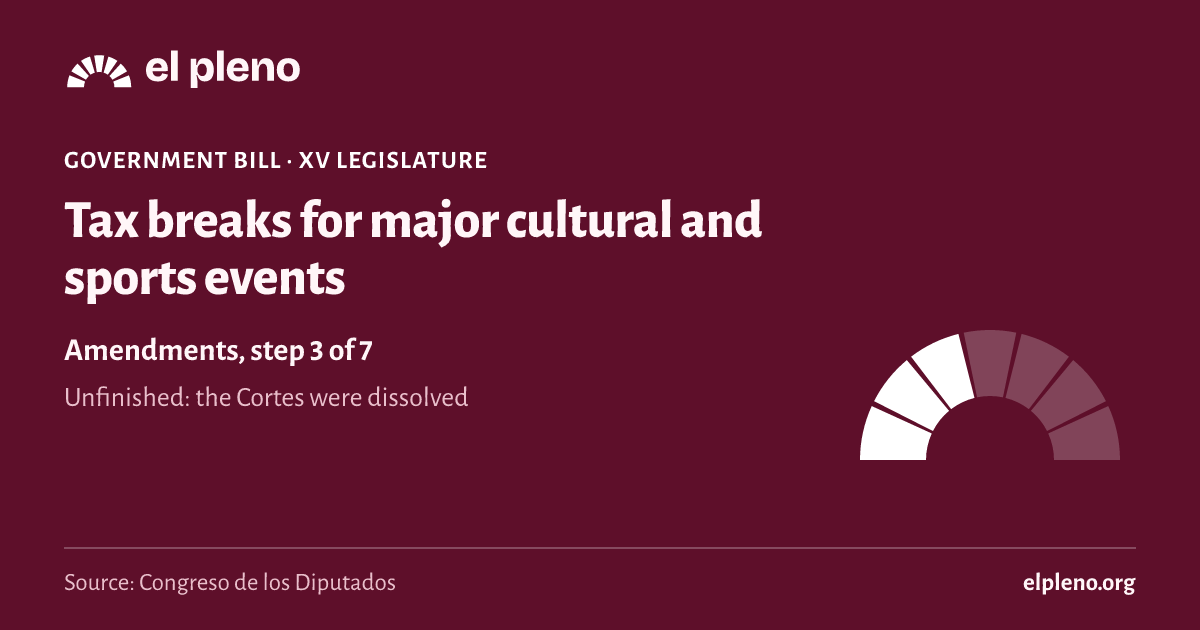
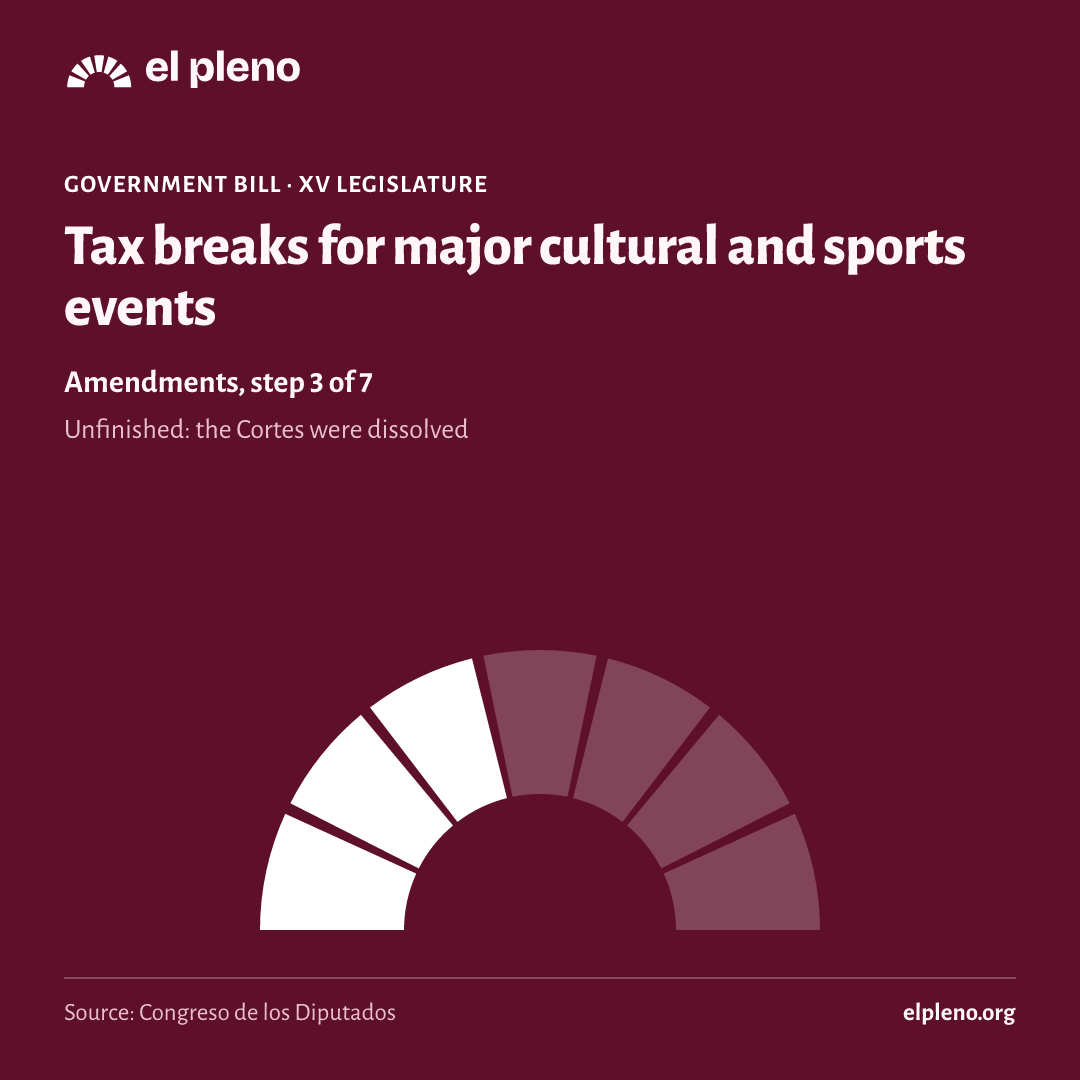
It took 3 of 7 steps. It reached Amendments, and today it is lapsed.
- Introduced22 July 2025Someone registers the text in the Congreso.
- Admitted2 September 2025The Bureau of the Congreso accepts it and, for a members’ bill, the plenary decides whether to consider it.
- Amendments5 September 2025Groups propose changes.
- Committeenot reachedA committee goes through the text in detail.
- Plenarynot reachedAll 350 deputies vote.
- Senatenot reachedThe Senate can pass it, amend it or veto it.
- BOEnot reachedIt is published in the Official State Gazette (BOE) and comes into force.
See the 5 official steps on a timeline
Was there a plenary vote?
We have no plenary vote linked to this law in the Congreso’s data.
What happens next
What happens now?
The legislature ended before it finished. To go on, someone would have to introduce it again in the new Cortes.
Sources
Where does all this come from?
- Congreso de los Diputados, file 121/000066
Official title, type, author, dates and stage.
Retrieved 11 November 2026
- Congreso de los Diputados, procedure
The date of each step, with its official wording.
Retrieved 12 November 2026
- The data comes from the open files of the Congreso, the Senate and the BOE, unaltered.
- Each deputy’s province is the one of their seat on the day of the vote.
- We never say “passed” because of a vote: the files do not say which majority was needed.