What it is
Bill to expand and strengthen the judicial and prosecutorial careers
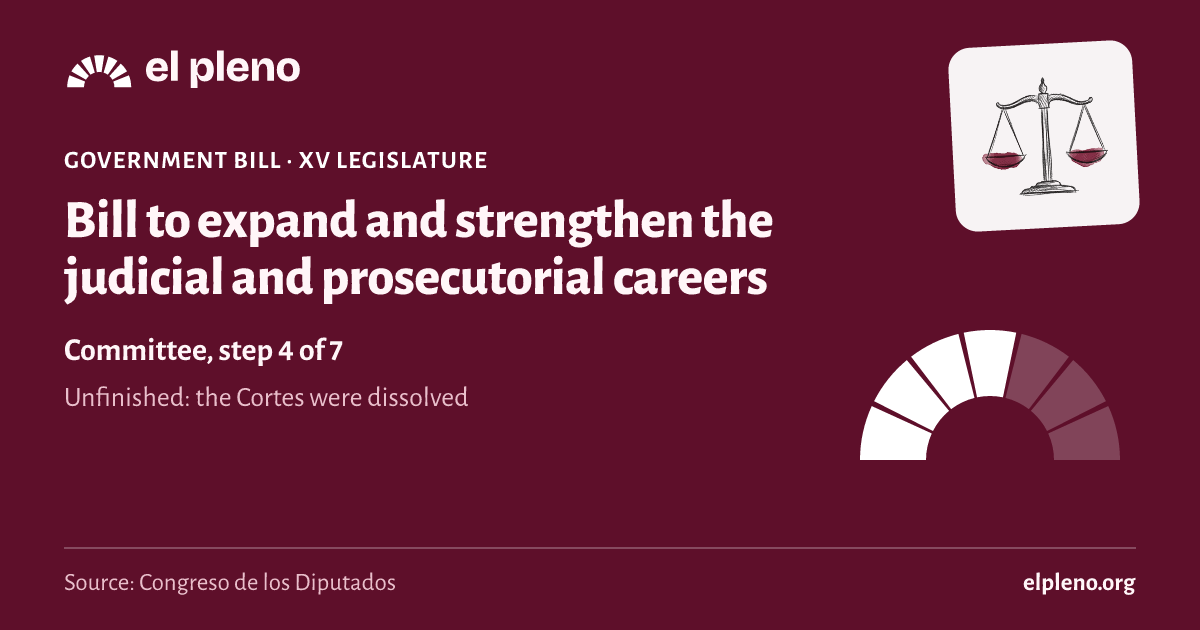
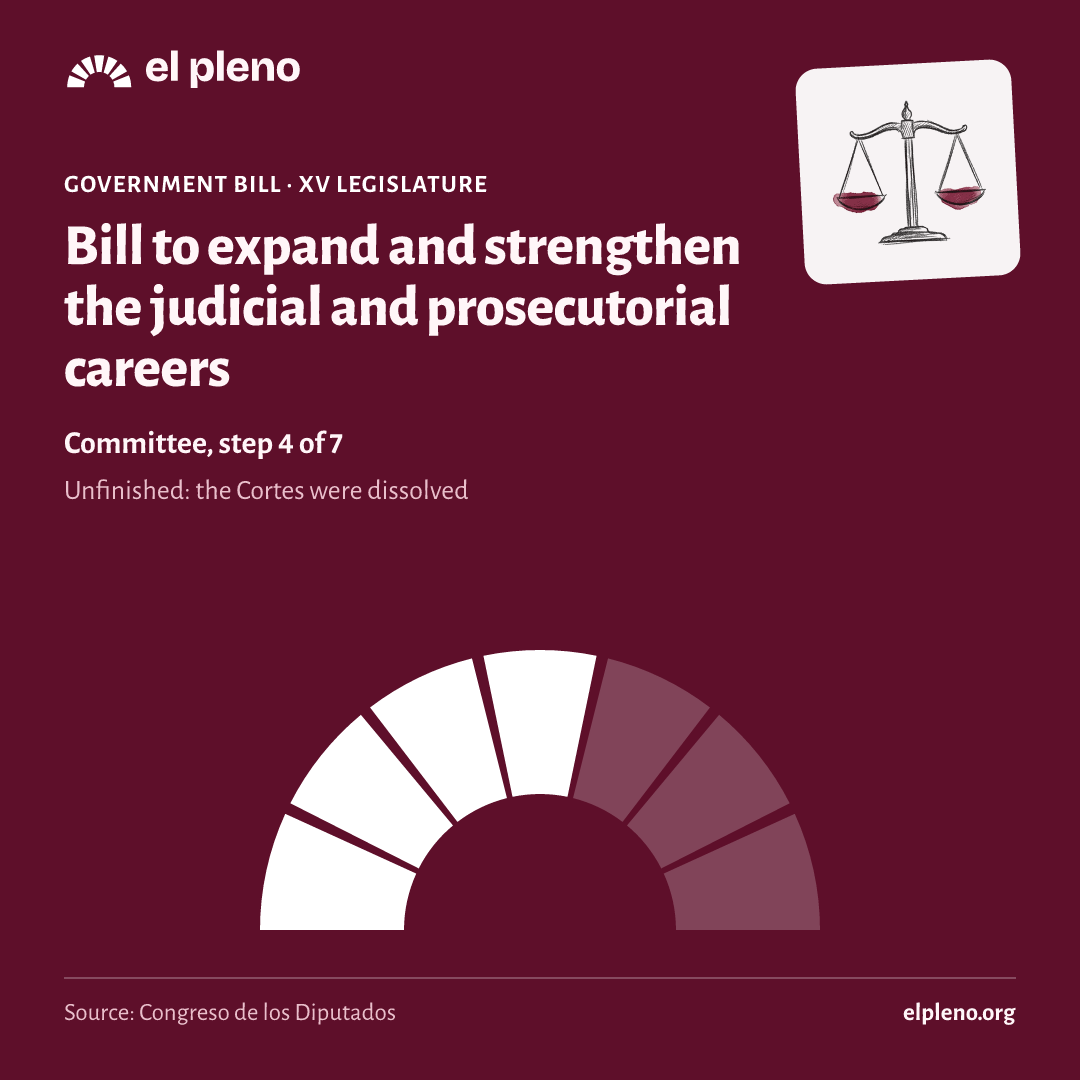
Committee step 4 of 7· LapsedIt is a government bill. Introduced by the Government. It was introduced on 16 May 2025. Introduced by: Gobierno.
Official title: Organic Government bill amending Organic Law 6/1985, of July 1, on the Judicial Power, and Law 50/1981, of December 30, regulating the Organic Statute of the Public Prosecutor's Office, for the expansion and strengthening of judicial and prosecutorial careers.
Source: Congreso de los Diputados, file 121/000059· updated 11 Nov
Automatic summary, not yet reviewed
- The bill would change how people enter the judicial and prosecutorial careers: the open competitive exam would have a multiple-choice test, an oral test recorded on video, and a written, anonymous test with practical cases, to value more than memorization.
- The Center for Legal Studies would become a public center to prepare for these exams and would grant scholarships, worth at least the annual minimum wage and for up to four years.
- Promotion would change: judges would become senior judges (magistrados) after five years of service, instead of waiting for vacancies. The same system would apply to prosecutors.
- Elections to the Government Chambers would use electronic or in-person voting, with individual candidacies and one vote per voter; proxy voting would be eliminated.
- Substitute judges and acting senior judges would only be subject to the incompatibility rules while actually performing their duties, and a substitute judge's assignment to a vacant position would last at most one year with no extension.
- The Judicial Ethics Commission would be regulated in detail: nine members, five from the judiciary and four professors of ethics or philosophy chosen by the Congress and the Senate, with opinions that have no binding effect.
- A single extraordinary stabilization process is proposed for substitute judges, acting senior judges and substitute prosecutors, with the call published before December 31, 2025 and resolved before December 31, 2026.
- Those who do not pass the stabilization process and see their relationship with the Administration end would receive compensation of twenty days of fixed salary per year of service, up to twelve monthly payments.
Who it affects
- Candidates for the judicial and prosecutorial careers: The entrance exams would change, and they could request financial aid from the Center for Legal Studies to prepare.
- Substitute judges, acting senior judges and substitute prosecutors: They could take part in an extraordinary stabilization process and would face stricter limits on their assignments.
- Active judges and senior judges: Promotion, specialization, incompatibility rules and Government Chamber elections would change for them.
- Prosecutors: The new seniority-based promotion system and access for jurists of recognized competence would apply to them.
Words worth knowing
- Sala de Gobierno (Government Chamber)
- The internal governing body of a court, which organizes the work of its judges.
- Concurso-oposición
- A selection process that combines a knowledge exam with an assessment of the candidate's merits.
- Consejo General del Poder Judicial
- The body that governs the courts and appoints judges in Spain.
- Vacatio legis
- The period between a law's approval and its entry into force, to allow everyone to adapt.
It summarizes the text as it was introduced. It is written by artificial intelligence and may contain mistakes: the official text is what counts. Read the official text · How we make summaries
Where it stands
How far did it get?
It took 4 of 7 steps. It reached Committee, and today it is lapsed.
- Introduced16 May 2025Someone registers the text in the Congreso.
- Admitted20 May 2025The Bureau of the Congreso accepts it and, for a members’ bill, the plenary decides whether to consider it.
- Amendments22 May 2025Groups propose changes.
- Committee2 June 2025A committee goes through the text in detail.
- Plenarynot reachedAll 350 deputies vote.
- Senatenot reachedThe Senate can pass it, amend it or veto it.
- BOEnot reachedIt is published in the Official State Gazette (BOE) and comes into force.
See the 8 official steps on a timeline
12 June 2025
How did the plenary vote?
Voted on: Joint vote on the amendments to the whole for return of the Organic Government bill amending Organic Act 6/1985, of 1 July, on the Judiciary, and Act 50/1981, of 30 December, regulating the Organic Statute of the Prosecutor's Office, for the expansion and strengthening of the judicial and prosecutorial careers, submitted by the VOX and Popular in the Congress Parliamentary Groups.
Source: Congreso de los Diputados, vote 18 of sitting 118· updated 10 Nov
Each dot is a seat. Tap one, or use the arrow keys, to see who it is.
Your province
How did the deputies from your province vote?
And your senators: the Senate does not link its votes to this law in its open data, so we cannot put them side by side here.
Or see how most of each province voted
- A Coruña Tie 4 yes · 4 no
- Albacete Tie 2 yes · 2 no
- Alicante/Alacant More votes in favour 7 yes · 5 no
- Almería More votes in favour 4 yes · 2 no
- Araba/Álava More votes against 1 yes · 3 no
- Asturias More votes in favour 4 yes · 3 no
- Ávila More votes in favour 2 yes · 1 no
- Badajoz More votes in favour 3 yes · 2 no
- Barcelona More votes against 7 yes · 25 no
- Bizkaia More votes against 1 yes · 7 no
- Burgos Tie 2 yes · 2 no
- Cáceres Tie 2 yes · 2 no
- Cádiz More votes in favour 5 yes · 4 no
- Cantabria More votes in favour 3 yes · 2 no
- Castellón/Castelló More votes in favour 3 yes · 2 no
- Ceuta More votes in favour 1 yes · 0 no
- Ciudad Real More votes in favour 3 yes · 2 no
- Córdoba Tie 3 yes · 3 no
- Cuenca More votes in favour 2 yes · 1 no
- Gipuzkoa More votes against 0 yes · 6 no
- Girona More votes against 0 yes · 6 no
- Granada More votes in favour 4 yes · 3 no
- Guadalajara More votes in favour 2 yes · 1 no
- Huelva Tie 2 yes · 2 no
- Huesca More votes in favour 2 yes · 1 no
- Illes Balears Tie 4 yes · 4 no
- Jaén More votes in favour 3 yes · 2 no
- La Rioja Tie 2 yes · 2 no
- Las Palmas Tie 4 yes · 4 no
- León Tie 2 yes · 2 no
- Lleida More votes against 0 yes · 4 no
- Lugo More votes in favour 3 yes · 1 no
- Madrid More votes in favour 21 yes · 15 no
- Málaga More votes in favour 7 yes · 4 no
- Melilla More votes in favour 1 yes · 0 no
- Murcia More votes in favour 6 yes · 4 no
- Navarra More votes against 2 yes · 3 no
- Ourense More votes in favour 3 yes · 1 no
- Palencia More votes in favour 2 yes · 1 no
- Pontevedra More votes against 3 yes · 4 no
- Salamanca More votes in favour 3 yes · 1 no
- Santa Cruz de Tenerife More votes against 3 yes · 4 no
- Segovia More votes in favour 2 yes · 1 no
- Sevilla More votes against 5 yes · 7 no
- Soria Tie 1 yes · 1 no
- Tarragona More votes against 1 yes · 5 no
- Teruel More votes in favour 2 yes · 1 no
- Toledo More votes in favour 4 yes · 2 no
- Valencia/València More votes in favour 8 yes · 7 no
- Valladolid More votes in favour 3 yes · 2 no
- Zamora More votes in favour 2 yes · 1 no
- Zaragoza More votes in favour 4 yes · 3 no
More details: how each group and each province voted
The groups
Who voted in favour and who against?
In favour, most of Popular en el Congreso and VOX. Against, most of Euskal Herria Bildu, Plurinacional SUMAR, Republicano, Socialista, Vasco (EAJ-PNV), Junts per Catalunya and Mixto. 1 deputy voted differently from their group.
By province: in 30 most voted in favour; in 11, against.
Coloured by how most of each province’s deputies voted.
- In favour: 30
- Against: 11
- Tie: 11
| Group | Seats | How it voted |
|---|---|---|
| Euskal Herria Bildu | 6 | 6 against |
| Plurinacional SUMAR | 27 | 27 against |
| Republicano | 7 | 7 against |
| Socialista | 120 | 119 against · 1 did not vote |
| Vasco (EAJ-PNV) | 5 | 5 against |
| Junts per Catalunya | 7 | 7 against |
| Mixto | 8 | 1 in favour · 6 against · 1 did not vote |
| Popular en el Congreso | 137 | 137 in favour |
| VOX | 33 | 32 in favour · 1 did not vote |
What happens next
What happens now?
The legislature ended before it finished. To go on, someone would have to introduce it again in the new Cortes.
Sources
Where does all this come from?
- Congreso de los Diputados, file 121/000059
Official title, type, author, dates and stage.
Retrieved 11 November 2026
- Congreso de los Diputados, procedure
The date of each step, with its official wording.
Retrieved 12 November 2026
- Congreso de los Diputados, vote 18 of sitting 118
The count and every seat’s vote.
Retrieved 10 November 2026
- The data comes from the open files of the Congreso, the Senate and the BOE, unaltered.
- Each deputy’s province is the one of their seat on the day of the vote.
- We never say “passed” because of a vote: the files do not say which majority was needed.