What it is
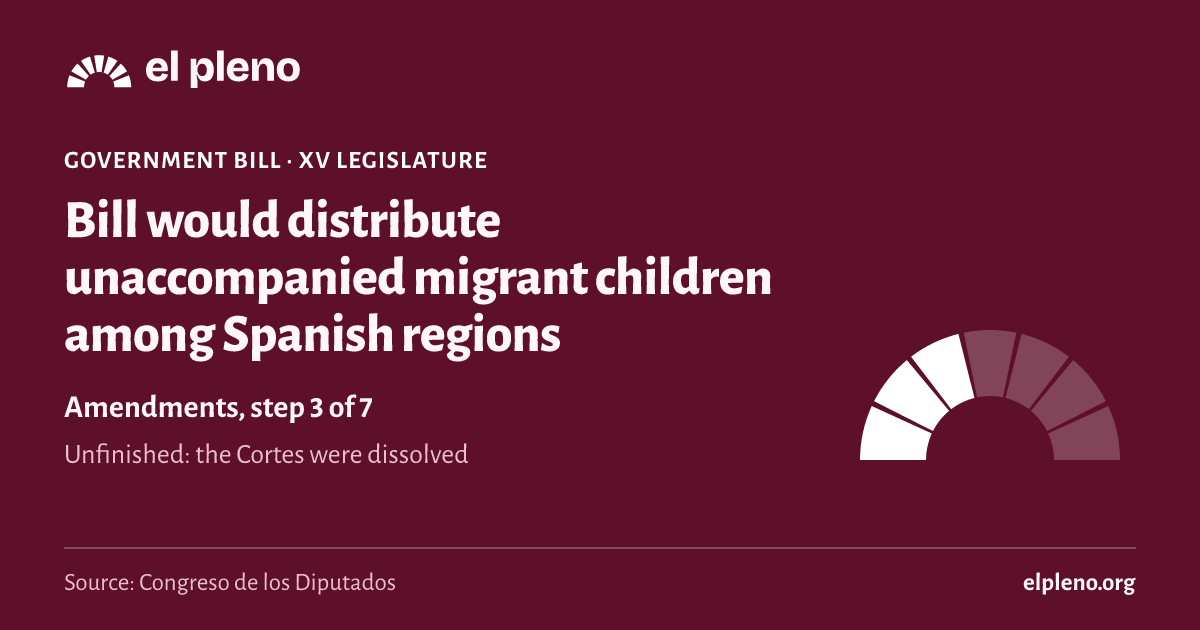
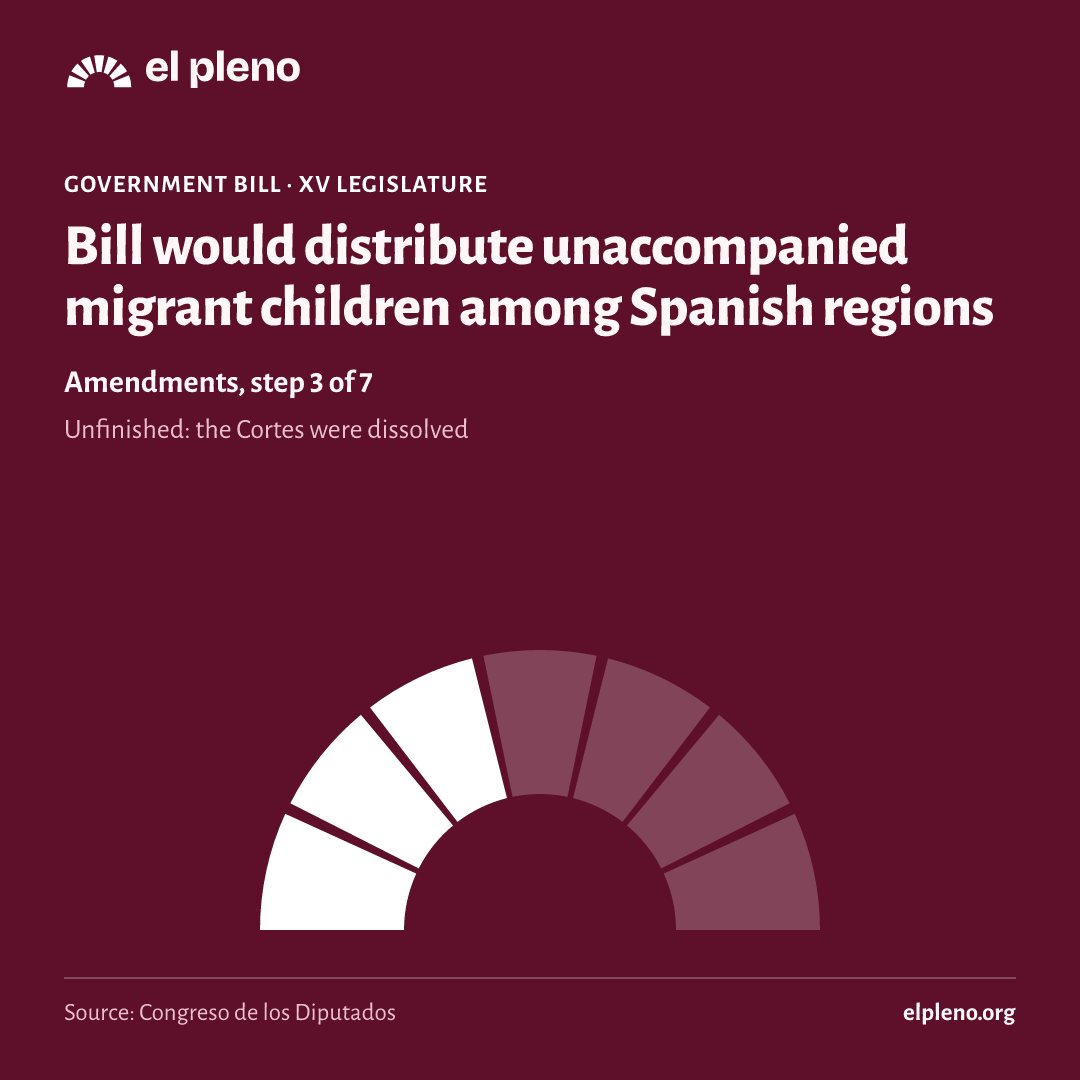
Bill would distribute unaccompanied migrant children among Spanish regions
Amendments step 3 of 7· LapsedIt is a government bill. Introduced by the Government. It was introduced on 10 April 2025. Introduced by: Gobierno.
Official title: Government bill approving urgent measures to guarantee the best interests of childhood and adolescence in situations of extraordinary migratory contingencies (originating from Royal Decree-Law 2/2025, of March 18).
Source: Congreso de los Diputados, file 121/000055· updated 11 Nov
Automatic summary, not yet reviewed
- The bill would declare an extraordinary migration contingency in regions or autonomous cities whose child protection system exceeds three times its ordinary capacity. The declaration would be approved within five calendar days of the region's notification.
- If the Sectoral Conference on Children and Adolescents does not reach a unanimous agreement, the State would set objective criteria for distributing children: half based on each territory's population, 13% based on its disposable income, 15% based on unemployment, and other shares based on reception effort, available places, border or island status, and population dispersion.
- The bill would require the child's transfer to the destination region within fifteen calendar days of registration in the Register of Unaccompanied Foreign Minors. The child and the destination region would be heard, and the Public Prosecutor would be informed.
- A Fund would be created under the ministry in charge of childhood to compensate regions for the costs of overcrowding or transfers of children. For 2025, an extraordinary credit of €100 million is provided.
- Organizations and people working with these children would have to report their location to the authorities. Failing to do so would become a new infraction.
- The criteria for applying the solidarity response plan would have to be approved within three months of the law taking effect, and the necessary relocations would have to be carried out within one year.
Who it affects
- Unaccompanied foreign minors: Unaccompanied foreign minors, who could be transferred to another region or autonomous city and would receive a certificate with their register data.
- Autonomous communities and cities: They would have to take in redistributed children, assume guardianship and care, and could receive financial compensation for overcrowding.
- General State Administration: It would declare the extraordinary migration contingency, decide where children are placed, and manage the compensation Fund.
- Public Prosecutor (Ministerio Fiscal): It would be guaranteed involvement in transfer and placement decisions.
- Organizations and people who care for these children: They would have to report the location of unaccompanied foreign minors to the authorities.
Words worth knowing
- Menor extranjero no acompañado
- A minor of another nationality who is in Spain without their parents or a responsible adult.
- Contingencia migratoria extraordinaria
- An exceptional situation of mass arrival of migrant children that overwhelms a territory's reception capacity.
- Tutela
- Legal responsibility to care for a minor and make decisions for them when their parents cannot.
- Conferencia Sectorial de Infancia y Adolescencia
- Body where the State and the autonomous regions meet to agree on childhood matters.
- Real decreto-ley
- A rule with the force of law that the Government can pass urgently; afterwards Congress must validate it or process it as a bill.
It summarizes the text as it was introduced. It is written by artificial intelligence and may contain mistakes: the official text is what counts. Read the official text · How we make summaries
Where it stands
How far did it get?
It took 3 of 7 steps. It reached Amendments, and today it is lapsed.
- Introduced10 April 2025Someone registers the text in the Congreso.
- Admitted6 May 2025The Bureau of the Congreso accepts it and, for a members’ bill, the plenary decides whether to consider it.
- Amendments9 May 2025Groups propose changes.
- Committeenot reachedA committee goes through the text in detail.
- Plenarynot reachedAll 350 deputies vote.
- Senatenot reachedThe Senate can pass it, amend it or veto it.
- BOEnot reachedIt is published in the Official State Gazette (BOE) and comes into force.
See the 5 official steps on a timeline
Was there a plenary vote?
We have no plenary vote linked to this law in the Congreso’s data.
What happens next
What happens now?
The legislature ended before it finished. To go on, someone would have to introduce it again in the new Cortes.
Sources
Where does all this come from?
- Congreso de los Diputados, file 121/000055
Official title, type, author, dates and stage.
Retrieved 11 November 2026
- Congreso de los Diputados, procedure
The date of each step, with its official wording.
Retrieved 12 November 2026
- The data comes from the open files of the Congreso, the Senate and the BOE, unaltered.
- Each deputy’s province is the one of their seat on the day of the vote.
- We never say “passed” because of a vote: the files do not say which majority was needed.