What it is
Bill would require more companies to publish sustainability information
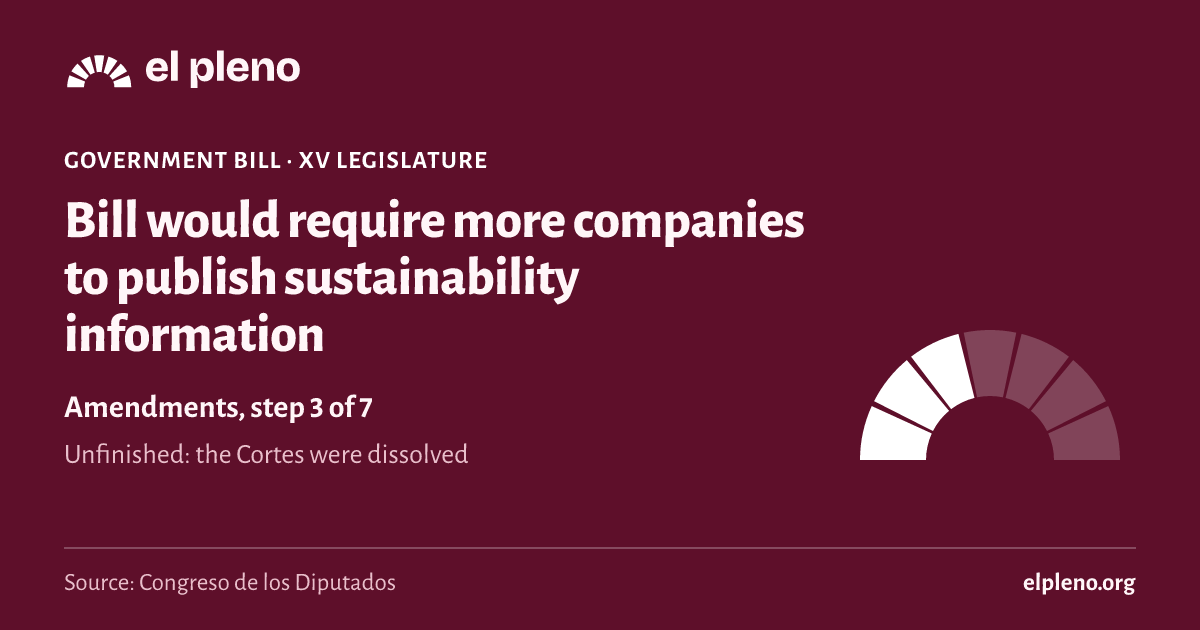
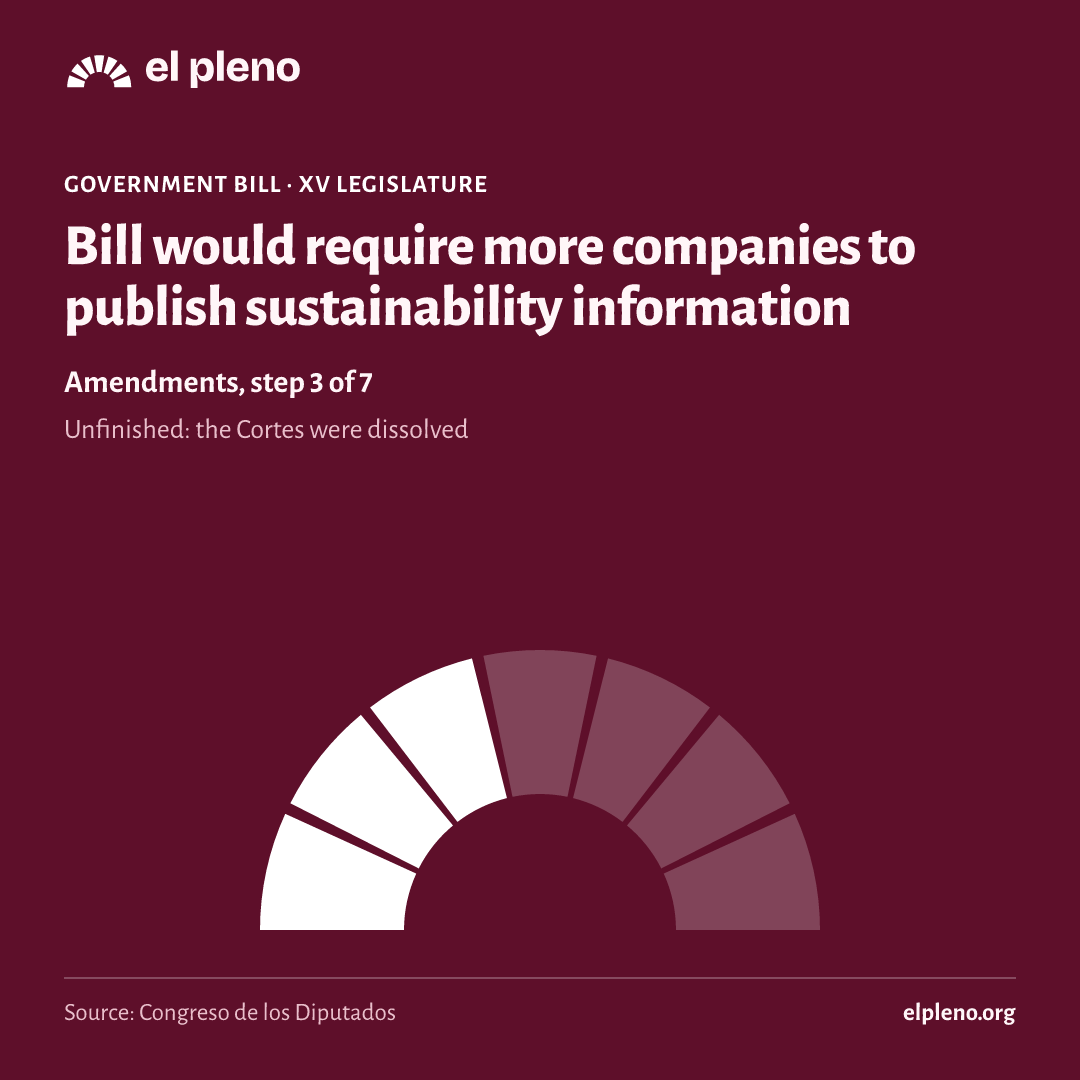
Amendments step 3 of 7· LapsedIt is a government bill. Introduced by the Government. It was introduced on 31 October 2024. Introduced by: Gobierno.
Official title: Government bill on corporate sustainability reporting, amending the Commercial Code, the Capital Companies Act and the Audit of Accounts Act.
Source: Congreso de los Diputados, file 121/000038· updated 11 Nov
Automatic summary, not yet reviewed
- The bill would require large companies and large groups to include a sustainability report within their management report. A group would be considered large if it exceeds two of three thresholds: assets over €25,000,000, revenue over €50,000,000, or more than 250 employees.
- Small and medium-sized companies that have issued securities on regulated markets would also be covered, except microenterprises. They could report a reduced version of the information, under simpler rules suited to their size.
- The sustainability report would have to explain the company's impact on environmental, social, human rights and governance matters, and how these matters affect the company. The double materiality principle would apply and the whole value chain would be covered.
- Sustainability information would have to be assured by an authorized verifier or verification firm. The Audit Act would be renamed Law on Auditing of Accounts and Verification of Sustainability Information.
- Credit institutions and insurance and reinsurance companies would also be subject to these duties if they meet the size thresholds. Some financial products, such as alternative investment funds, would be excluded.
- Spanish subsidiaries and branches of companies from countries outside the European Union would have to publish a sustainability report accompanied by an assurance report, when the group generates more than €150,000,000 in revenue in the EU.
- Application would be phased in: first large public-interest entities with more than 500 employees (fiscal years starting January 1, 2024), then other large companies (from 2025) and listed SMEs (from 2026). Subsidiaries of third-country companies would start in 2028.
- The bill coordinates this new reporting with the Climate Change Act: companies filing the sustainability report would be deemed to have met the climate risk duties in Article 32 of that law.
Who it affects
- Large companies and large groups: Would have to publish and get assurance for a sustainability report within the management report.
- SMEs listed on regulated markets: Covered from 2026, with a simplified version of the information; microenterprises are excluded.
- Banks and insurers: Subject to the same duties if they meet the size criteria.
- Spanish subsidiaries and branches of third-country companies: Would have to publish a group sustainability report with assurance, from 2028.
- Auditors and verifiers: New registration, training, independence and supervision requirements under the ICAC.
Words worth knowing
- Informe de gestión (management report)
- A document companies file with their annual accounts explaining how the business is doing and its risks.
- Doble materialidad (double materiality)
- Requires explaining both the company's impact on the environment and society, and how these matters affect the company itself.
- Cadena de valor (value chain)
- All the activities, resources and relationships the company uses to create its products or services, from start to end of life.
- Entidad de interés público (public-interest entity)
- Closely watched companies that affect many people, such as listed companies, banks and insurers.
- Verificación limitada (limited assurance)
- A lighter review of the report than a full audit; it is what would be required at first.
It summarizes the text as it was introduced. It is written by artificial intelligence and may contain mistakes: the official text is what counts. Read the official text · How we make summaries
Where it stands
How far did it get?
It took 3 of 7 steps. It reached Amendments, and today it is lapsed.
- Introduced31 October 2024Someone registers the text in the Congreso.
- Admitted12 November 2024The Bureau of the Congreso accepts it and, for a members’ bill, the plenary decides whether to consider it.
- Amendments15 November 2024Groups propose changes.
- Committeenot reachedA committee goes through the text in detail.
- Plenarynot reachedAll 350 deputies vote.
- Senatenot reachedThe Senate can pass it, amend it or veto it.
- BOEnot reachedIt is published in the Official State Gazette (BOE) and comes into force.
See the 5 official steps on a timeline
Was there a plenary vote?
We have no plenary vote linked to this law in the Congreso’s data.
What happens next
What happens now?
The legislature ended before it finished. To go on, someone would have to introduce it again in the new Cortes.
Sources
Where does all this come from?
- Congreso de los Diputados, file 121/000038
Official title, type, author, dates and stage.
Retrieved 11 November 2026
- Congreso de los Diputados, procedure
The date of each step, with its official wording.
Retrieved 12 November 2026
- The data comes from the open files of the Congreso, the Senate and the BOE, unaltered.
- Each deputy’s province is the one of their seat on the day of the vote.
- We never say “passed” because of a vote: the files do not say which majority was needed.