What it is
The bill would bring back Spain's independent energy regulator
Amendments step 3 of 7· LapsedIt is a government bill. Introduced by the Government. It was introduced on 26 September 2024. Introduced by: Gobierno.
Official title: Government bill for the re-establishment of the National Energy Commission, A.A.I.
Source: Congreso de los Diputados, file 121/000035· updated 11 Nov
Automatic summary, not yet reviewed
- The bill would reestablish the National Energy Commission (CNE) as an independent administrative authority, separate from the National Markets and Competition Commission, to regulate and supervise the electricity, liquid hydrocarbons, natural gas, and hydrogen and renewable gases sectors.
- The CNE would act with full independence from the Government and from companies, and one of its goals would be the decarbonization of the economy, including energy transition targets in its decisions.
- The Government could set energy policy guidelines that the CNE would have to take into account, and a Cooperation Commission would be created to resolve disagreements over regulatory circulars.
- The CNE would take on tasks such as setting network tolls and remuneration, inspecting the sector, handling consumer complaints, resolving disputes between operators, and overseeing ownership stakes in the energy sector.
- The CNE Council would have nine members appointed by the Government after appearing before the Congress of Deputies, with a six-year term, no reelection, and a strict conflicts-of-interest regime.
- The CNE could issue binding circulars, inspect companies, demand information, and impose penalties under the electricity and hydrocarbons laws.
- Transparency would be strengthened: publication of its decisions and reports, an internal control body, and an annual appearance of its chair before the Congress of Deputies.
- The CNMC would stop performing these energy functions and would transfer staff, resources, and its main headquarters to the CNE; the law would enter into force the day after its publication in the official gazette.
Who it affects
- Electricity and gas consumers: The CNE would handle their complaints, oversee prices and supply conditions, and guarantee access to their consumption data.
- Energy sector companies: They would be subject to the CNE's circulars, inspections, information requests, and penalties, and would have to report certain ownership acquisitions.
- Suppliers and network operators: They would pay fees to fund the CNE and be subject to the toll and remuneration methodologies it approves.
- The National Markets and Competition Commission (CNMC): It would lose the energy functions, which would move to the new CNE, and would transfer staff and resources.
- The Government and the Ministry for the Ecological Transition: They could set energy policy guidelines and decide on ownership stakes, although the CNE would act independently.
Words worth knowing
- Autoridad administrativa independiente (A.A.I.)
- Public body that regulates and supervises a sector without depending on the Government in its decisions.
- Circular
- A rule issued by the regulator to develop and apply sector laws; it is binding on those affected.
- Peaje (network toll)
- The price paid for using the electricity or gas transmission and distribution networks.
- Descarbonización (decarbonization)
- Reducing greenhouse gas emissions down to net zero.
- Potestad sancionadora (sanctioning power)
- The ability to impose penalties or fines on those who break sector rules.
It summarizes the text as it was introduced. It is written by artificial intelligence and may contain mistakes: the official text is what counts. Read the official text · How we make summaries
Where it stands
How far did it get?
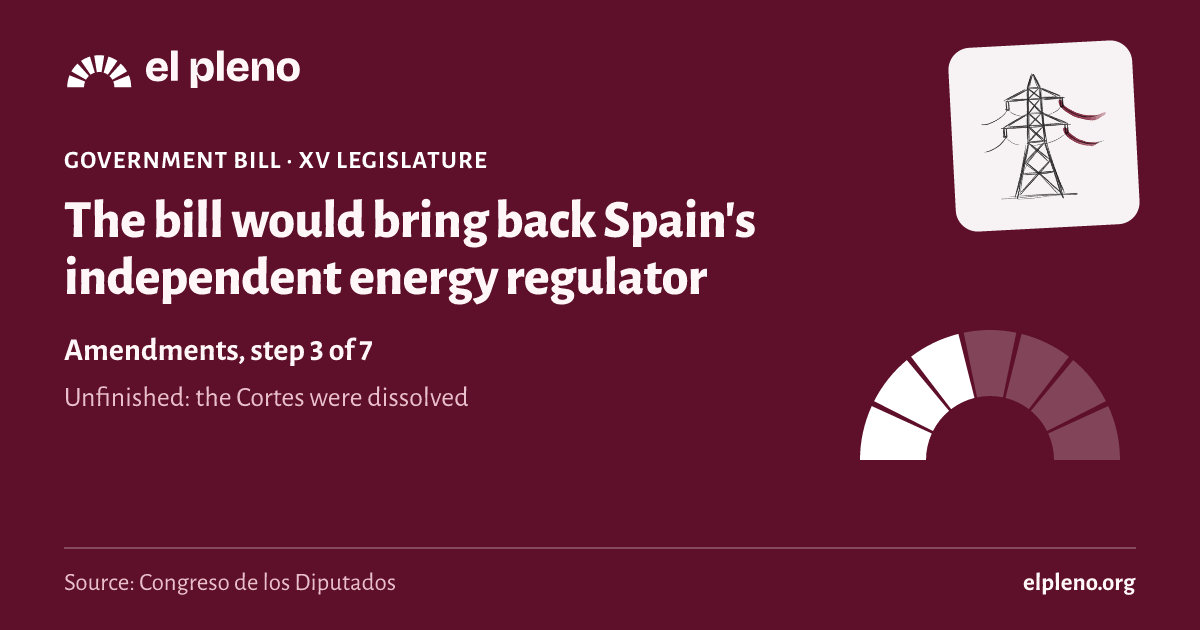
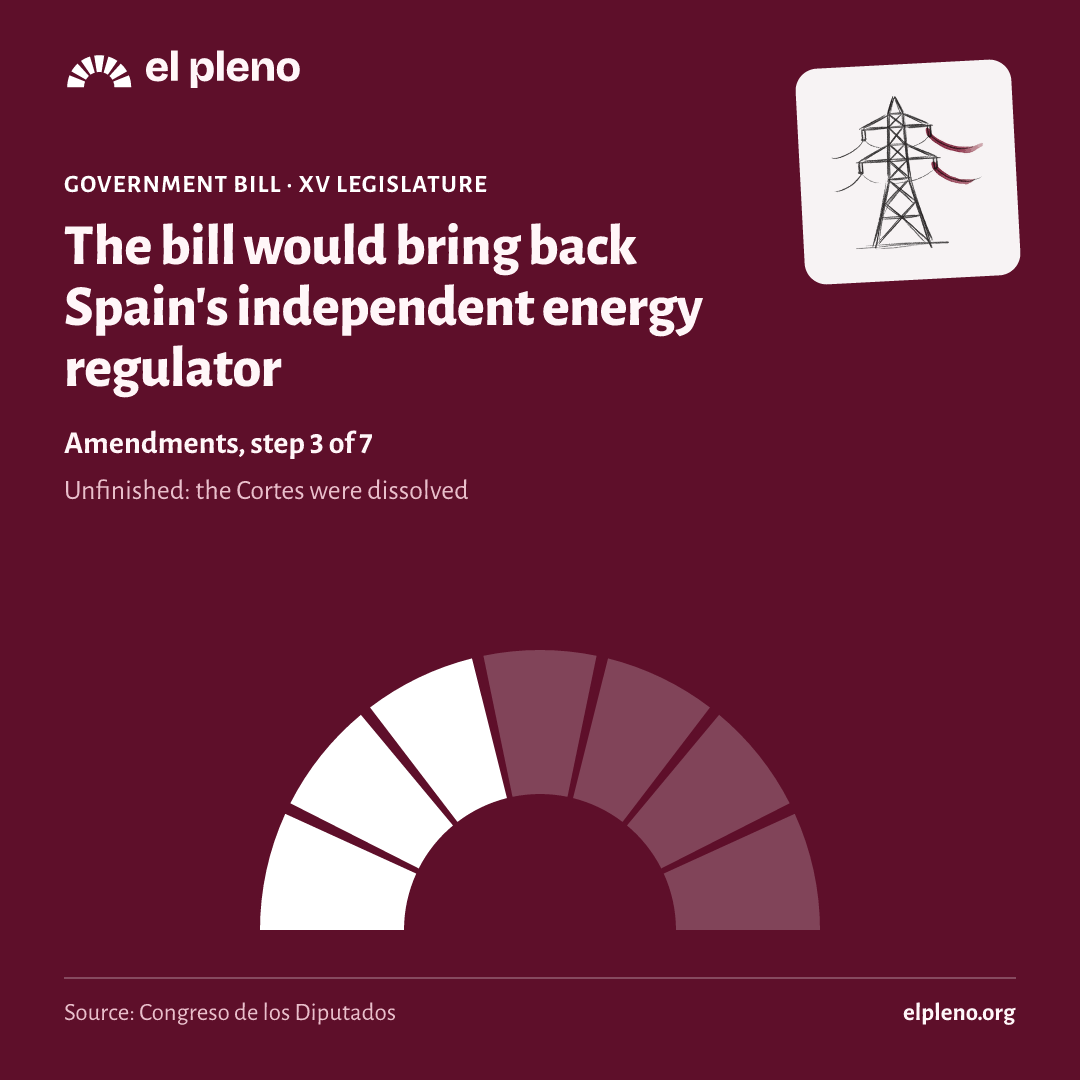
It took 3 of 7 steps. It reached Amendments, and today it is lapsed.
- Introduced26 September 2024Someone registers the text in the Congreso.
- Admitted8 October 2024The Bureau of the Congreso accepts it and, for a members’ bill, the plenary decides whether to consider it.
- Amendments11 October 2024Groups propose changes.
- Committeenot reachedA committee goes through the text in detail.
- Plenarynot reachedAll 350 deputies vote.
- Senatenot reachedThe Senate can pass it, amend it or veto it.
- BOEnot reachedIt is published in the Official State Gazette (BOE) and comes into force.
See the 5 official steps on a timeline
Was there a plenary vote?
We have no plenary vote linked to this law in the Congreso’s data.
What happens next
What happens now?
The legislature ended before it finished. To go on, someone would have to introduce it again in the new Cortes.
Sources
Where does all this come from?
- Congreso de los Diputados, file 121/000035
Official title, type, author, dates and stage.
Retrieved 11 November 2026
- Congreso de los Diputados, procedure
The date of each step, with its official wording.
Retrieved 12 November 2026
- The data comes from the open files of the Congreso, the Senate and the BOE, unaltered.
- Each deputy’s province is the one of their seat on the day of the vote.
- We never say “passed” because of a vote: the files do not say which majority was needed.