What it is
Compensate people whose savings were seized under Franco
It is a members’ bill. Introduced by parliamentary groups, the Senate, regional governments or citizens. It was introduced on 3 December 2019. Introduced by: Comunidad Autónoma de Cataluña - Parlamento.
Official title: Private member's bill to amend Law 52/2007, of December 26, recognizing and expanding rights and establishing measures in favor of those who suffered persecution or violence during the Civil War and the Dictatorship (corresponding to file numbers 125/000010/0000 of the XII Legislature and 125/000003/0000 of the XIII Legislature).
Source: Congreso de los Diputados, file 125/000003· updated 11 Nov
Automatic summary, not yet reviewed
- The bill, introduced by the Parliament of Catalonia, would amend Law 52/2007, which recognizes rights of those who suffered persecution or violence during the Civil War and the Dictatorship. It is not an approved law, only an initial text in the legislative process.
- The bill would add Article 4 bis to that law. It would recognize the right to compensation for individuals affected by the seizure of paper money or other fiduciary instruments deposited by Francoist authorities in the account 'Billetes de canje desestimado' or in the 'Fondo de papel moneda puesto en circulación por el enemigo', or for their heirs. A later regulation would set the required documents, deadlines and how compensation is calculated.
- It would also add a ninth additional provision. The Spanish Government, together with the Government of the Generalitat of Catalonia, would have to study and enable measures to compensate for goods seized from safe deposit boxes at banks and savings banks during the Civil War, but only if those seizures were carried out illegally.
- The preamble explains the origin: Francoist authorities declared invalid the banknotes issued by the Bank of Spain after July 18, 1936, and subjected earlier banknotes to exchanges with conditions that were very hard to meet. Many citizens received only a receipt in exchange for their savings, as a repressive measure against the defeated side.
Who it affects
- People whose paper money or fiduciary instruments were seized under Franco, and their heirs: They would gain a right to compensation, under conditions set by a later regulation.
- Families whose goods were seized from safe deposit boxes at banks or savings banks during the Civil War: The Government would have to study compensation measures if the seizure was illegal.
Words worth knowing
- Signos fiduciarios (fiduciary instruments)
- Paper or metal money whose value comes from trust that it can be used to pay, not from the material itself. Banknotes are an example.
- Derechohabientes (rights holders)
- People who inherit or receive a right from another person, for example their heirs.
- Resarcimiento (compensation)
- Payment to make up for a harm or loss someone suffered.
- Cajas de alquiler (safe deposit boxes)
- Safes that banks and savings banks rent to customers to store valuables.
- Proposición de ley (proposed bill)
- A text drafted as a law, in this case introduced by a regional parliament for the Congress to debate. It is not a law until approved.
It summarizes the text as it was introduced. It is written by artificial intelligence and may contain mistakes: the official text is what counts. Read the official text · How we make summaries
Where it stands
How far did it get?
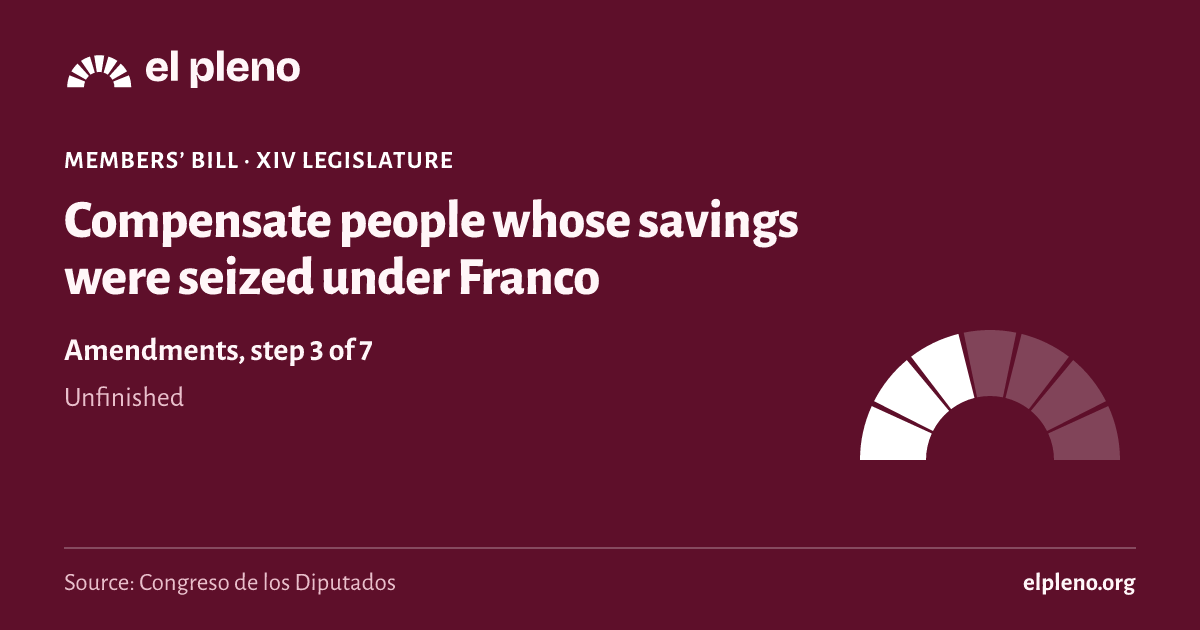
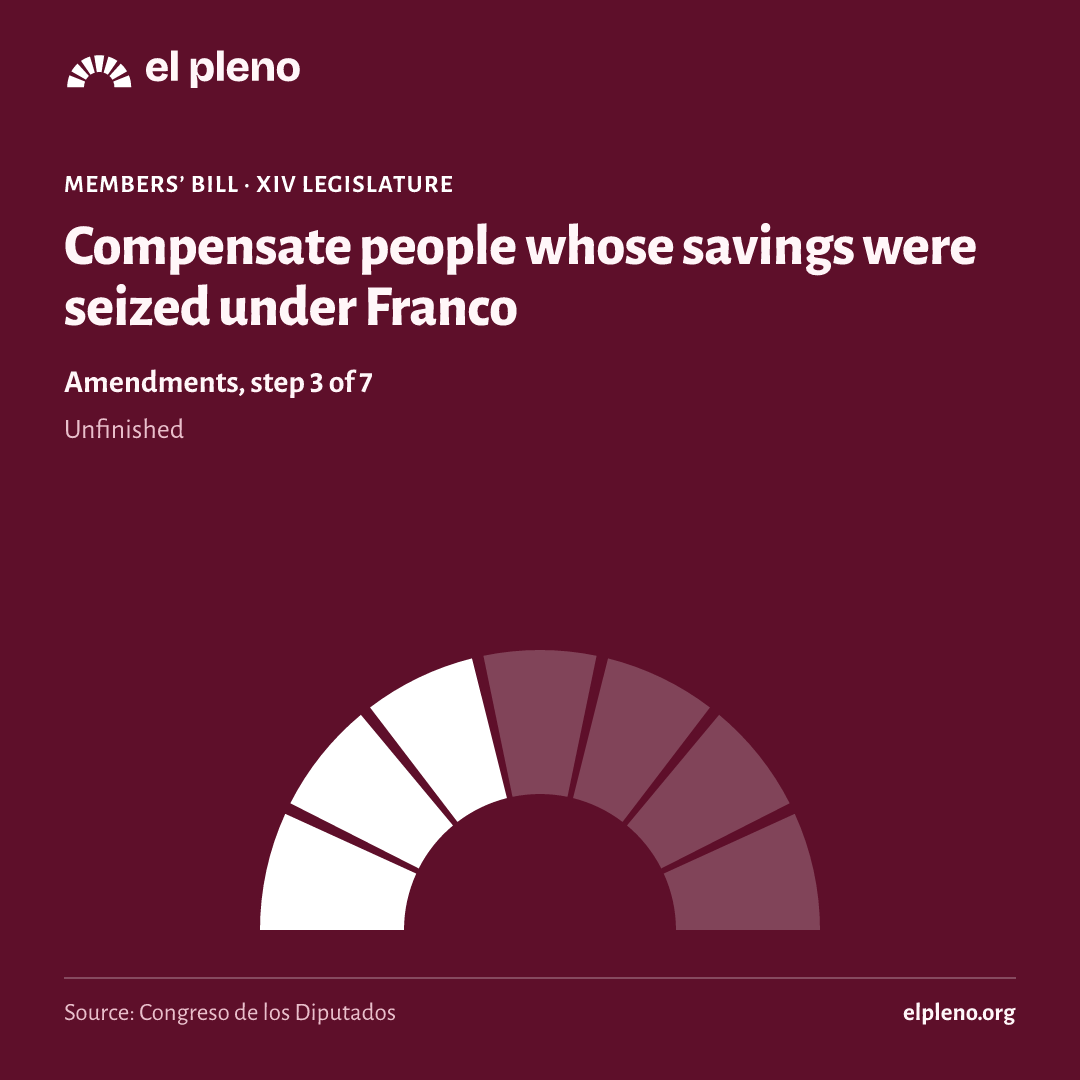
It took 3 of 7 steps. It reached Amendments, and today it is unfinished.
- Introduced3 December 2019Someone registers the text in the Congreso.
- Admitted13 December 2019The Bureau of the Congreso accepts it and, for a members’ bill, the plenary decides whether to consider it.
- Amendments23 October 2020Groups propose changes.
- Committeenot reachedA committee goes through the text in detail.
- Plenarynot reachedAll 350 deputies vote.
- Senatenot reachedThe Senate can pass it, amend it or veto it.
- BOEnot reachedIt is published in the Official State Gazette (BOE) and comes into force.
See the 9 official steps on a timeline
13 October 2020
How did the plenary vote?
Voted on: Private member's bill by the Parliament of Catalonia, amending Law 52/2007, of December 26, recognizing and expanding rights and establishing measures in favor of those who suffered persecution or violence during the Civil War and the Dictatorship (corresponding to file numbers 125/000010/0000 of the XII Legislature and 125/000003/0000 of the XIII Legislature).
Source: Congreso de los Diputados, vote 1 of sitting 48· updated 11 Nov
Each dot is a seat. Tap one, or use the arrow keys, to see who it is.
Your province
How did the deputies from your province vote?
And your senators: the Senate does not link its votes to this law in its open data, so we cannot put them side by side here.
Or see how most of each province voted
- A Coruña More votes in favour 5 yes · 0 no · 3 abst.
- Albacete More votes in favour 2 yes · 1 no · 1 abst.
- Alicante/Alacant More votes in favour 6 yes · 3 no · 3 abst.
- Almería Tie 2 yes · 2 no · 2 abst.
- Araba/Álava More votes in favour 4 yes · 0 no
- Asturias More votes in favour 4 yes · 2 no · 1 abst.
- Ávila Tie 1 yes · 1 no · 1 abst.
- Badajoz More votes in favour 3 yes · 1 no · 2 abst.
- Barcelona More votes in favour 28 yes · 2 no · 2 abst.
- Bizkaia More votes in favour 7 yes · 0 no · 1 abst.
- Burgos More votes in favour 2 yes · 0 no · 2 abst.
- Cáceres More votes in favour 2 yes · 1 no · 1 abst.
- Cádiz More votes in favour 5 yes · 2 no · 2 abst.
- Cantabria Tie 1 yes · 1 no · 3 abst.
- Castellón/Castelló More votes in favour 3 yes · 1 no · 1 abst.
- Ceuta More votes against 0 yes · 1 no
- Ciudad Real More votes in favour 2 yes · 1 no · 2 abst.
- Córdoba More votes in favour 3 yes · 1 no · 2 abst.
- Cuenca More votes in favour 2 yes · 0 no · 1 abst.
- Gipuzkoa More votes in favour 6 yes · 0 no
- Girona More votes in favour 6 yes · 0 no
- Granada More votes in favour 4 yes · 1 no · 2 abst.
- Guadalajara Tie 1 yes · 1 no · 1 abst.
- Huelva More votes in favour 3 yes · 1 no · 1 abst.
- Huesca More votes in favour 2 yes · 0 no · 1 abst.
- Illes Balears More votes in favour 4 yes · 2 no · 2 abst.
- Jaén More votes in favour 3 yes · 1 no · 1 abst.
- La Rioja More votes in favour 2 yes · 0 no · 2 abst.
- Las Palmas More votes in favour 5 yes · 1 no · 2 abst.
- León More votes in favour 2 yes · 1 no · 1 abst.
- Lleida More votes in favour 4 yes · 0 no
- Lugo More votes in favour 2 yes · 0 no · 2 abst.
- Madrid More votes in favour 20 yes · 7 no · 10 abst.
- Málaga More votes in favour 6 yes · 2 no · 3 abst.
- Melilla Tie 0 yes · 0 no · 1 abst.
- Murcia More votes in favour 4 yes · 3 no · 3 abst.
- Navarra More votes in favour 5 yes · 0 no
- Ourense More votes in favour 2 yes · 0 no · 2 abst.
- Palencia More votes in favour 1 yes · 0 no · 2 abst.
- Pontevedra More votes in favour 4 yes · 0 no · 3 abst.
- Salamanca Tie 1 yes · 1 no · 2 abst.
- Santa Cruz de Tenerife More votes in favour 4 yes · 1 no · 2 abst.
- Segovia Tie 1 yes · 1 no · 1 abst.
- Sevilla More votes in favour 8 yes · 2 no · 2 abst.
- Soria More votes in favour 1 yes · 0 no · 1 abst.
- Tarragona More votes in favour 6 yes · 0 no
- Teruel More votes in favour 1 yes · 0 no · 1 abst.
- Toledo Tie 2 yes · 2 no · 2 abst.
- Valencia/València More votes in favour 8 yes · 3 no · 4 abst.
- Valladolid More votes in favour 2 yes · 1 no · 2 abst.
- Zamora Tie 1 yes · 1 no · 1 abst.
- Zaragoza More votes in favour 4 yes · 1 no · 2 abst.
More details: how each group and each province voted
The groups
Who voted in favour and who against?
In favour, most of Euskal Herria Bildu, Republicano, Socialista, Vasco (EAJ-PNV), Mixto, Ciudadanos, Gcup-ec-gc and GPlu. Against, most of VOX. 2 deputies voted differently from their group.
By province: in 33 most voted in favour; in 1, against.
Coloured by how most of each province’s deputies voted.
- In favour: 33
- Against: 1
- Abstained: 4
- Tie: 14
| Group | Seats | How it voted |
|---|---|---|
| Euskal Herria Bildu | 5 | 5 in favour |
| Republicano | 13 | 13 in favour |
| Socialista | 120 | 120 in favour |
| Vasco (EAJ-PNV) | 6 | 6 in favour |
| Mixto | 9 | 6 in favour · 1 against · 1 abst. · 1 did not vote |
| Ciudadanos | 10 | 10 in favour |
| Gcup-ec-gc | 35 | 35 in favour |
| GPlu | 12 | 12 in favour |
| Popular en el Congreso | 88 | 88 abst. |
| VOX | 52 | 52 against |
What happens next
What happens now?
The legislature ended before it finished. To go on, someone would have to introduce it again in the new Cortes.
It has not been presented again yet.
Sources
Where does all this come from?
- Congreso de los Diputados, file 125/000003
Official title, type, author, dates and stage.
Retrieved 11 November 2026
- Congreso de los Diputados, vote 1 of sitting 48
The count and every seat’s vote.
Retrieved 11 November 2026
- The data comes from the open files of the Congreso, the Senate and the BOE, unaltered.
- Each deputy’s province is the one of their seat on the day of the vote.
- We only say “passed” or “rejected” when the majority needed is certain; otherwise we say which side had more votes.