What it is
Bill would let city councils replace fines with community work or educational activities
It is a members’ bill. Introduced by parliamentary groups, the Senate, regional governments or citizens. It was introduced on 27 April 2023. Introduced by: Senado.
Official title: Private member's bill amending Law 7/1985, of April 2, on the Basic Regime of Local Authorities, to add a new article regulating alternative measures to pecuniary sanctions.
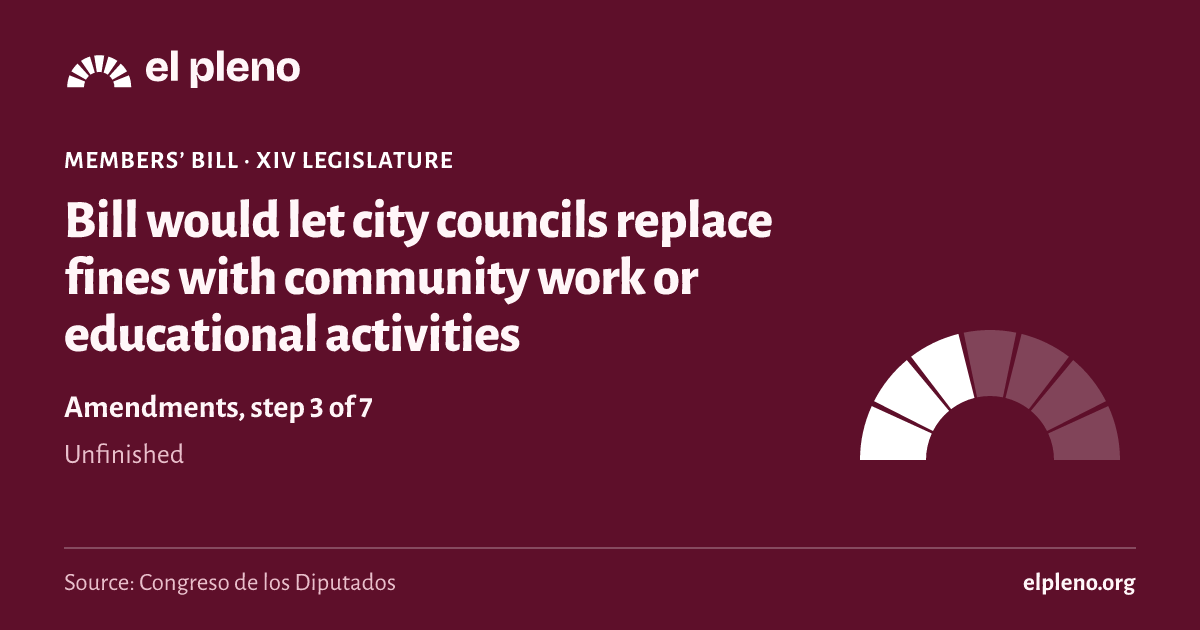
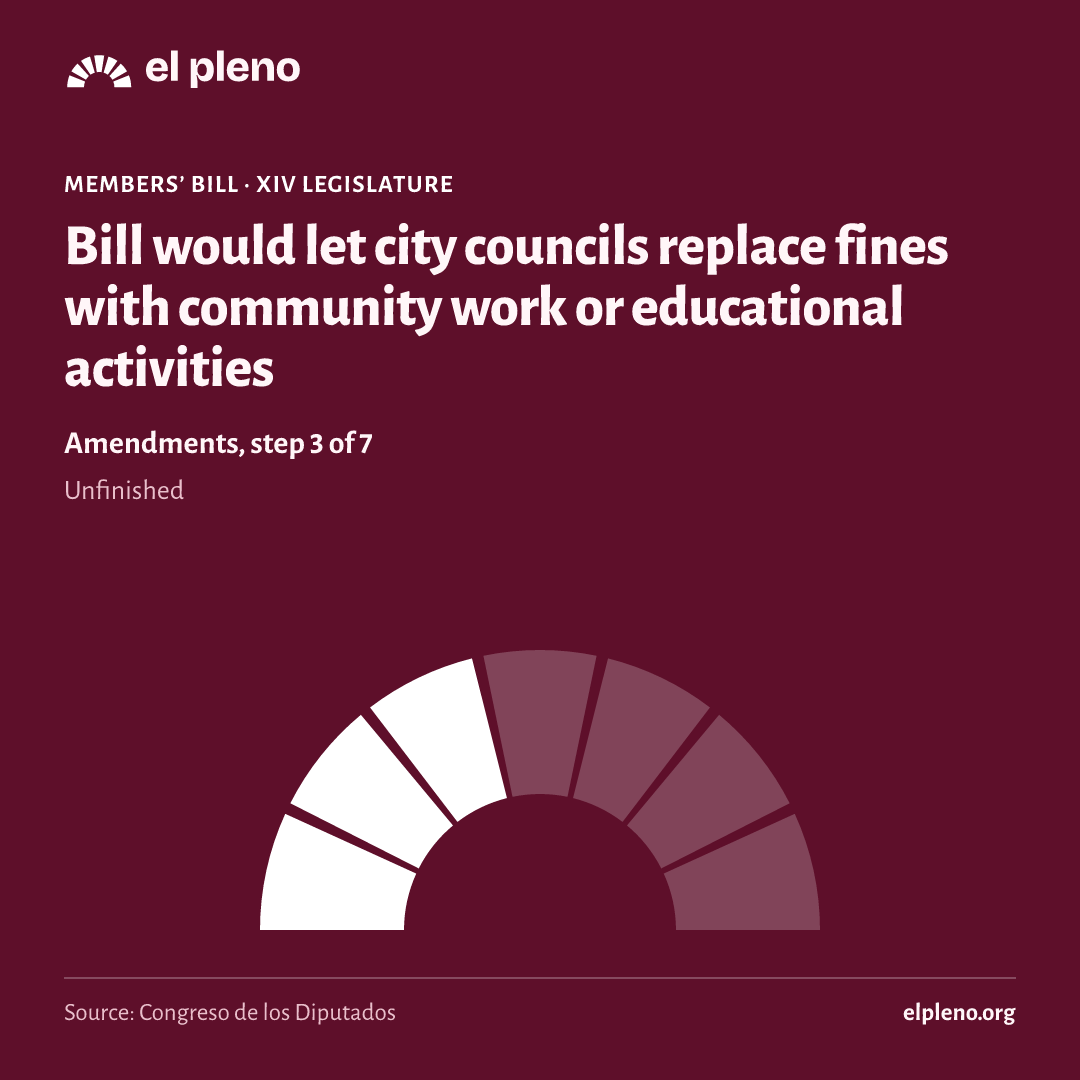
Source: Congreso de los Diputados, file 124/000015· updated 11 Nov
Automatic summary, not yet reviewed
- The bill would add a new Article 142 to Law 7/1985 so that local entities could fully or partially replace fines with community service or socioeducational or civic activities, always with the consent of the person concerned or their legal representative.
- The replacement could also be requested after the fine is imposed. The penalty would be fully or partially suspended, but if the agreed measure is not carried out, the fine would be enforced.
- The explanatory statement argues that today a fine is the only possible penalty in local coexistence matters, and that it hits people with fewer resources harder. It also seeks to give legal certainty to ordinances that already provide for these measures, after adverse rulings such as the Catalan High Court decision on the Lleida ordinance.
- The Senate sent the bill to the Congress of Deputies (Congreso de los Diputados), which referred it to the Territorial Policy Committee with full legislative power. The deadline for amendments is fifteen working days, ending May 31, 2023.
Who it affects
- City councils and other local entities: They could include alternative measures to fines in their ordinances on coexistence and civic behavior offenses.
- People fined by municipal ordinances: They could choose, with their consent or on request, to perform community service or educational or civic activities instead of paying.
- Legal representatives of minors or dependent persons: They could give consent or request the replacement of the fine on their behalf.
Words worth knowing
- Entidad local
- Local public administration, such as a city council (ayuntamiento) or provincial council (diputación).
- Ordenanza municipal
- A rule approved by each city council to regulate coexistence and services in its municipality.
- Sanción pecuniaria
- A fine, that is, paying money as a punishment for an offense.
- Potestad sancionadora
- The power of a public administration to impose sanctions when its rules are broken.
- Competencia legislativa plena
- The power of a parliamentary committee to pass a law directly, without a vote by the full chamber.
It summarizes the text as it was introduced. It is written by artificial intelligence and may contain mistakes: the official text is what counts. Read the official text · How we make summaries
Where it stands
How far did it get?
It took 3 of 7 steps. It reached Amendments, and today it is unfinished.
- Introduced27 April 2023Someone registers the text in the Congreso.
- Admitted9 May 2023The Bureau of the Congreso accepts it and, for a members’ bill, the plenary decides whether to consider it.
- Amendments12 May 2023Groups propose changes.
- Committeenot reachedA committee goes through the text in detail.
- Plenarynot reachedAll 350 deputies vote.
- Senatenot reachedThe Senate can pass it, amend it or veto it.
- BOEnot reachedIt is published in the Official State Gazette (BOE) and comes into force.
See the 5 official steps on a timeline
Was there a plenary vote?
We have no plenary vote linked to this law in the Congreso’s data.
What happens next
What happens now?
The legislature ended before it finished. To go on, someone would have to introduce it again in the new Cortes.
It has not been presented again yet.
The same initiative in the other chamber:
Sources
Where does all this come from?
- Congreso de los Diputados, file 124/000015
Official title, type, author, dates and stage.
Retrieved 11 November 2026
- The data comes from the open files of the Congreso, the Senate and the BOE, unaltered.
- Each deputy’s province is the one of their seat on the day of the vote.
- We only say “passed” or “rejected” when the majority needed is certain; otherwise we say which side had more votes.