What it is
Bill to bring back sedition and embezzlement crimes
It is a members’ bill. Introduced by parliamentary groups, the Senate, regional governments or citizens. It was introduced on 11 May 2023. Introduced by: Grupo Parlamentario Popular en el Congreso.
Official title: Private member's bill on the crime of sedition, embezzlement and the calling of an illegal referendum (Organic).
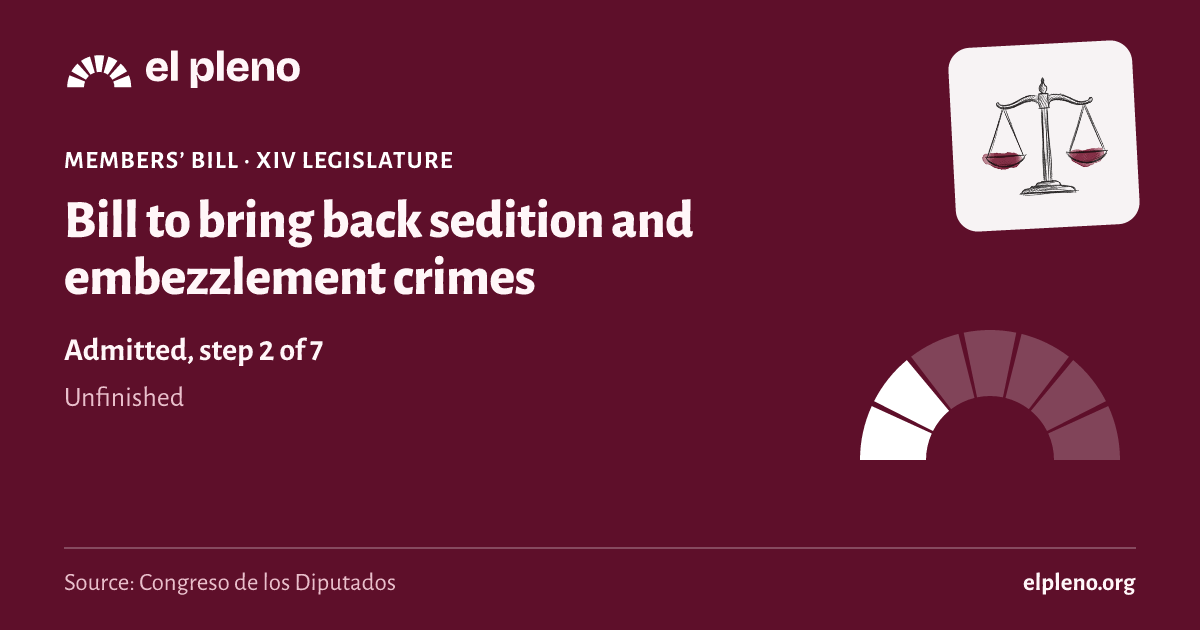
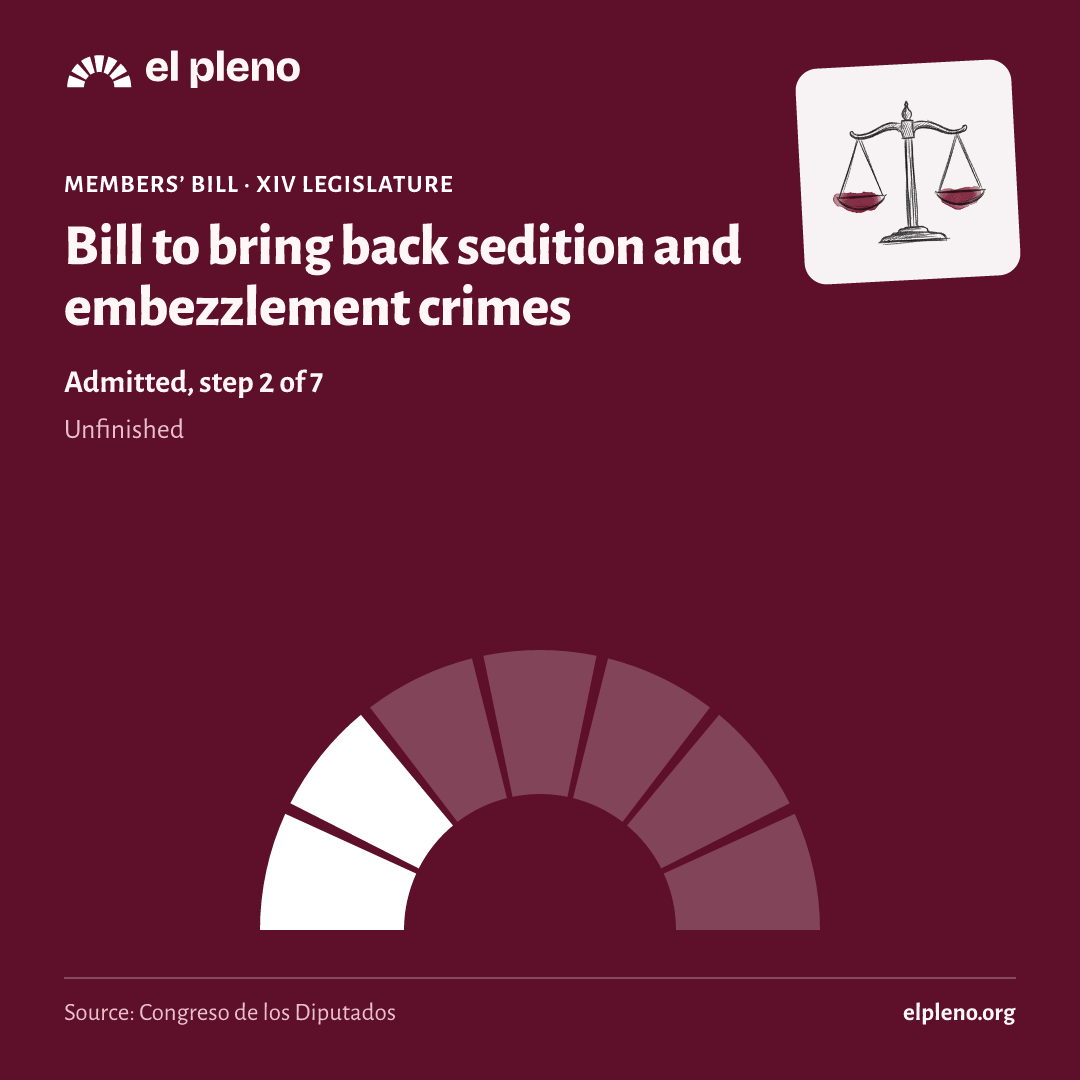
Source: Congreso de los Diputados, file 122/000327· updated 11 Nov
Automatic summary, not yet reviewed
- The bill would amend the Criminal Code to bring back the crime of sedition, toughen embezzlement penalties, and punish calling illegal referendums. It is a bill introduced by the Popular Party group, not an approved law.
- On embezzlement, it would delete Article 432 bis and restore Articles 432 and 433 to their wording before the 2022 reform. Appropriating public funds would carry two to six years in prison, rising to four to eight in aggravated cases, and only losses under 4,000 euros would get reduced penalties.
- It would reinstate the crime of sedition, repealed in 2022, as a new chapter with Articles 544 to 549. Those who lead a sedition could face eight to ten years in prison, or ten to fifteen if they are public authorities.
- It would add a new Article 506 bis: a public authority or official who calls elections or popular consultations without having the powers to do so would face three to five years in prison. Anyone who facilitates or promotes such a process, once declared illegal, would face one to three years.
- It would also add an Article 521 bis for those who act as poll workers or help hold an illegal election or consultation: six months to one year in prison or a fine of twelve to twenty-four months.
- The law would be enacted under the State's exclusive power over criminal legislation and would take effect twenty days after publication in the Official State Gazette (Boletín Oficial del Estado).
Who it affects
- Public authorities and officials who manage public money, because embezzlement penalties would become tougher again.: Two to six years in prison, rising to four to eight in aggravated cases, plus disqualification.
- Authorities or officials who call or authorize elections or referendums without having the powers to do so.: Three to five years in prison and absolute disqualification.
- People who act as poll workers or help hold a consultation already declared illegal.: Six months to one year in prison or a fine.
- People who rise up publicly and in tumult to block the application of the laws by force.: Punished again as sedition, with four to ten years in prison depending on their role, or ten to fifteen if they are authorities.
Words worth knowing
- Malversación (embezzlement)
- Crime committed by a public authority or official who uses public money or property for a purpose other than the one intended.
- Sedición (sedition)
- Rising up publicly and in tumult, short of rebellion, to block by force the application of the laws or the work of public authorities.
- Proposición de ley (bill)
- A text introduced by a parliamentary group so it can become a law. It is not a law until approved.
- Ley orgánica (organic law)
- A law reserved for major matters, such as criminal law, requiring an absolute majority in the Congress to pass.
- Inhabilitación absoluta (absolute disqualification)
- A penalty that bars a person from holding any public job or office for the duration of the sentence.
It summarizes the text as it was introduced. It is written by artificial intelligence and may contain mistakes: the official text is what counts. Read the official text · How we make summaries
Where it stands
How far did it get?
It took 2 of 7 steps. It reached Admitted, and today it is unfinished.
- Introduced11 May 2023Someone registers the text in the Congreso.
- Admitted16 May 2023The Bureau of the Congreso accepts it and, for a members’ bill, the plenary decides whether to consider it.
- Amendmentsnot reachedGroups propose changes.
- Committeenot reachedA committee goes through the text in detail.
- Plenarynot reachedAll 350 deputies vote.
- Senatenot reachedThe Senate can pass it, amend it or veto it.
- BOEnot reachedIt is published in the Official State Gazette (BOE) and comes into force.
See the 5 official steps on a timeline
Was there a plenary vote?
We have no plenary vote linked to this law in the Congreso’s data.
What happens next
What happens now?
The legislature ended before it finished. To go on, someone would have to introduce it again in the new Cortes.
It has not been presented again yet.
Sources
Where does all this come from?
- Congreso de los Diputados, file 122/000327
Official title, type, author, dates and stage.
Retrieved 11 November 2026
- The data comes from the open files of the Congreso, the Senate and the BOE, unaltered.
- Each deputy’s province is the one of their seat on the day of the vote.
- We only say “passed” or “rejected” when the majority needed is certain; otherwise we say which side had more votes.