What it is
Bill to stop children under 16 from accessing pornography
It is a members’ bill. Introduced by parliamentary groups, the Senate, regional governments or citizens. It was introduced on 11 May 2023. Introduced by: Grupo Parlamentario Plural.
Official title: Private member's bill for an Organic Law strengthening measures to restrict access to pornography for minors under sixteen years of age.
Source: Congreso de los Diputados, file 122/000326· updated 11 Nov
Automatic summary, not yet reviewed
- The bill seeks to restrict as much as possible the access of children under sixteen to pornography, citing data on teen consumption and its link to sexual assaults among minors.
- The bill would criminally punish those responsible for pornographic video platforms that lack age verification systems to block access by children under sixteen, even if the minor falsely claimed to be of legal age.
- It would also punish with six months to two years in prison anyone who uses highly realistic images created with artificial intelligence (deepfakes) or real images obtained without consent to create content that seriously harms a person's honor or privacy.
- The bill would empower the National Markets and Competition Commission (CNMC National Markets and Competition Commission (Comisión Nacional de los Mercados y la Competencia), the public body that enforces the law in the audiovisual and competition sectors.) to formally warn platforms that allow minors to access pornography. If they do not act within fifteen days, the CNMC could go to court to order the service shut down and would report the offense to the prosecutor's office.
- The bill would require all internet-connected devices sold in Spain to come with parental controls activated by default, which only adults could turn off.
Who it affects
- Video platforms and other intermediaries of pornographic content: They would need age verification systems or face prison sentences and service shutdown.
- People who create or share deepfakes or intimate images without consent: They could face six months to two years in prison.
- Children under sixteen: They would face more barriers to accessing pornography and devices with parental controls on by default.
- CNMC and the prosecutor's office: The CNMC could warn, sanction, and ask courts to shut down non-compliant platforms; the prosecutor's office could pursue criminal action.
- Families and adults responsible for minors: Parental controls would come activated by default and only adults could disable them.
Words worth knowing
- Deepfake
- A video, image, or audio created with artificial intelligence that imitates the appearance and voice of a real person very convincingly.
- CNMC
- National Markets and Competition Commission (Comisión Nacional de los Mercados y la Competencia), the public body that enforces the law in the audiovisual and competition sectors.
- Control parental
- Parental control: a tool on a device or app that lets adults limit the content minors can see.
- PIV (prestador de servicio de intercambio de vídeos a través de plataforma)
- A platform where users upload and share videos, such as video-based social networks.
- Proposición de Ley Orgánica
- An organic bill: a legislative proposal introduced by members of parliament that is not yet approved or in force.
It summarizes the text as it was introduced. It is written by artificial intelligence and may contain mistakes: the official text is what counts. Read the official text · How we make summaries
Where it stands
How far did it get?
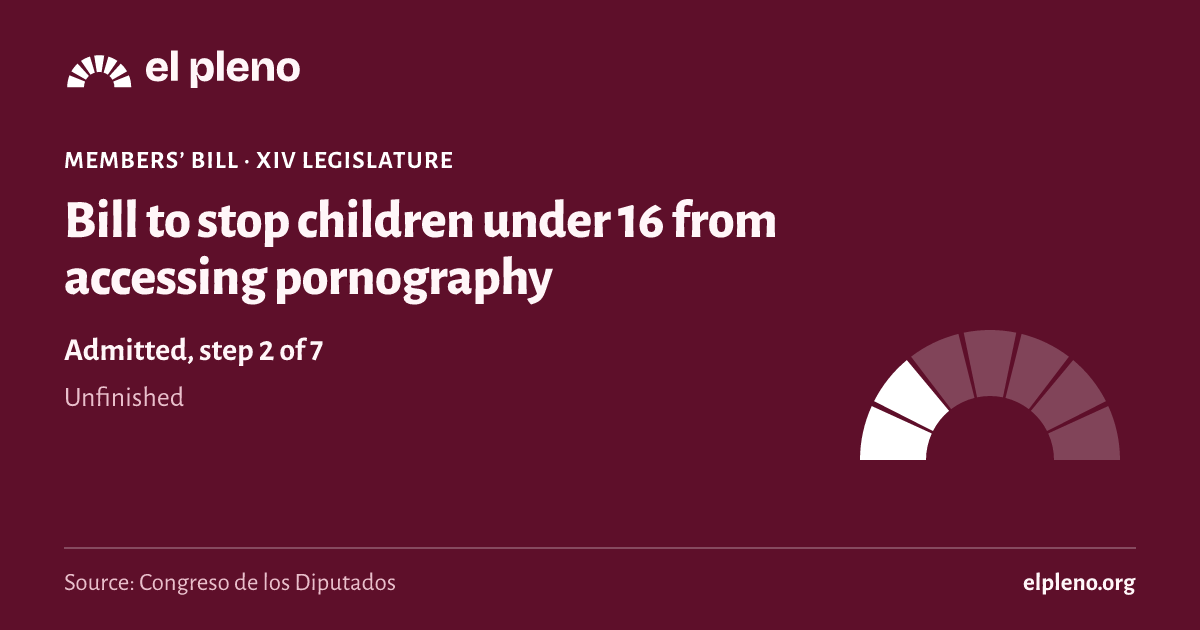
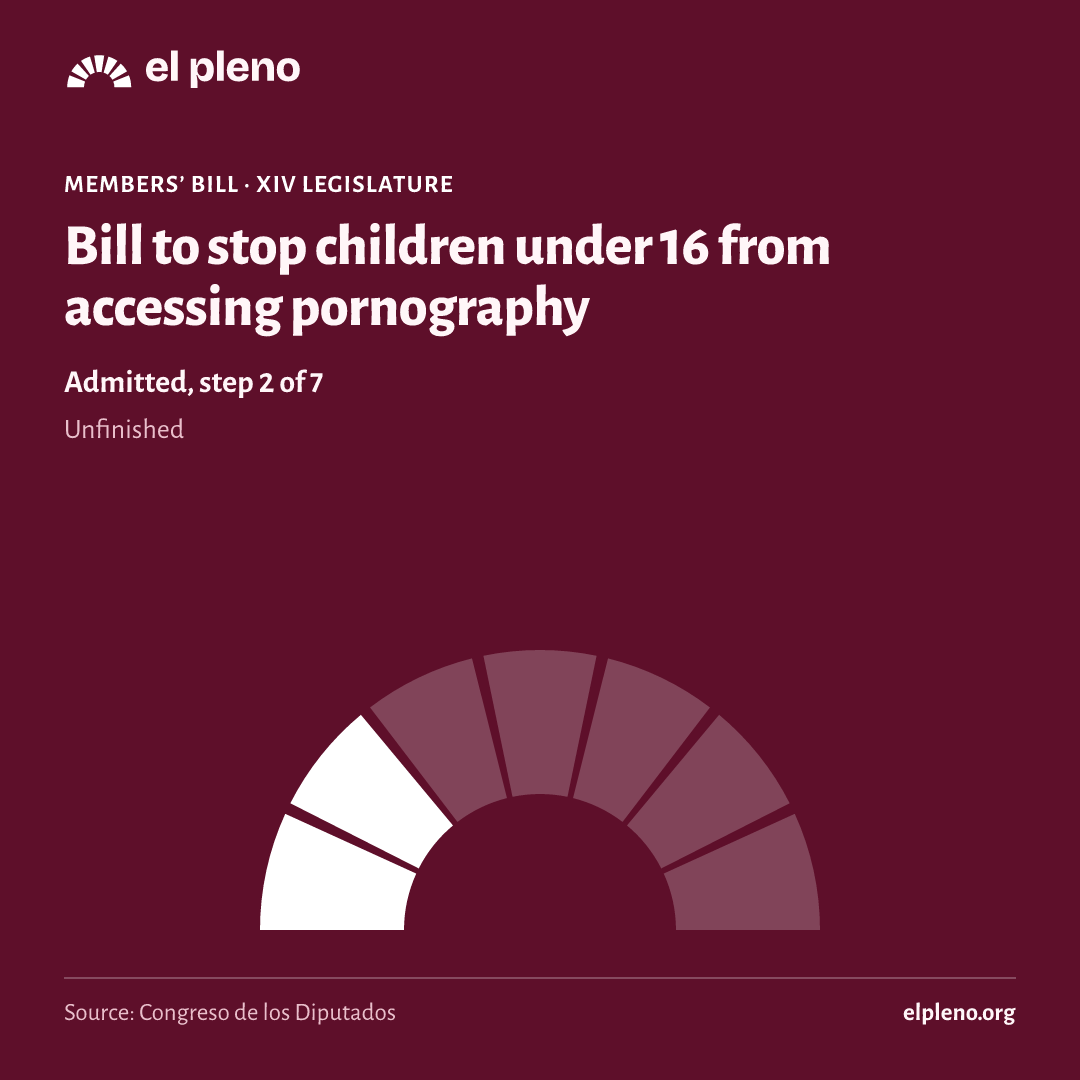
It took 2 of 7 steps. It reached Admitted, and today it is unfinished.
- Introduced11 May 2023Someone registers the text in the Congreso.
- Admitted16 May 2023The Bureau of the Congreso accepts it and, for a members’ bill, the plenary decides whether to consider it.
- Amendmentsnot reachedGroups propose changes.
- Committeenot reachedA committee goes through the text in detail.
- Plenarynot reachedAll 350 deputies vote.
- Senatenot reachedThe Senate can pass it, amend it or veto it.
- BOEnot reachedIt is published in the Official State Gazette (BOE) and comes into force.
See the 5 official steps on a timeline
Was there a plenary vote?
We have no plenary vote linked to this law in the Congreso’s data.
What happens next
What happens now?
The legislature ended before it finished. To go on, someone would have to introduce it again in the new Cortes.
It has not been presented again yet.
Sources
Where does all this come from?
- Congreso de los Diputados, file 122/000326
Official title, type, author, dates and stage.
Retrieved 11 November 2026
- The data comes from the open files of the Congreso, the Senate and the BOE, unaltered.
- Each deputy’s province is the one of their seat on the day of the vote.
- We only say “passed” or “rejected” when the majority needed is certain; otherwise we say which side had more votes.