What it is
VOX bill to repeal the Democratic Memory Law and other rules
It is a members’ bill. Introduced by parliamentary groups, the Senate, regional governments or citizens. It was introduced on 11 April 2023. Introduced by: Grupo Parlamentario VOX.
Official title: Private member's bill for an Organic Law for the repeal of various norms contrary to national unity and the integrity of the institutions.
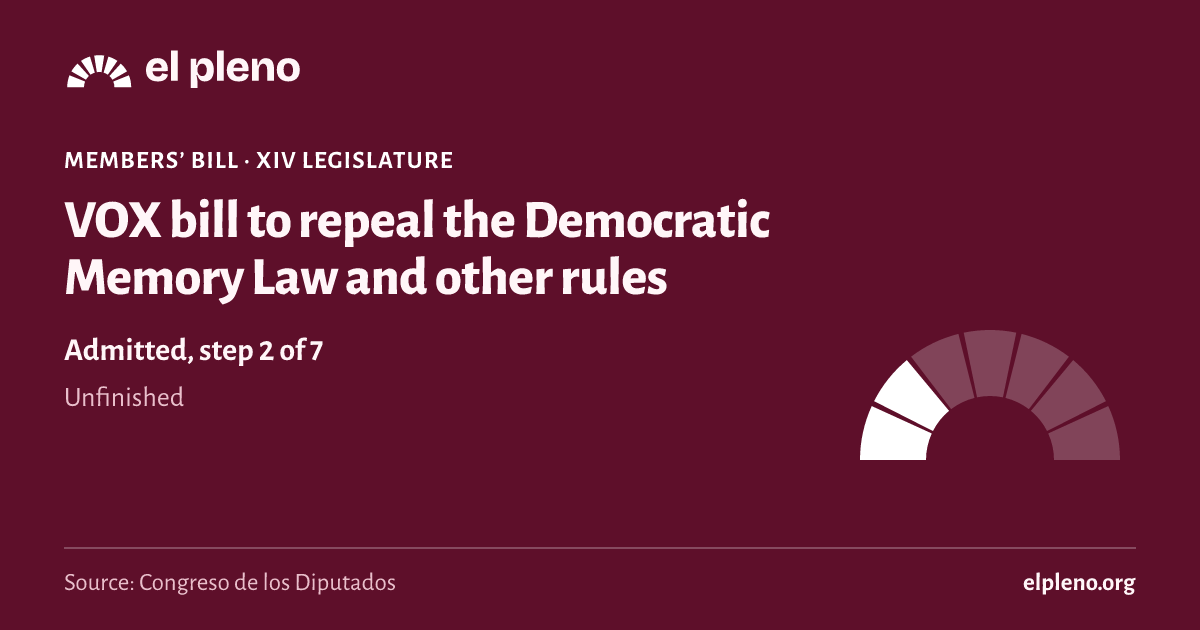
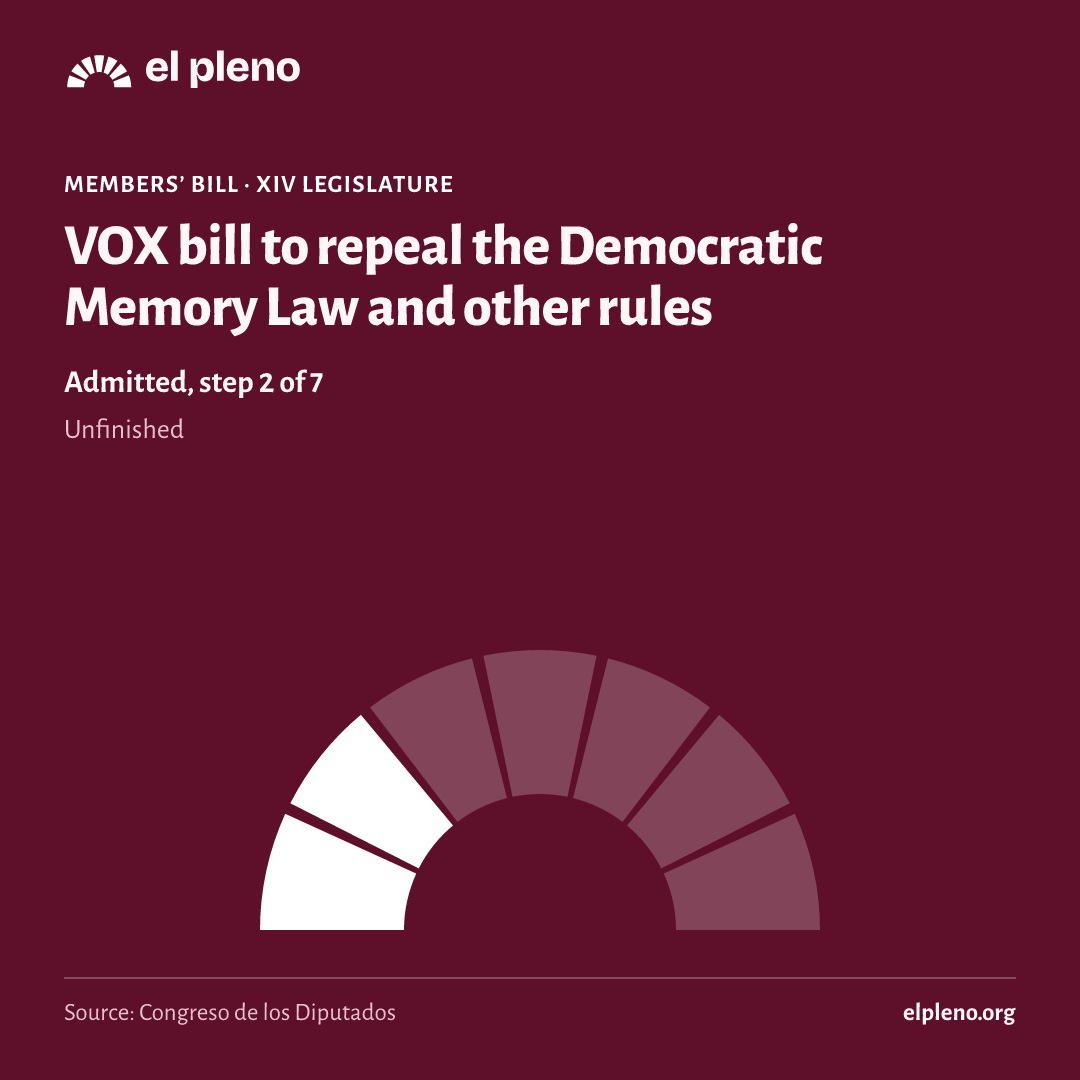
Source: Congreso de los Diputados, file 122/000319· updated 11 Nov
Automatic summary, not yet reviewed
- This is a bill introduced by the VOX parliamentary group in the Congress of Deputies, admitted for processing on April 18, 2023. It is not an approved law.
- The bill would expressly repeal the Democratic Memory Law of 2022, which its authors say imposes a biased view of History and violates several fundamental rights.
- It would delete articles 570 bis and 598 bis of the organic law A law on fundamental rights, the electoral system or other matters the Constitution reserves. It needs an absolute majority in the Congreso: 176 votes. on the Judiciary, added by 2021 and 2022 laws about the General Council of the Judiciary when acting in a caretaker role and the appointment of Constitutional Court judges. The authors say this restores judicial independence.
- It would delete the fifth additional provision of the Minimum Vital Income Law, which allows regions with a special economic regime to manage this benefit. According to the text, this breaks equality among Spaniards.
- It would delete section 7 of the second additional provision of the Local Government Law, which removed the State's authority over local civil servants with national certification in the Basque provinces.
- It would also delete section two.ter of article twenty of the Public Prosecutor's Statute, which created a prosecutor's office for human rights and democratic memory. It would take effect the day after publication in the Official State Gazette.
Who it affects
- People and organizations affected by the Democratic Memory Law: That law would no longer apply if the bill is passed.
- Judges and magistrates: Rules on the General Council of the Judiciary in a caretaker role and on appointing Constitutional Court judges would change.
- Recipients of the minimum vital income in regions with a special economic regime: Management of the benefit would return to the single state system.
- Local civil servants with national certification in the Basque provinces: Their regulation would again fall under the State.
- Public Prosecutor's Office: The specialized office for human rights and democratic memory would disappear.
Words worth knowing
- Proposición de ley
- A text through which a parliamentary group proposes a new law. It is not a law until approved.
- Ley orgánica (organic law)
- A law reserved for major matters, such as fundamental rights, requiring an absolute majority in Congress to pass.
- Derogar (repeal)
- To invalidate a previous rule.
- Consejo General del Poder Judicial (CGPJ)
- The body that governs Spain's judges and courts.
- Ingreso mínimo vital (minimum vital income)
- A Social Security benefit for people with very low income.
- organic law
- A law on fundamental rights, the electoral system or other matters the Constitution reserves. It needs an absolute majority in the Congreso: 176 votes.
It summarizes the text as it was introduced. It is written by artificial intelligence and may contain mistakes: the official text is what counts. Read the official text · How we make summaries
Where it stands
How far did it get?
It took 2 of 7 steps. It reached Admitted, and today it is unfinished.
- Introduced11 April 2023Someone registers the text in the Congreso.
- Admitted18 April 2023The Bureau of the Congreso accepts it and, for a members’ bill, the plenary decides whether to consider it.
- Amendmentsnot reachedGroups propose changes.
- Committeenot reachedA committee goes through the text in detail.
- Plenarynot reachedAll 350 deputies vote.
- Senatenot reachedThe Senate can pass it, amend it or veto it.
- BOEnot reachedIt is published in the Official State Gazette (BOE) and comes into force.
See the 5 official steps on a timeline
Was there a plenary vote?
We have no plenary vote linked to this law in the Congreso’s data.
What happens next
What happens now?
The legislature ended before it finished. To go on, someone would have to introduce it again in the new Cortes.
It has not been presented again yet.
Sources
Where does all this come from?
- Congreso de los Diputados, file 122/000319
Official title, type, author, dates and stage.
Retrieved 11 November 2026
- The data comes from the open files of the Congreso, the Senate and the BOE, unaltered.
- Each deputy’s province is the one of their seat on the day of the vote.
- We only say “passed” or “rejected” when the majority needed is certain; otherwise we say which side had more votes.