What it is
Proposal to claw back public aid from companies that relocate
It is a members’ bill. Introduced by parliamentary groups, the Senate, regional governments or citizens. It was introduced on 3 March 2023. Introduced by: Grupo Parlamentario Confederal de Unidas Podemos-En Comú Podem-Galicia en Común.
Official title: Private member's bill for measures against the relocation of strategic economic activities that have received public aid.
Source: Congreso de los Diputados, file 122/000313· updated 11 Nov
Automatic summary, not yet reviewed
- The bill seeks to prevent companies that received public aid from moving their industry, activity, or tax or registered address to another State. It defines relocation as that transfer, even if carried out by a linked company or one in the same group.
- It proposes adding a new ground for clawing back subsidies: if the company relocates or moves its registered or tax address to another State within ten years of receiving a subsidy for strategic activities, industrial investments, internationalization, competitiveness, digitalization, or keeping the business running, it must repay the money plus late-payment interest.
- It also proposes regulating the procedure for reclaiming that aid: it starts ex officio, the interested party is guaranteed a hearing, and it must be resolved within twelve months; otherwise the procedure expires.
- The ten-year rule would also apply to aid already granted before the law takes effect, as long as that period had not passed since the grant. The Government and the Autonomous Communities would have six months to adapt their subsidy rules, and other rules one year.
Who it affects
- Companies and industries that have received public aid or subsidies: They would have to repay the aid with interest if they relocate or move their registered or tax address to another State within ten years of receiving it.
- Administrations that grant subsidies: They could start the clawback procedure ex officio, with a maximum of twelve months to decide.
- The Government and the Autonomous Communities: They would have six months to adapt their subsidy rules to the new law.
Words worth knowing
- Reintegro de subvenciones
- The obligation to repay public money received as aid, plus any interest due.
- Interés de demora
- A surcharge added to the money to be repaid, as compensation for the delay.
- Domicilio fiscal
- The place where a company is registered to pay its taxes.
- Caducidad del procedimiento
- If the Administration does not decide within the set period, the process is cancelled, although actions may continue.
- Deslocalización
- Moving an industry, activity, or production unit, or the registered or tax address, to another State.
It summarizes the text as it was introduced. It is written by artificial intelligence and may contain mistakes: the official text is what counts. Read the official text · How we make summaries
Where it stands
How far did it get?
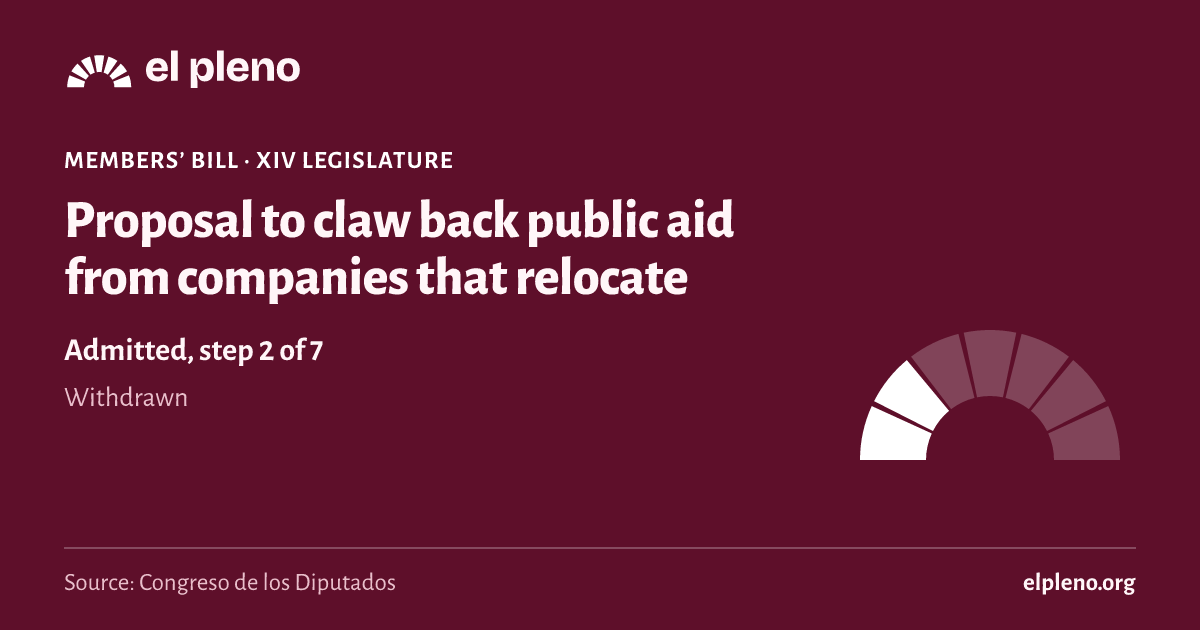
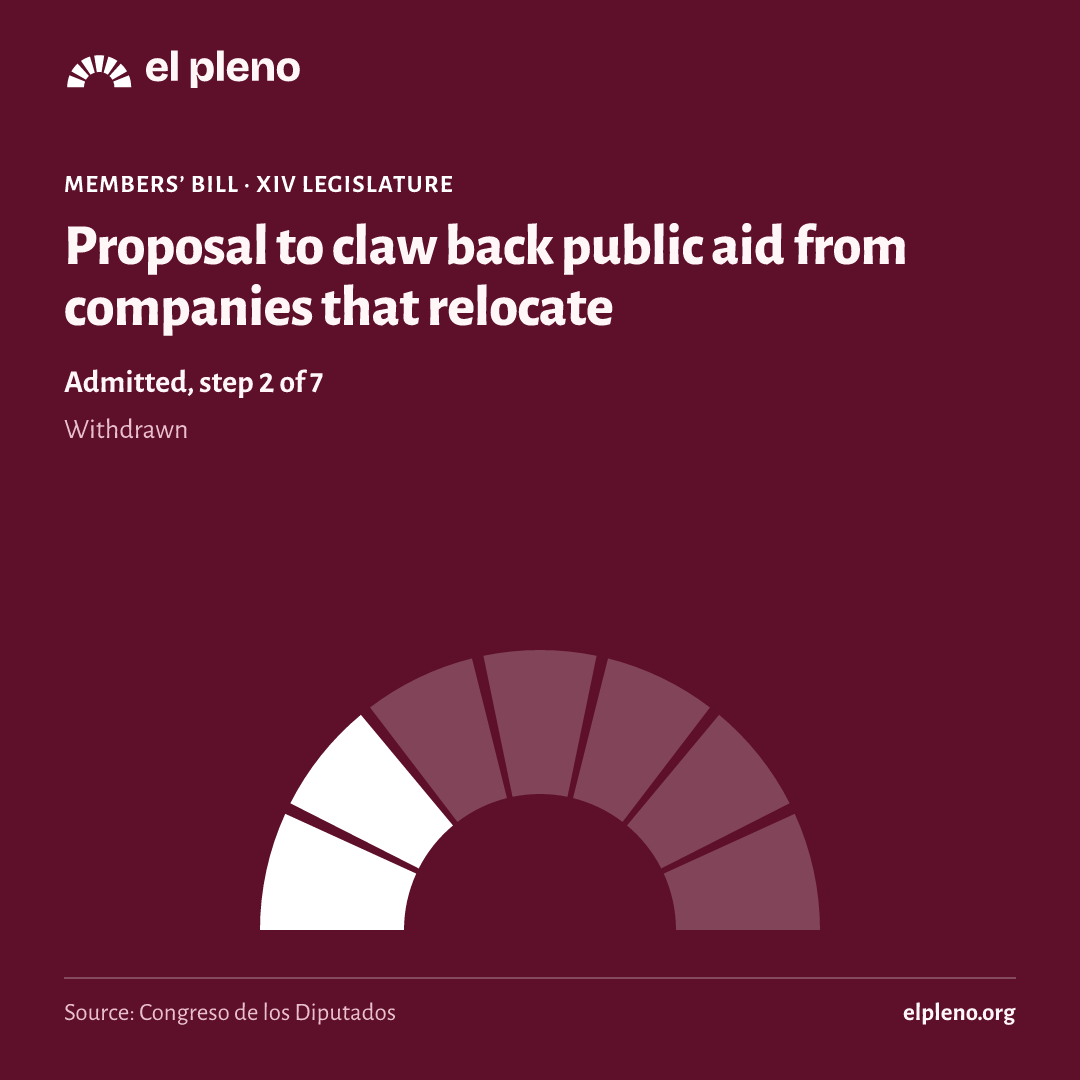
It took 2 of 7 steps. It reached Admitted, and today it is withdrawn.
- Introduced3 March 2023Someone registers the text in the Congreso.
- Admitted7 March 2023The Bureau of the Congreso accepts it and, for a members’ bill, the plenary decides whether to consider it.
- Amendmentsnot reachedGroups propose changes.
- Committeenot reachedA committee goes through the text in detail.
- Plenarynot reachedAll 350 deputies vote.
- Senatenot reachedThe Senate can pass it, amend it or veto it.
- BOEnot reachedIt is published in the Official State Gazette (BOE) and comes into force.
See the 5 official steps on a timeline
Was there a plenary vote?
We have no plenary vote linked to this law in the Congreso’s data.
What happens next
What happens now?
Whoever introduced it withdrew it, or it was merged into another one. It goes no further.
Sources
Where does all this come from?
- Congreso de los Diputados, file 122/000313
Official title, type, author, dates and stage.
Retrieved 11 November 2026
- The data comes from the open files of the Congreso, the Senate and the BOE, unaltered.
- Each deputy’s province is the one of their seat on the day of the vote.
- We only say “passed” or “rejected” when the majority needed is certain; otherwise we say which side had more votes.