What it is
Better financial protection for living organ donors
It is a members’ bill. Introduced by parliamentary groups, the Senate, regional governments or citizens. It was introduced on 21 February 2023. Introduced by: Grupo Parlamentario Socialista.
Official title: Private member's bill to improve the protection of living organ donors for subsequent transplantation.
Source: Congreso de los Diputados, file 122/000308· updated 11 Nov
Automatic summary, not yet reviewed
- The bill seeks to ensure that living organ donors do not suffer financial harm because of their donation. Today those sick leaves are covered as temporary disability for common illness, and the bill proposes a special, more protective scheme.
- The bill would recognize organ donation as a special situation of temporary disability due to common contingencies. It would cover the days of medical preparation and from hospital admission until discharge after recovery, with no prior contribution period required and a benefit equal to 100 percent of the regulatory base from the first day of leave.
- The bill would create a paid leave for the time strictly needed for preparatory steps, such as reports, clinical exams and giving consent, as long as they fall within the workday. It would apply to both private-sector workers and public employees.
- Staff serving in the Administration of Justice would also be covered. During the first six months of leave they would receive their full pay, and from the seventh month the benefit from the Mutualidad General Judicial would equal 100 percent of their complementary pay.
- The same scheme is proposed for civil servants of the Armed Forces and of the State. In both cases, they would receive full pay during the first four months and, after that, a benefit equal to 100 percent of their complementary pay.
- The Government would be empowered to issue the rules needed to implement the law. The law would take effect the day after its publication in the Official State Gazette (Boletín Oficial del Estado).
Who it affects
- Workers under the General Social Security Scheme who donate an organ while alive: They could receive a benefit of 100 percent from the first day of leave, with no prior contributions required, during preparation and recovery from the donation.
- Private-sector workers under the Workers' Statute: They would have paid leave for the preparatory steps of the donation, and their contract would be suspended under the new special temporary disability.
- Public employees: They would have the same paid leave for the preparatory steps of the donation.
- Staff serving in the Administration of Justice: They would receive full pay for the first six months and, after that, 100 percent of their complementary pay from the Mutualidad General Judicial.
- Civil servants of the Armed Forces and of the State: They would receive full pay for the first four months and, after that, 100 percent of their complementary pay.
Words worth knowing
- Incapacidad temporal (temporary disability)
- A situation in which a person cannot work due to illness or an accident and receives a benefit while on sick leave.
- Base reguladora (regulatory base)
- The reference amount used to calculate how much a Social Security benefit pays.
- Cotización (social security contributions)
- Money that workers and employers pay into Social Security; sometimes a minimum contribution period is required to receive a benefit.
- Permiso retribuido (paid leave)
- Time off work for a reason recognized by law, while receiving pay as if working.
- Mutualidad (mutual society)
- An entity that manages Social Security for certain groups, such as judges or civil servants.
It summarizes the text as it was introduced. It is written by artificial intelligence and may contain mistakes: the official text is what counts. Read the official text · How we make summaries
Where it stands
How far did it get?
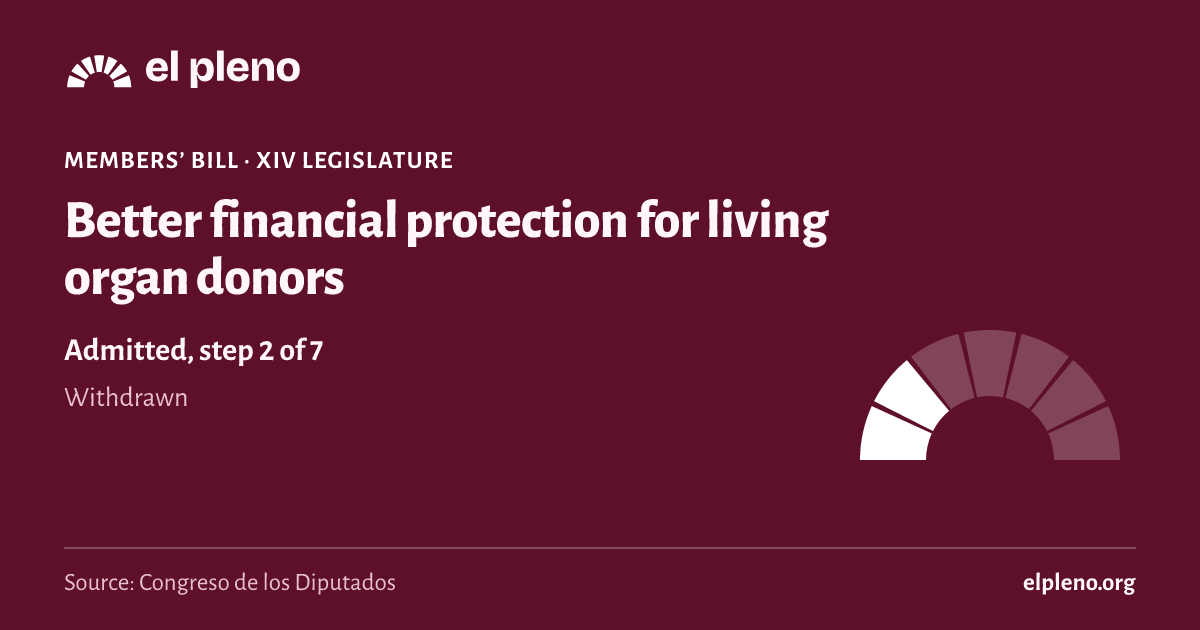
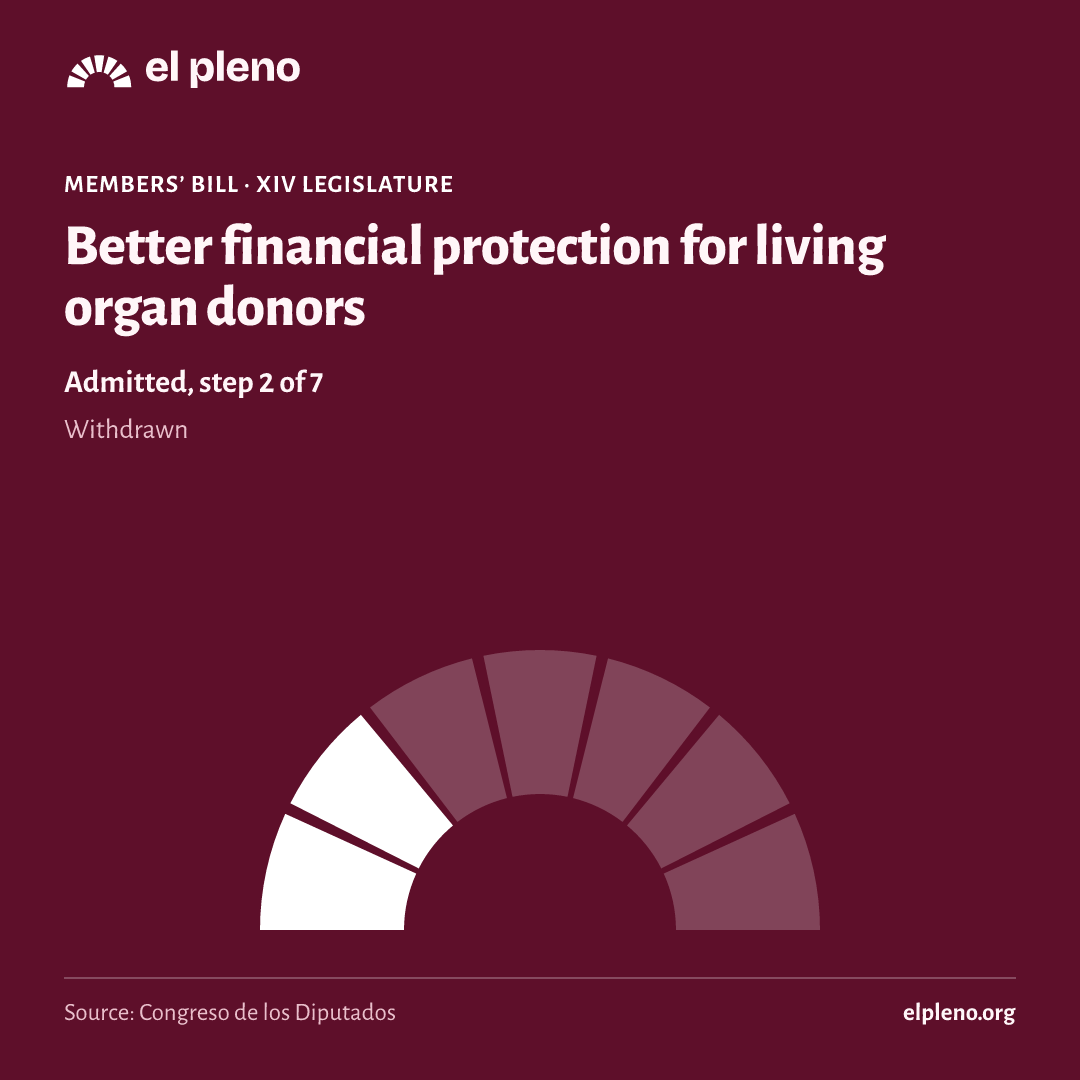
It took 2 of 7 steps. It reached Admitted, and today it is withdrawn.
- Introduced21 February 2023Someone registers the text in the Congreso.
- Admitted28 February 2023The Bureau of the Congreso accepts it and, for a members’ bill, the plenary decides whether to consider it.
- Amendmentsnot reachedGroups propose changes.
- Committeenot reachedA committee goes through the text in detail.
- Plenarynot reachedAll 350 deputies vote.
- Senatenot reachedThe Senate can pass it, amend it or veto it.
- BOEnot reachedIt is published in the Official State Gazette (BOE) and comes into force.
See the 6 official steps on a timeline
Was there a plenary vote?
We have no plenary vote linked to this law in the Congreso’s data.
What happens next
What happens now?
Whoever introduced it withdrew it, or it was merged into another one. It goes no further.
It was presented again:
- XV Legislature, Congreso de los Diputados· Passed· nearly the same title Bill proposes better pay protection for living organ donors
Sources
Where does all this come from?
- Congreso de los Diputados, file 122/000308
Official title, type, author, dates and stage.
Retrieved 11 November 2026
- The data comes from the open files of the Congreso, the Senate and the BOE, unaltered.
- Each deputy’s province is the one of their seat on the day of the vote.
- We only say “passed” or “rejected” when the majority needed is certain; otherwise we say which side had more votes.