What it is
Bill would replace the investor residence visa home purchase rule with a business project
It is a members’ bill. Introduced by parliamentary groups, the Senate, regional governments or citizens. It was introduced on 14 February 2023. Introduced by: Grupo Parlamentario Plural.
Official title: Private member's bill amending Law 14/2013, of 27 September, on support for entrepreneurs and their internationalization.

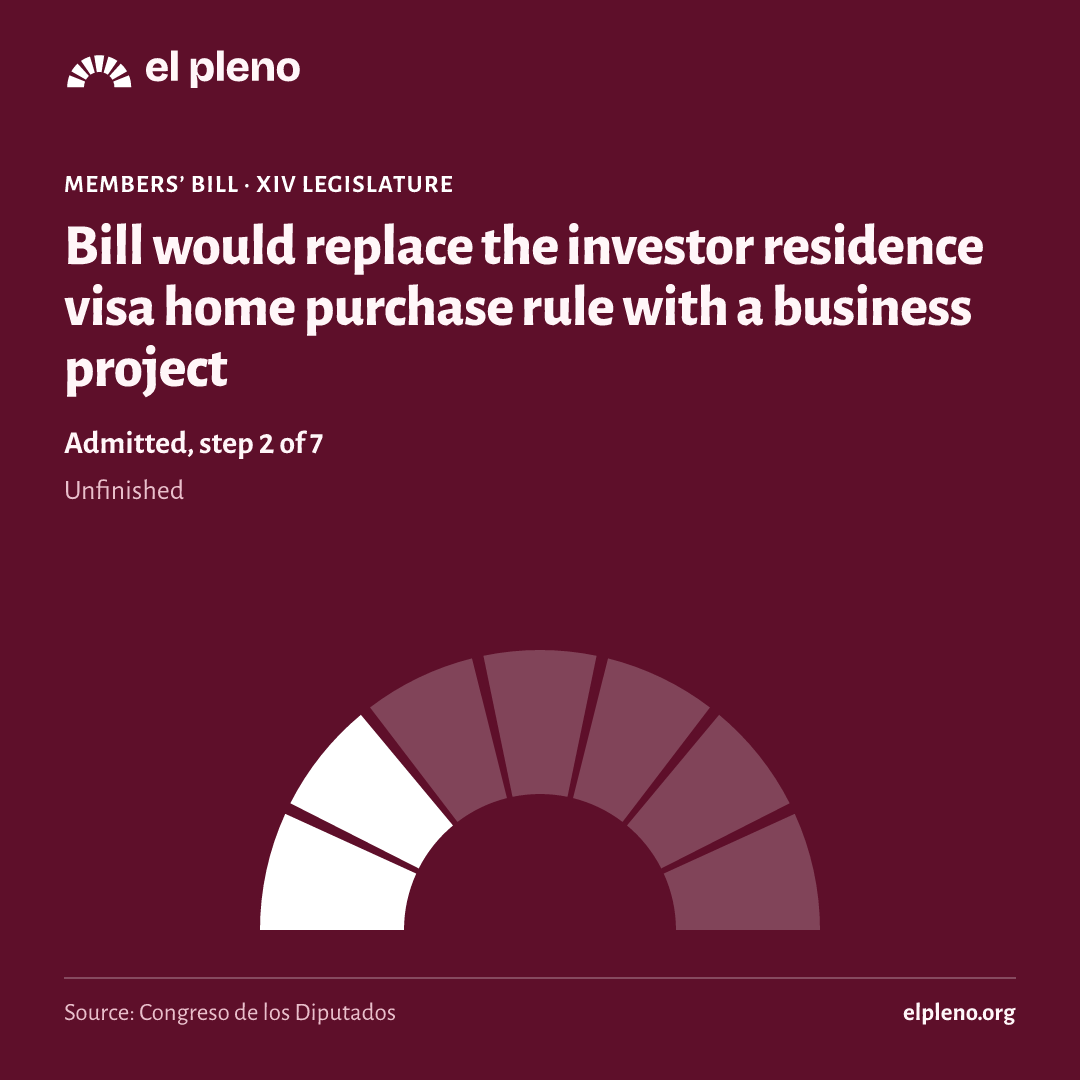
Source: Congreso de los Diputados, file 122/000304· updated 11 Nov
Automatic summary, not yet reviewed
- The bill would remove the requirement to buy real estate in Spain for 500,000 euros or more to get the investor residence visa. Its authors argue that these purchases drive up housing prices and favor money laundering.
- The bill would replace that requirement with carrying out a business project in Spain certified as being in the general interest. To qualify, the project must create jobs, have a significant socioeconomic impact, or contribute relevant scientific or technological innovation.
- The other investment routes for the visa would remain: Spanish public debt of 2 million euros, or shares or bank deposits in Spanish companies or banks of 1 million euros. The bill also details how to prove each type of investment.
- If passed, the law would take effect the day after its publication in the Boletín Oficial del Estado (official state gazette).
Who it affects
- Non-resident foreign investors: Could apply for the investor residence visa by presenting a business project in the general interest instead of buying real estate.
- People wanting to live in Spain by buying a home: Would no longer be able to get the visa by buying property for 500,000 euros or more.
- Economic and Commercial Offices (Oficinas Económicas y Comerciales): Would have to issue a favorable report on the general interest of the business projects submitted.
- People looking for a home or business premises in Spain: The bill's authors say it would ease pressure on housing and commercial property prices.
Words worth knowing
- Visado de residencia para inversores
- Investor residence visa: a permit allowing a foreigner to live in Spain in exchange for a large investment in the country.
- Silencio administrativo
- Administrative silence: if the administration does not reply in time, the application is deemed decided, in this case favorably.
- Paraíso fiscal
- Tax haven: a territory with very low or no taxes, often used to evade taxes.
- Registro de Inversiones Exteriores
- Register of Foreign Investment, kept by the Ministry of Economy, where some foreign investments must be declared.
It summarizes the text as it was introduced. It is written by artificial intelligence and may contain mistakes: the official text is what counts. Read the official text · How we make summaries
Where it stands
How far did it get?
It took 2 of 7 steps. It reached Admitted, and today it is unfinished.
- Introduced14 February 2023Someone registers the text in the Congreso.
- Admitted21 February 2023The Bureau of the Congreso accepts it and, for a members’ bill, the plenary decides whether to consider it.
- Amendmentsnot reachedGroups propose changes.
- Committeenot reachedA committee goes through the text in detail.
- Plenarynot reachedAll 350 deputies vote.
- Senatenot reachedThe Senate can pass it, amend it or veto it.
- BOEnot reachedIt is published in the Official State Gazette (BOE) and comes into force.
See the 6 official steps on a timeline
Was there a plenary vote?
We have no plenary vote linked to this law in the Congreso’s data.
What happens next
What happens now?
The legislature ended before it finished. To go on, someone would have to introduce it again in the new Cortes.
It was presented again:
- XV Legislature, Congreso de los Diputados· Unfinished Bill would remove residency visa for buying property
Sources
Where does all this come from?
- Congreso de los Diputados, file 122/000304
Official title, type, author, dates and stage.
Retrieved 11 November 2026
- The data comes from the open files of the Congreso, the Senate and the BOE, unaltered.
- Each deputy’s province is the one of their seat on the day of the vote.
- We only say “passed” or “rejected” when the majority needed is certain; otherwise we say which side had more votes.