What it is
VOX bill would extend migrant detention and close immigrant centers
It is a members’ bill. Introduced by parliamentary groups, the Senate, regional governments or citizens. It was introduced on 3 February 2023. Introduced by: Grupo Parlamentario VOX.
Official title: Private member's bill for an Organic Law amending Article 62 of Organic Law 4/2000, of 11 January, on the rights and freedoms of foreigners in Spain and their social integration, to establish a transitional regime for the operation of Foreigner Detention Centers until their definitive closure.
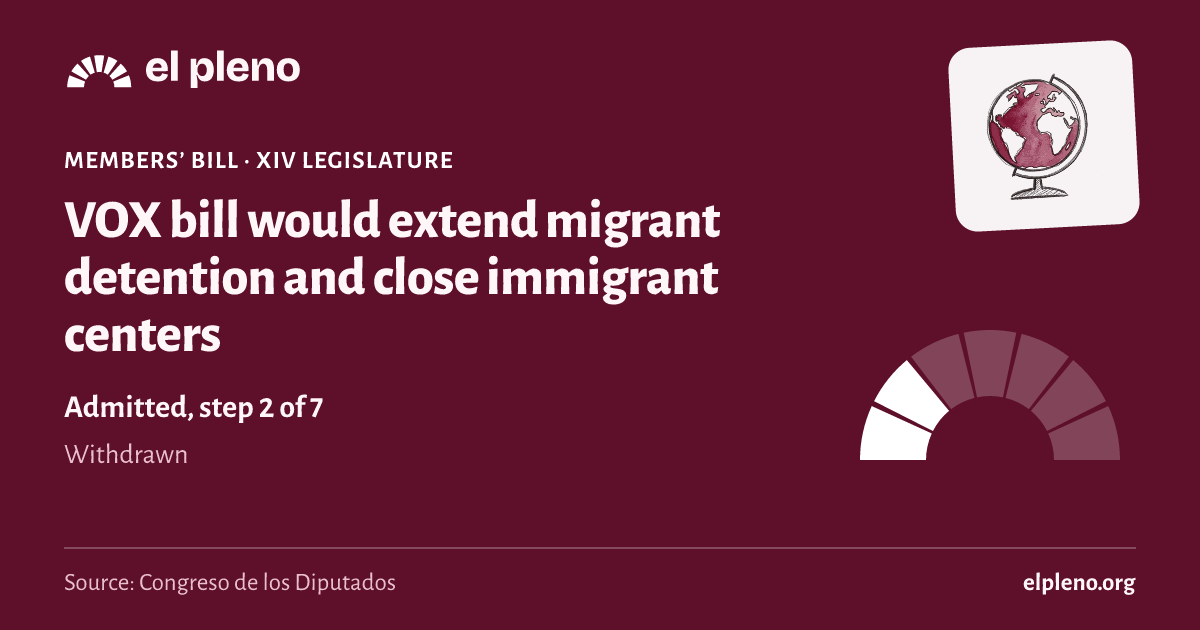

Source: Congreso de los Diputados, file 122/000292· updated 11 Nov
Automatic summary, not yet reviewed
- The bill, introduced by the VOX parliamentary group, would extend the maximum detention period in immigrant detention centers from sixty days to six months, extendable by another six months, and would place detention costs on the authorities of the foreigner's country of origin.
- It would allow asylum seekers to suspend their expulsion or return only if they show, even through mere indications, that they meet the requirements for that protection.
- It would ban filing international protection applications from inside an immigrant detention center.
- It would also extend to six months, extendable by another six, the maximum deadline to decide expulsion cases.
- It would require the Government to send Congress, within six months, a report on how to permanently close the immigrant detention centers. In addition, pending asylum applications would lapse if the requirements are not justified within fifteen days.
Who it affects
- Foreigners held in a detention center (CIE): Their detention could last up to a year instead of sixty days, and they could not apply for asylum from the center.
- Asylum seekers: They would need to show, even through mere indications, that they meet the requirements for their application to suspend expulsion.
- People with pending asylum applications: Their applications would lapse if they do not justify the requirements within fifteen days.
- Countries of origin of detained foreigners: They would cover the detention costs under the proposal.
Words worth knowing
- CIE (Centro de Internamiento de Extranjeros)
- Immigrant detention center: a public, non-prison facility where foreigners are held while awaiting expulsion or return.
- Expediente de expulsión
- Administrative case that can end with the foreigner being forced to leave Spain.
- Indiciario
- Based on indications: enough signs or clues, without needing full proof.
- Protección internacional
- Protection Spain may grant to someone fleeing their country: asylum or subsidiary protection.
It summarizes the text as it was introduced. It is written by artificial intelligence and may contain mistakes: the official text is what counts. Read the official text · How we make summaries
Where it stands
How far did it get?
It took 2 of 7 steps. It reached Admitted, and today it is withdrawn.
- Introduced3 February 2023Someone registers the text in the Congreso.
- Admitted7 February 2023The Bureau of the Congreso accepts it and, for a members’ bill, the plenary decides whether to consider it.
- Amendmentsnot reachedGroups propose changes.
- Committeenot reachedA committee goes through the text in detail.
- Plenarynot reachedAll 350 deputies vote.
- Senatenot reachedThe Senate can pass it, amend it or veto it.
- BOEnot reachedIt is published in the Official State Gazette (BOE) and comes into force.
See the 5 official steps on a timeline
Was there a plenary vote?
We have no plenary vote linked to this law in the Congreso’s data.
What happens next
What happens now?
Whoever introduced it withdrew it, or it was merged into another one. It goes no further.
Sources
Where does all this come from?
- Congreso de los Diputados, file 122/000292
Official title, type, author, dates and stage.
Retrieved 11 November 2026
- The data comes from the open files of the Congreso, the Senate and the BOE, unaltered.
- Each deputy’s province is the one of their seat on the day of the vote.
- We only say “passed” or “rejected” when the majority needed is certain; otherwise we say which side had more votes.