What it is
Bill to require municipality names to always include Spanish
It is a members’ bill. Introduced by parliamentary groups, the Senate, regional governments or citizens. It was introduced on 31 January 2023. Introduced by: Grupo Parlamentario VOX.
Official title: Private member's bill amending Article 14 of Law 7/1985, of 2 April, Regulating the Basic Local Government System, to guarantee compliance with Article 3 of the Constitution regarding the naming of municipalities.
Source: Congreso de los Diputados, file 122/000291· updated 11 Nov
Automatic summary, not yet reviewed
- The bill, introduced by the VOX parliamentary group, would amend Article 14 of Law 7/1985 on the bases of local government. Today that article allows a municipality's name to be in Spanish, in another official language of the region, or in both; under the change, the name would always have to be in Spanish, and only additionally in the region's co-official language.
- The authors base the change on Article 3 of the Constitution, which makes Spanish the State's official language and requires everyone to know it. They claim that in many municipalities the Spanish place name has disappeared from official and private documents.
- Within three months of the law's approval, the Government would have to send the Cortes Generales (Spanish Parliament) a list of national and regional rules that must be adapted to the law, along with a calendar for doing so.
- The Government would be empowered to issue the rules needed to apply the law, which would take effect the day after its publication in the Boletín Oficial del Estado (official gazette). Rules conflicting with it would be repealed.
Who it affects
- Municipalities and provinces with names in a co-official language, because their official name would always have to include Spanish.: Their official name would change or be adapted.
- The Government, which would have to review and adapt the affected national and regional rules.: New rule-review obligations.
- Town councils, because the law on local government regulates how each municipality is named.: Changes to naming rules.
Words worth knowing
- Topónimo
- The proper name of a place, such as a municipality or province.
- Lengua cooficial
- A language that is official in an autonomous community alongside Spanish, such as Catalan or Galician.
- Proposición de ley
- A bill introduced by a parliamentary group. It is not a law until Congress and the Senate pass it.
- Disposición derogatoria
- The part of a law that states which earlier rules stop applying.
It summarizes the text as it was introduced. It is written by artificial intelligence and may contain mistakes: the official text is what counts. Read the official text · How we make summaries
Where it stands
How far did it get?
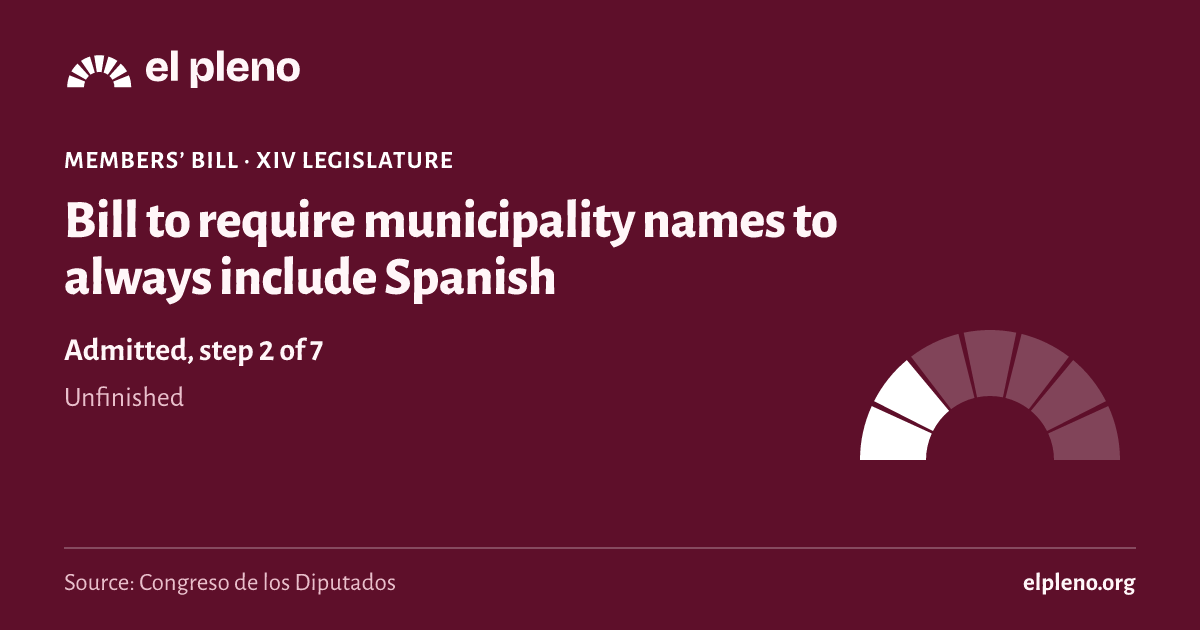
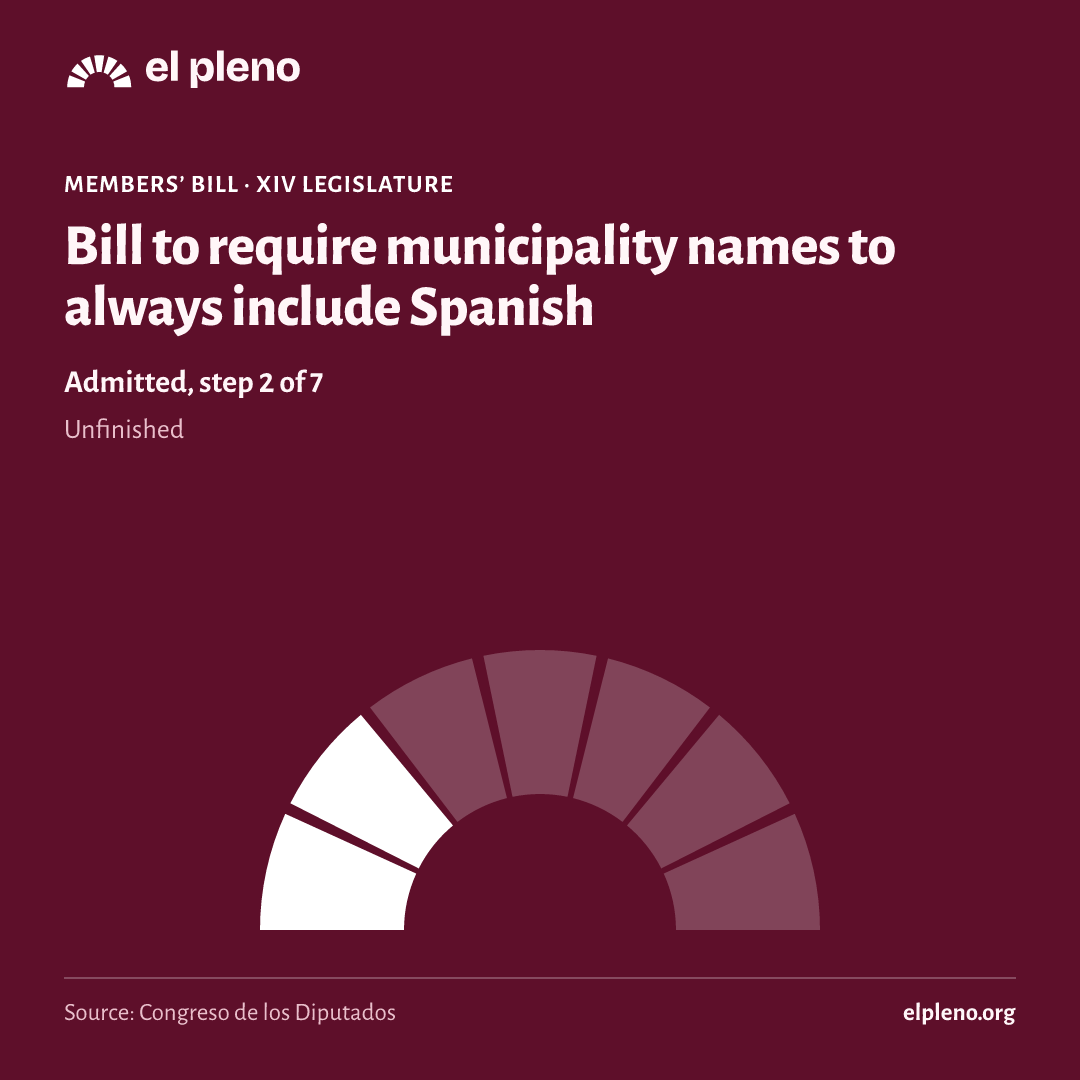
It took 2 of 7 steps. It reached Admitted, and today it is unfinished.
- Introduced31 January 2023Someone registers the text in the Congreso.
- Admitted7 February 2023The Bureau of the Congreso accepts it and, for a members’ bill, the plenary decides whether to consider it.
- Amendmentsnot reachedGroups propose changes.
- Committeenot reachedA committee goes through the text in detail.
- Plenarynot reachedAll 350 deputies vote.
- Senatenot reachedThe Senate can pass it, amend it or veto it.
- BOEnot reachedIt is published in the Official State Gazette (BOE) and comes into force.
See the 6 official steps on a timeline
Was there a plenary vote?
We have no plenary vote linked to this law in the Congreso’s data.
What happens next
What happens now?
The legislature ended before it finished. To go on, someone would have to introduce it again in the new Cortes.
It has not been presented again yet.
Sources
Where does all this come from?
- Congreso de los Diputados, file 122/000291
Official title, type, author, dates and stage.
Retrieved 11 November 2026
- The data comes from the open files of the Congreso, the Senate and the BOE, unaltered.
- Each deputy’s province is the one of their seat on the day of the vote.
- We only say “passed” or “rejected” when the majority needed is certain; otherwise we say which side had more votes.