What it is
Bill to require environmental review for wind and solar projects
It is a members’ bill. Introduced by parliamentary groups, the Senate, regional governments or citizens. It was introduced on 30 January 2023. Introduced by: Grupo Parlamentario Plural.
Official title: Private member's bill for the recovery of environmental guarantees and citizen participation in the processing of wind and photovoltaic projects.
Source: Congreso de los Diputados, file 122/000290· updated 11 Nov
Automatic summary, not yet reviewed
- The bill proposes to repeal the reforms in Royal Decree-Laws 6/2022, 11/2022 and 20/2022, which according to the text allow wind and solar projects to be installed without an Environmental Impact Statement and without public participation.
- It removes the articles that created the procedure called 'Informe de determinación de afección ambiental A document that replaced the Environmental Impact Statement under the royal decree-laws; it is based on paperwork submitted by the developer company itself, with no public consultation.' and the simplified authorization procedures, so that ordinary processing with environmental impact assessment comes back.
- Projects already under review would have to adapt to the environmental impact assessment procedures of Law 21/2013, although steps already taken that comply with that law could be kept.
- Projects that finished processing under the repealed rules would have to go through an extraordinary review to check whether they meet Law 21/2013, including a public participation step.
Who it affects
- Companies developing wind and solar projects: They would lose the fast-track processing and would have to go through ordinary environmental assessment.
- Neighbors and community groups affected by the installations: They would regain the right to take part and file comments on projects.
- Public administrations: They would have to review projects already approved under the repealed rules and process new ones under Law 21/2013.
Words worth knowing
- Declaración de Impacto Ambiental (Environmental Impact Statement)
- An official decision that analyzes whether a project harms the environment and under what conditions it can go ahead.
- Informe de determinación de afección ambiental
- A document that replaced the Environmental Impact Statement under the royal decree-laws; it is based on paperwork submitted by the developer company itself, with no public consultation.
- Alegaciones (comments or objections)
- Written comments through which any person or organization can object to a project while it is being processed.
- Proposición de ley (bill)
- A text in the form of a law introduced by parliamentary groups in the Congress of Deputies (Congreso de los Diputados); it still needs to be debated and passed before it takes effect.
It summarizes the text as it was introduced. It is written by artificial intelligence and may contain mistakes: the official text is what counts. Read the official text · How we make summaries
Where it stands
How far did it get?
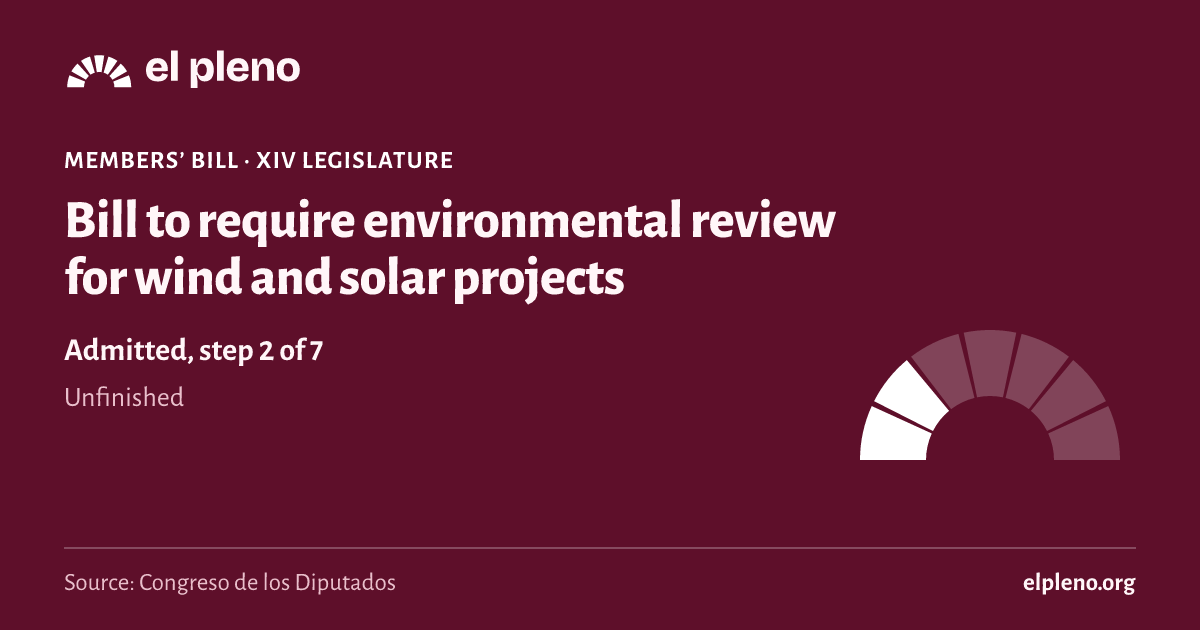
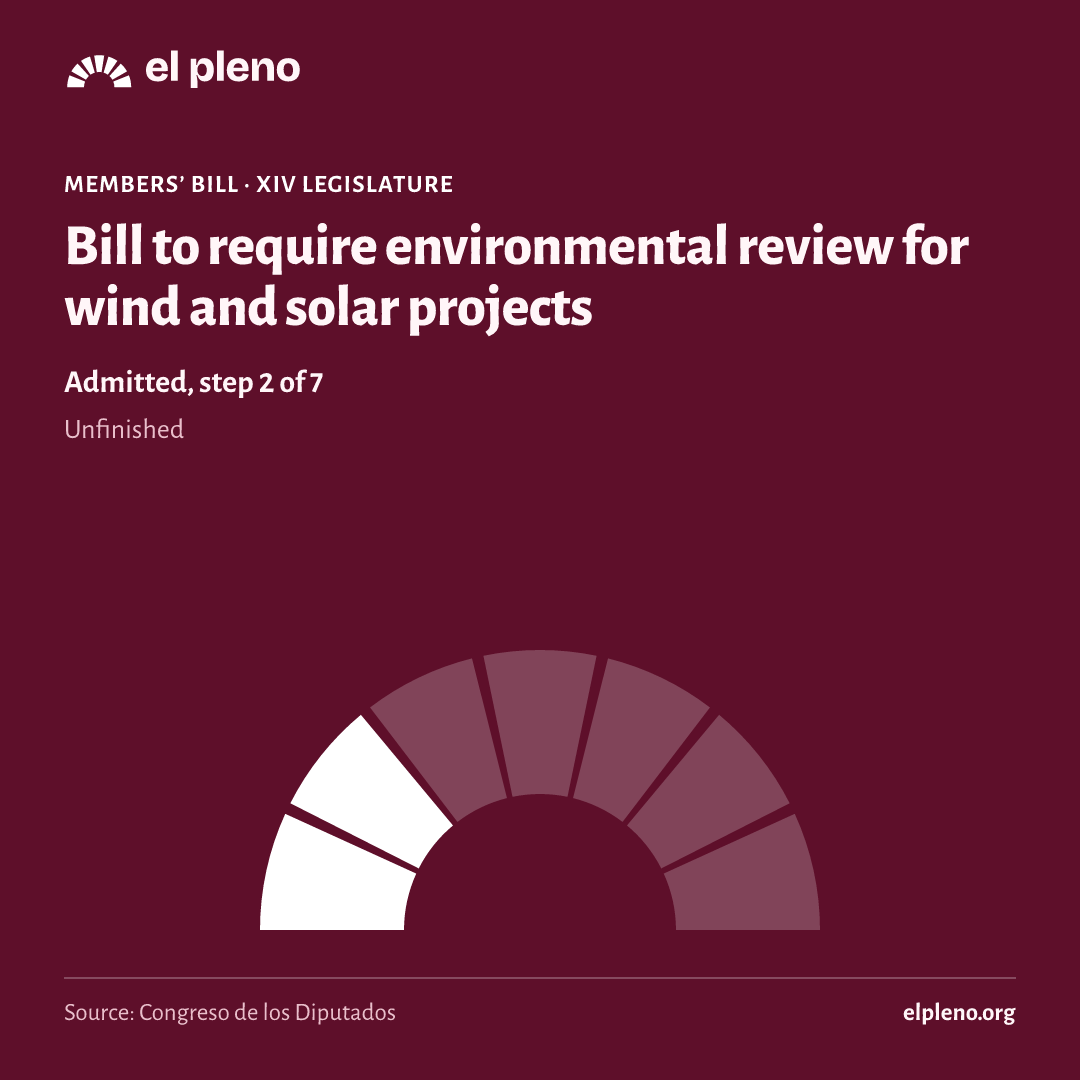
It took 2 of 7 steps. It reached Admitted, and today it is unfinished.
- Introduced30 January 2023Someone registers the text in the Congreso.
- Admitted7 February 2023The Bureau of the Congreso accepts it and, for a members’ bill, the plenary decides whether to consider it.
- Amendmentsnot reachedGroups propose changes.
- Committeenot reachedA committee goes through the text in detail.
- Plenarynot reachedAll 350 deputies vote.
- Senatenot reachedThe Senate can pass it, amend it or veto it.
- BOEnot reachedIt is published in the Official State Gazette (BOE) and comes into force.
See the 6 official steps on a timeline
Was there a plenary vote?
We have no plenary vote linked to this law in the Congreso’s data.
What happens next
What happens now?
The legislature ended before it finished. To go on, someone would have to introduce it again in the new Cortes.
It has not been presented again yet.
Sources
Where does all this come from?
- Congreso de los Diputados, file 122/000290
Official title, type, author, dates and stage.
Retrieved 11 November 2026
- The data comes from the open files of the Congreso, the Senate and the BOE, unaltered.
- Each deputy’s province is the one of their seat on the day of the vote.
- We only say “passed” or “rejected” when the majority needed is certain; otherwise we say which side had more votes.