What it is
Bill to speed up renewals of the Constitutional Court
It is a members’ bill. Introduced by parliamentary groups, the Senate, regional governments or citizens. It was introduced on 19 December 2022. Introduced by: Grupo Parlamentario Plural.
Official title: Private member's bill for an Organic Law amending Organic Law 2/1979, of 3 October, on the Constitutional Court.
Source: Congreso de los Diputados, file 122/000283· updated 11 Nov
Automatic summary, not yet reviewed
- The bill would remove the check the Constitutional Court itself performed on people already appointed as judges, because the appointing body already verifies those requirements.
- It would allow the Government or the General Council of the Judiciary to renew their two judges separately if the other body has not made its proposal three months after the scheduled date.
- It would reaffirm that the bodies appointing judges must check they meet the constitutional requirements, and would add failing to meet them as a ground for removal from office.
- Two transitional rules would clarify what happens with renewals already underway: pending appointments could go ahead without that verification, and the President of the General Council of the Judiciary would have to start the procedure within five working days if the deadline has already passed.
Who it affects
- The Constitutional Court (Tribunal Constitucional), which would lose the task of verifying the requirements of already appointed judges and could renew blocked seats.: Changes its appointment and removal procedures.
- The Government and the General Council of the Judiciary (Consejo General del Poder Judicial), which could appoint separately if the other is more than three months late.: New duty to check requirements and possible separate appointments.
- Political parties and parliamentary groups in the Congress of Deputies and the Senate, which the bill seeks to stop from blocking renewals.: Less room to delay appointments.
- Appointed judges, who could be removed if they do not meet the constitutional requirements.: New ground for removal.
Words worth knowing
- Tribunal Constitucional
- The body that guarantees that laws and acts of public authorities comply with the Spanish Constitution. It is not part of any of the three branches of the State.
- Ley Orgánica
- Organic law: a type of law reserved for major matters, such as how the Constitutional Court works. It needs a reinforced majority in the Congress to pass.
- Consejo General del Poder Judicial
- General Council of the Judiciary: the governing body of Spanish judges and courts. Half of its members are chosen by the Congress and half by the Senate.
- Voto particular
- Dissenting opinion: a written opinion by a judge who disagrees with the majority ruling.
- Proposición de ley
- A bill introduced by parliamentary groups to create or change a law. It is not an approved law until the full parliamentary process ends.
It summarizes the text as it was introduced. It is written by artificial intelligence and may contain mistakes: the official text is what counts. Read the official text · How we make summaries
Where it stands
How far did it get?
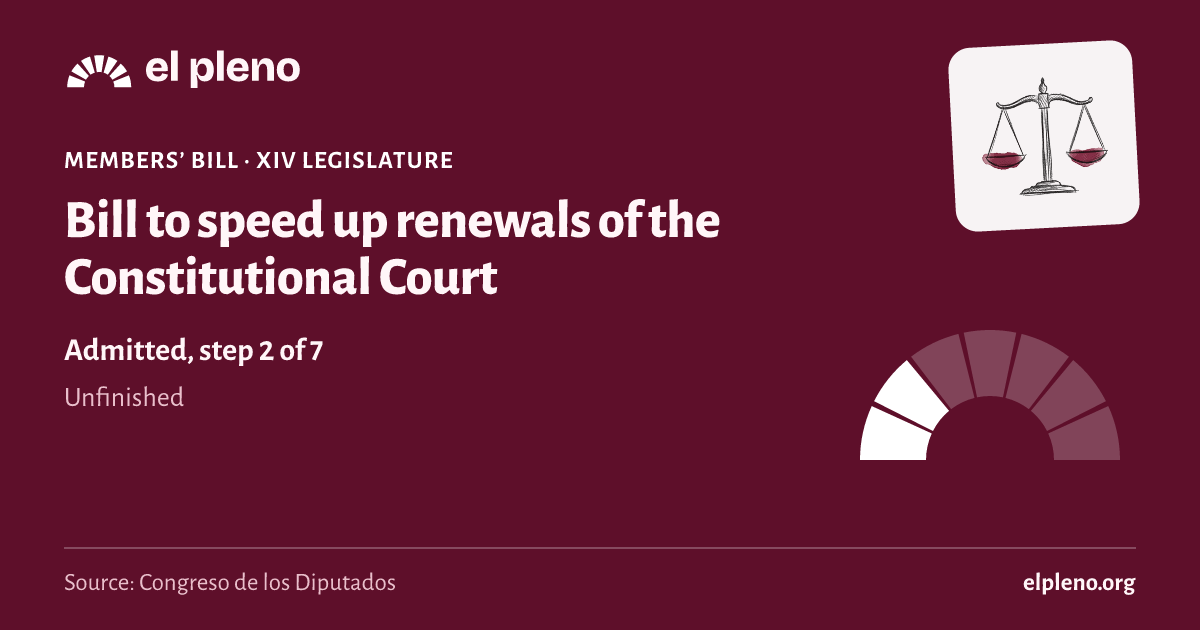
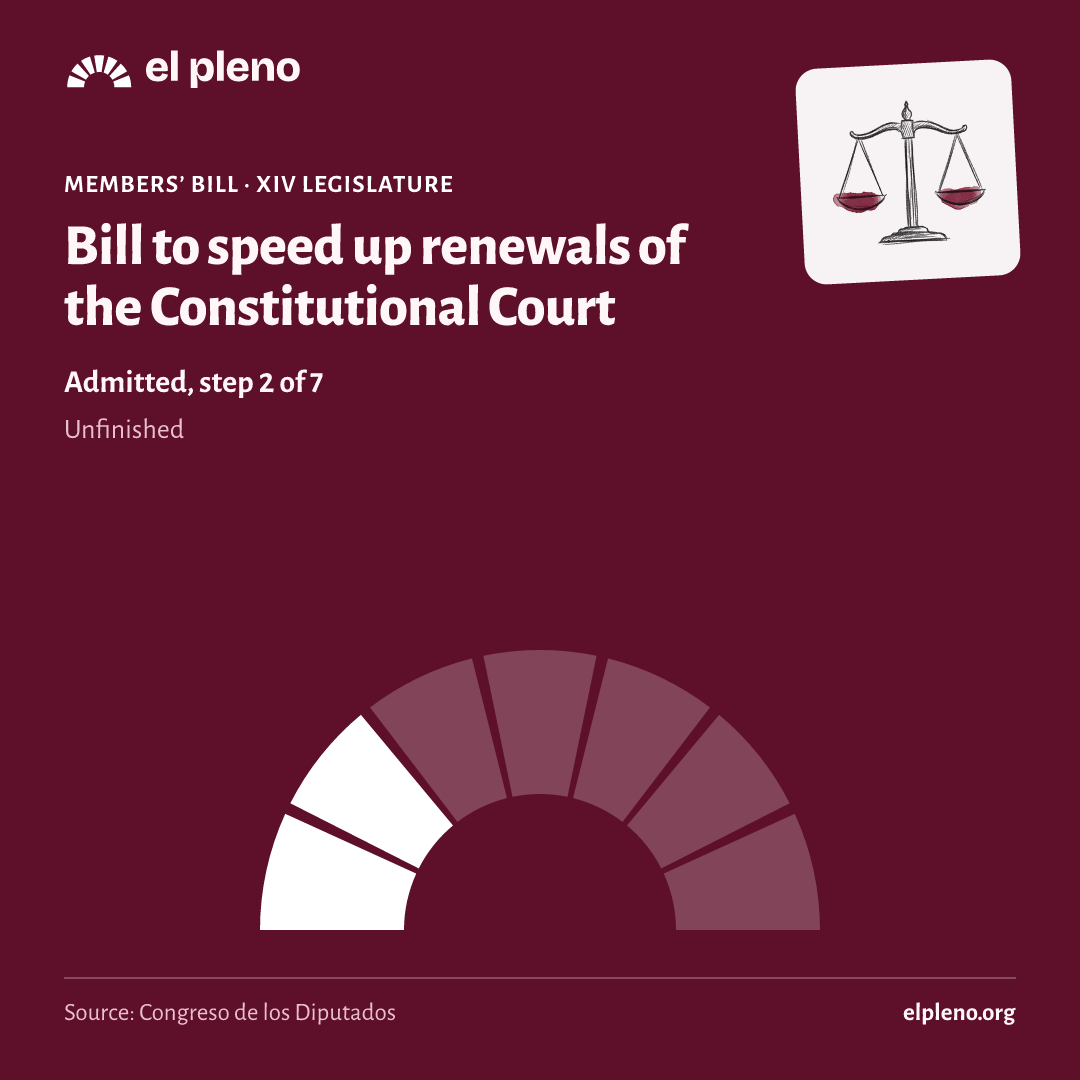
It took 2 of 7 steps. It reached Admitted, and today it is unfinished.
- Introduced19 December 2022Someone registers the text in the Congreso.
- Admitted24 January 2023The Bureau of the Congreso accepts it and, for a members’ bill, the plenary decides whether to consider it.
- Amendmentsnot reachedGroups propose changes.
- Committeenot reachedA committee goes through the text in detail.
- Plenarynot reachedAll 350 deputies vote.
- Senatenot reachedThe Senate can pass it, amend it or veto it.
- BOEnot reachedIt is published in the Official State Gazette (BOE) and comes into force.
See the 6 official steps on a timeline
Was there a plenary vote?
We have no plenary vote linked to this law in the Congreso’s data.
What happens next
What happens now?
The legislature ended before it finished. To go on, someone would have to introduce it again in the new Cortes.
It has not been presented again yet.
Sources
Where does all this come from?
- Congreso de los Diputados, file 122/000283
Official title, type, author, dates and stage.
Retrieved 11 November 2026
- The data comes from the open files of the Congreso, the Senate and the BOE, unaltered.
- Each deputy’s province is the one of their seat on the day of the vote.
- We only say “passed” or “rejected” when the majority needed is certain; otherwise we say which side had more votes.