What it is
Bill would again allow oil, gas and mineral extraction in Spain
It is a members’ bill. Introduced by parliamentary groups, the Senate, regional governments or citizens. It was introduced on 1 December 2022. Introduced by: Grupo Parlamentario VOX.
Official title: Private member's bill amending Law 7/2021, of 20 May, on climate change and energy transition, to include the concept of energy sovereignty and reverse the prohibition on the exploration, research and exploitation of Spain's own mineral and energy resources.
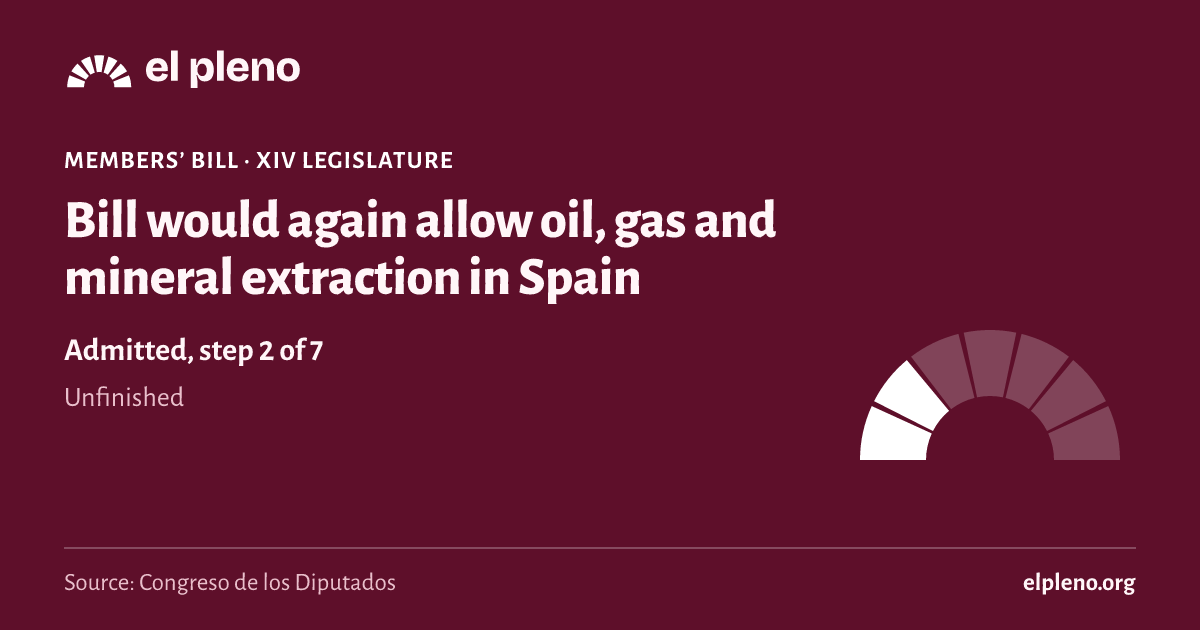
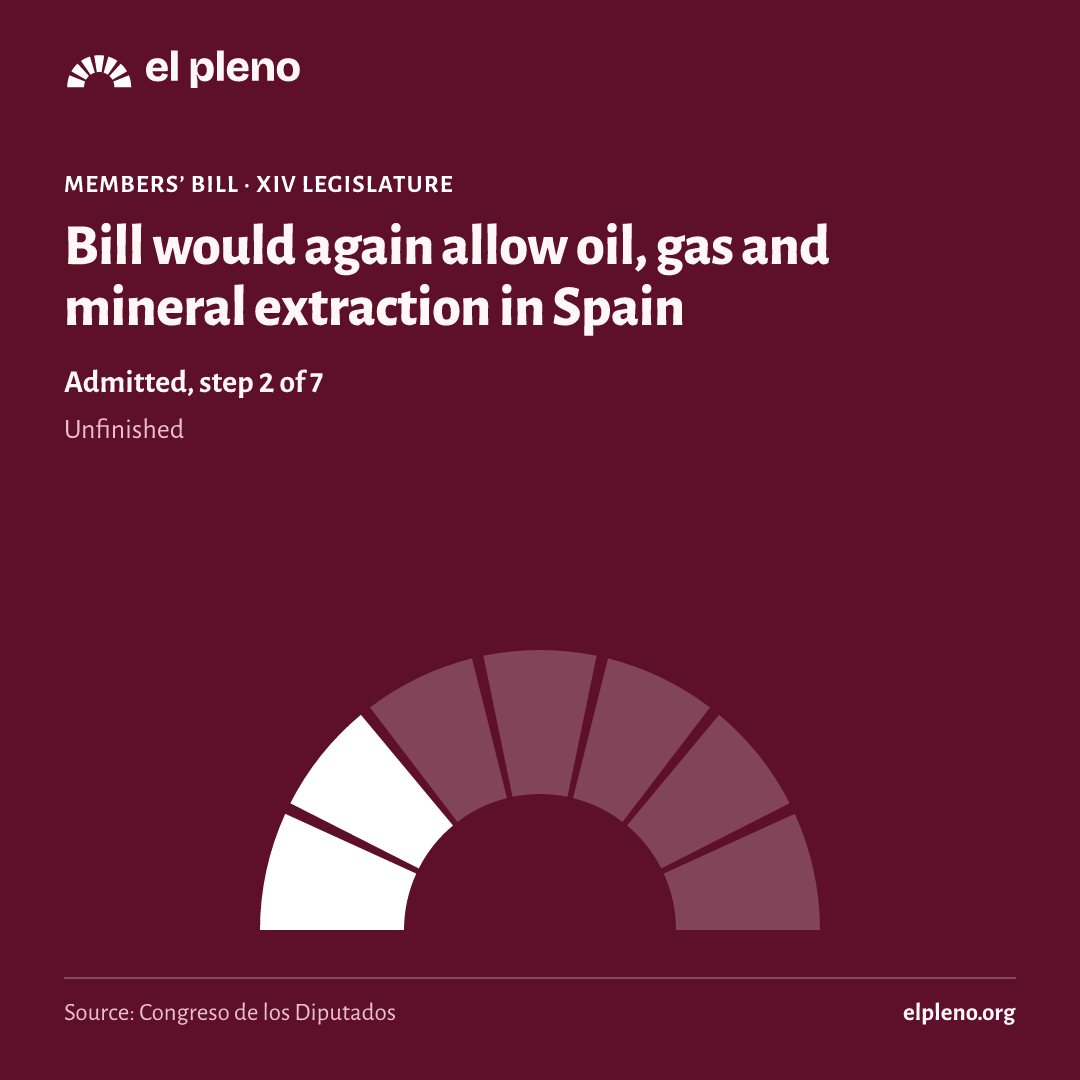
Source: Congreso de los Diputados, file 122/000279· updated 11 Nov
Automatic summary, not yet reviewed
- The bill, introduced by the VOX parliamentary group, would amend the climate change law so that its purpose becomes Spain's energy sovereignty, meaning producing more domestic energy and relying less on imports. It is not an approved law, only a text filed in Congress.
- It replaces the law's guiding principles with new ones, such as energy sovereignty, scientific rigor, protection of the natural environment and promotion of national industry.
- It removes the current bans on exploring and extracting hydrocarbons, radioactive minerals and coal. It also allows re-filing applications that were denied under those bans, including high-volume hydraulic fracturing activities.
- It requires the Government to send the Cortes, within three months, a tax reform bill that sharply cuts taxes on electricity and motor fuels.
- It deletes the specific greenhouse gas reduction targets and the low-emission mobility plans, and replaces the climate impact analysis of new rules with one based on scientific evidence and the national interest.
- The law would take effect the day after its publication in the Official State Gazette, and the Government could issue the rules needed to apply it.
Who it affects
- Energy and mining companies: They could again explore for and extract hydrocarbons, radioactive minerals and coal in Spain.
- Consumers: The bill seeks to lower electricity and fuel prices by cutting taxes.
- The Government: It would have to produce a tax reform within three months and issue implementing rules.
- Municipalities and regions: They would no longer be required to push low-emission mobility plans.
Words worth knowing
- Soberanía energética (energy sovereignty)
- A country's ability to secure the energy resources it needs on its own, reducing dependence on other countries.
- Hidrocarburos (hydrocarbons)
- Fuels such as oil and natural gas.
- Fracturación hidráulica (hydraulic fracturing)
- A technique to extract gas or oil by injecting water underground at high pressure, also known as fracking.
- Proposición de ley (bill)
- A text introduced by members of parliament to become a law. It is not an approved law yet.
It summarizes the text as it was introduced. It is written by artificial intelligence and may contain mistakes: the official text is what counts. Read the official text · How we make summaries
Where it stands
How far did it get?
It took 2 of 7 steps. It reached Admitted, and today it is unfinished.
- Introduced1 December 2022Someone registers the text in the Congreso.
- Admitted5 December 2022The Bureau of the Congreso accepts it and, for a members’ bill, the plenary decides whether to consider it.
- Amendmentsnot reachedGroups propose changes.
- Committeenot reachedA committee goes through the text in detail.
- Plenarynot reachedAll 350 deputies vote.
- Senatenot reachedThe Senate can pass it, amend it or veto it.
- BOEnot reachedIt is published in the Official State Gazette (BOE) and comes into force.
See the 7 official steps on a timeline
Was there a plenary vote?
We have no plenary vote linked to this law in the Congreso’s data.
What happens next
What happens now?
The legislature ended before it finished. To go on, someone would have to introduce it again in the new Cortes.
It has not been presented again yet.
Sources
Where does all this come from?
- Congreso de los Diputados, file 122/000279
Official title, type, author, dates and stage.
Retrieved 11 November 2026
- The data comes from the open files of the Congreso, the Senate and the BOE, unaltered.
- Each deputy’s province is the one of their seat on the day of the vote.
- We only say “passed” or “rejected” when the majority needed is certain; otherwise we say which side had more votes.