What it is
VOX bill would toughen penalties for attacks on Spain's national unity
It is a members’ bill. Introduced by parliamentary groups, the Senate, regional governments or citizens. It was introduced on 21 November 2022. Introduced by: Grupo Parlamentario VOX.
Official title: Private member's bill for an Organic Law amending Organic Law 10/1995, of 23 November, the Penal Code, for the protection of national unity.
Source: Congreso de los Diputados, file 122/000275· updated 11 Nov
Automatic summary, not yet reviewed
- The Bureau of the Congress of Deputies (Mesa del Congreso) admitted for processing this bill introduced by the VOX parliamentary group, which proposes amending the Criminal Code to protect national unity. It is not an approved law.
- The bill would add loss of non-original Spanish nationality as a new penalty restricting rights, applicable to naturalized foreigners convicted of the new crimes against the unity of the Nation or of offenses against Spain.
- The bill would create a new crime against the unity of the Nation: a public authority or official who collaborates with, favors, promotes or tolerates acts against the unity or territorial integrity of Spain or that facilitate the independence of part of the country would face prison terms of ten to twenty years, increased if the offenders are officials of the Government of Spain or of regional governments, and even more if the offender is the Prime Minister or there is cooperation with foreign governments.
- The bill would toughen the crime of insults or offenses against Spain or its symbols: if committed to support terrorism, alter the constitutional order or promote the independence of part of the territory, the current fine would become one to two years in prison, with an aggravating factor if committed by government officials.
- The bill would increase the penalties for treason and crimes against the independence of the State when the offenders are the Prime Minister, deputy prime ministers or ministers of the Government of Spain, or members of regional government councils.
- The law would apply to crimes completed after it takes effect, even if some of the conduct began earlier, and it would enter into force the day after its publication in the Official State Gazette (Boletín Oficial del Estado).
Who it affects
- Public authorities, officials and officeholders who act against the unity of Spain or tolerate such acts: They could face prison terms of ten to twenty years, increased if they are presidents, vice presidents, ministers or members of regional government councils.
- The Prime Minister of Spain: The bill provides the harshest penalty for this office: the penalty raised two levels for the new crimes against the unity of the Nation.
- Foreigners naturalized as Spanish citizens convicted of these crimes: They could lose their Spanish nationality in addition to serving the sentence.
- People who insult or offend Spain or its symbols to support terrorism, alter the constitutional order or promote the independence of part of the territory: The current fine would become one to two years in prison.
Words worth knowing
- Ley orgánica (organic law)
- A type of Spanish law reserved for major matters, such as the Criminal Code, which requires a special vote in Congress.
- Proposición de ley (parliamentary bill)
- A text through which a parliamentary group proposes a law. It is not yet a law: it must go through several steps and votes.
- Pena privativa de derechos (penalty restricting rights)
- A penalty that removes or limits rights of the convicted person, such as holding public office or driving.
- Pena superior en grado (penalty raised one level)
- An increase of the provided penalty one or two steps beyond its maximum, under Criminal Code rules.
- Ultraje (insult or outrage)
- A serious offense or insult, in this case against Spain or its symbols, such as the flag or the anthem.
It summarizes the text as it was introduced. It is written by artificial intelligence and may contain mistakes: the official text is what counts. Read the official text · How we make summaries
Where it stands
How far did it get?
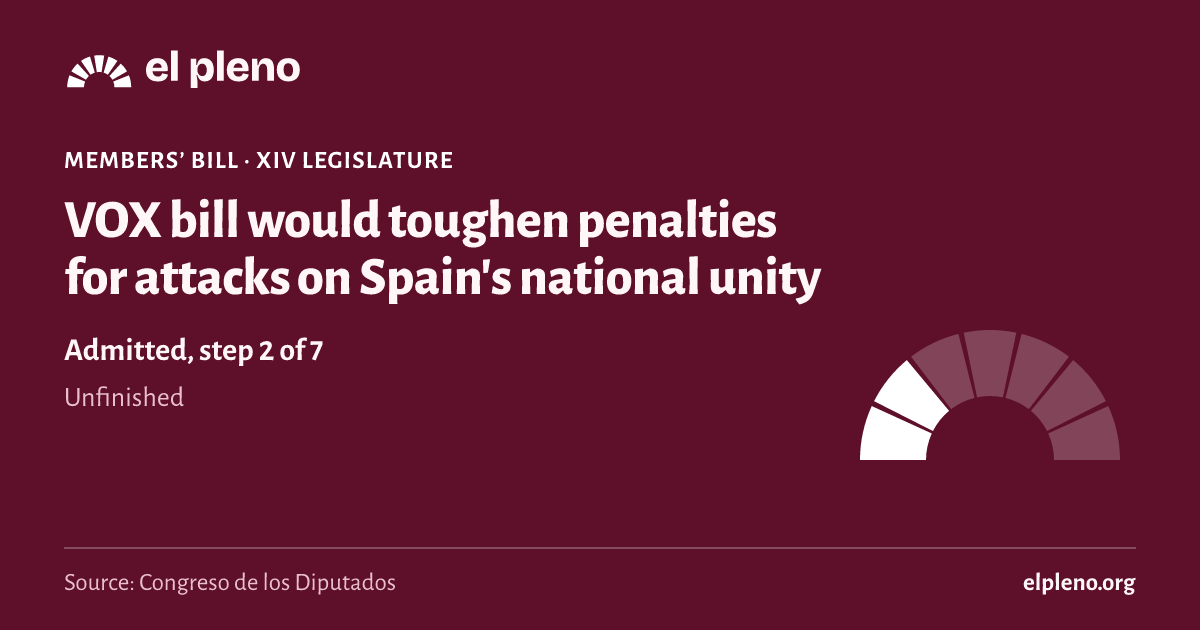
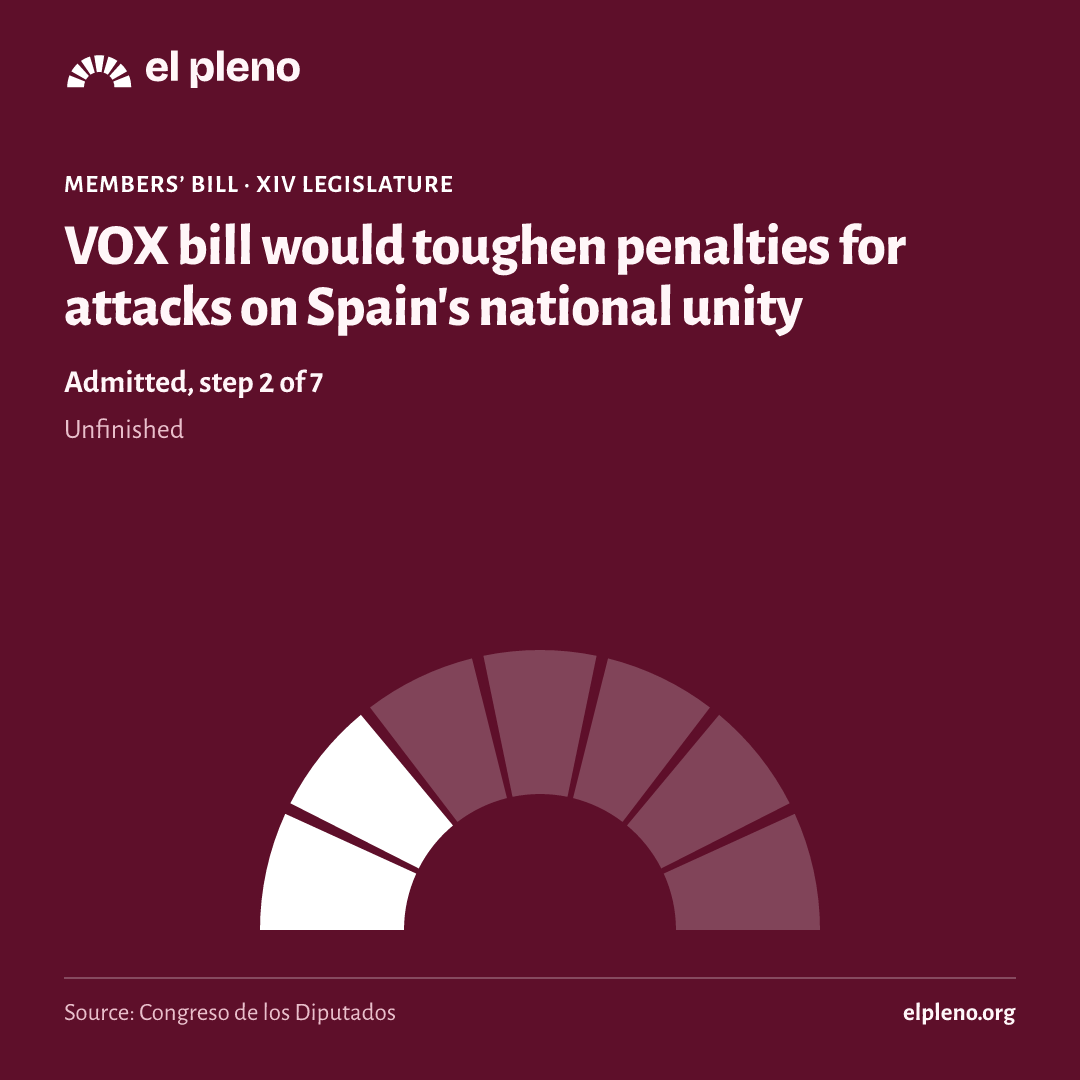
It took 2 of 7 steps. It reached Admitted, and today it is unfinished.
- Introduced21 November 2022Someone registers the text in the Congreso.
- Admitted29 November 2022The Bureau of the Congreso accepts it and, for a members’ bill, the plenary decides whether to consider it.
- Amendmentsnot reachedGroups propose changes.
- Committeenot reachedA committee goes through the text in detail.
- Plenarynot reachedAll 350 deputies vote.
- Senatenot reachedThe Senate can pass it, amend it or veto it.
- BOEnot reachedIt is published in the Official State Gazette (BOE) and comes into force.
See the 6 official steps on a timeline
Was there a plenary vote?
We have no plenary vote linked to this law in the Congreso’s data.
What happens next
What happens now?
The legislature ended before it finished. To go on, someone would have to introduce it again in the new Cortes.
It has not been presented again yet.
Sources
Where does all this come from?
- Congreso de los Diputados, file 122/000275
Official title, type, author, dates and stage.
Retrieved 11 November 2026
- The data comes from the open files of the Congreso, the Senate and the BOE, unaltered.
- Each deputy’s province is the one of their seat on the day of the vote.
- We only say “passed” or “rejected” when the majority needed is certain; otherwise we say which side had more votes.