What it is
Proposal to reform Spain's electoral law: seats, Senate and debates
It is a members’ bill. Introduced by parliamentary groups, the Senate, regional governments or citizens. It was introduced on 31 October 2022. Introduced by: Grupo Parlamentario Ciudadanos.
Official title: Private member's bill for an Organic Law amending Organic Law 5/1985, of 19 June, on the General Electoral System.
Source: Congreso de los Diputados, file 122/000265· updated 11 Nov
Automatic summary, not yet reviewed
- The bill would make the distribution of Congress seats more proportional: it reduces the base number of seats assigned to each province and switches to a largest-remainder seat allocation formula, so votes count more equally.
- It would change Senate elections: each province would be split into four districts, each electing one senator, using the single transferable vote, where voters rank candidates and the lowest-ranked are eliminated until someone wins more than half the votes.
- It proposes that provincial council (diputación) members be elected by universal, direct suffrage, with a separate ballot box in municipal elections, instead of the current indirect system where councilors choose them.
- It would require at least two televised debates among the parties during the campaign, on the public broadcaster, which must share the signal with anyone who requests it. It would also let parties ask AIReF Independent Authority for Fiscal Responsibility, a public body that monitors public finances and assesses their sustainability., the independent fiscal authority, to assess the effect of their platforms on the public deficit and debt.
- It strengthens polling rules: polls must publish their technical details and their clients, publishing them is banned in the two days before the vote, and fines and prison sentences are increased for falsifying polls or knowingly spreading fake ones.
- It sets that elections triggered by the end of a legislature's term would by default be held on the sixth Sunday after the term expires, with automatic adjustments if that falls at Christmas or Easter, and creates prison sentences for anyone blocking the issuance or publication of the election call decree.
Who it affects
- Political parties and candidates: They would have to adapt to new districts, candidate lists with balanced numbers of women and men, mandatory debates, and stricter rules on polls and spending.
- Voters: Senate ballots would change (voters rank candidates by preference), and provincial council members would be elected directly.
- Provincial councils (diputaciones provinciales): Their members would be elected by direct popular vote, and their elections would be state-funded.
- Media outlets and polling companies: They would face more transparency duties and higher fines and penalties for breaking polling rules.
- Government officials and public officeholders: They could face prison terms if they block the calling or publication of elections due to the end of a legislature's term.
Words worth knowing
- Circunscripción electoral (electoral district)
- A territory, such as a province, whose votes are used to allocate the seats for that territory.
- Voto único transferible (single transferable vote)
- A system where voters rank candidates by preference, and votes from eliminated candidates transfer to the next choices until all seats are filled.
- Fórmula de restos mayores (largest remainder formula)
- A seat allocation method where leftover seats go to the parties with the largest remainders in the calculation, making results closer to vote shares.
- AIReF
- Independent Authority for Fiscal Responsibility, a public body that monitors public finances and assesses their sustainability.
- Silencio demoscópico (polling blackout)
- The ban on publishing polls in the days right before a vote.
It summarizes the text as it was introduced. It is written by artificial intelligence and may contain mistakes: the official text is what counts. Read the official text · How we make summaries
Where it stands
How far did it get?
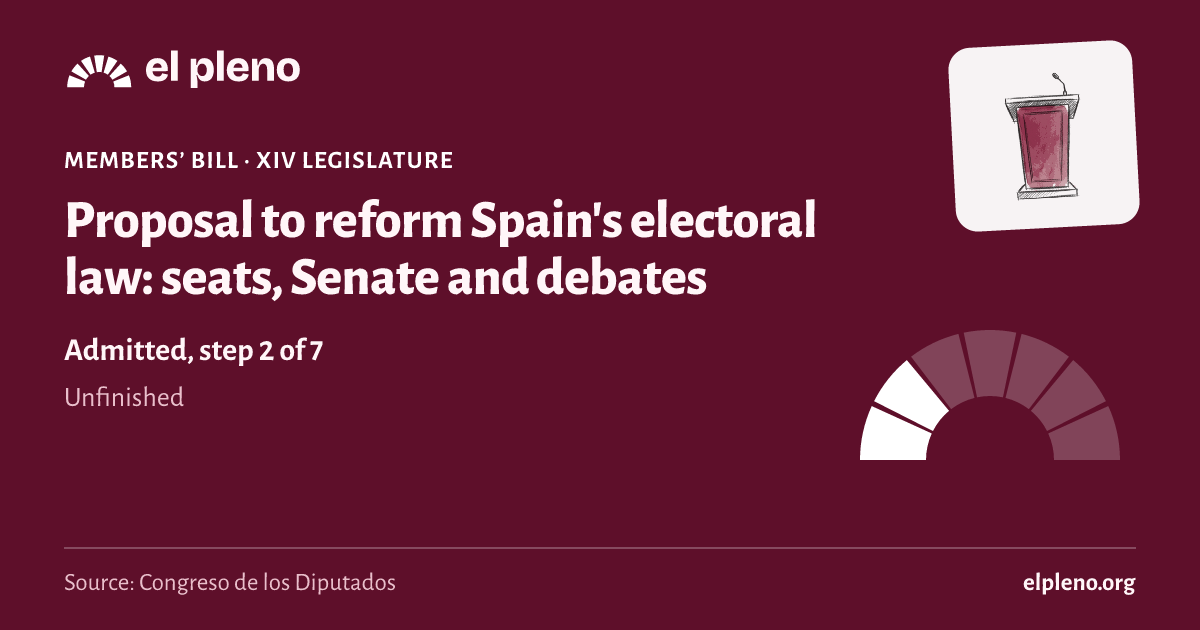
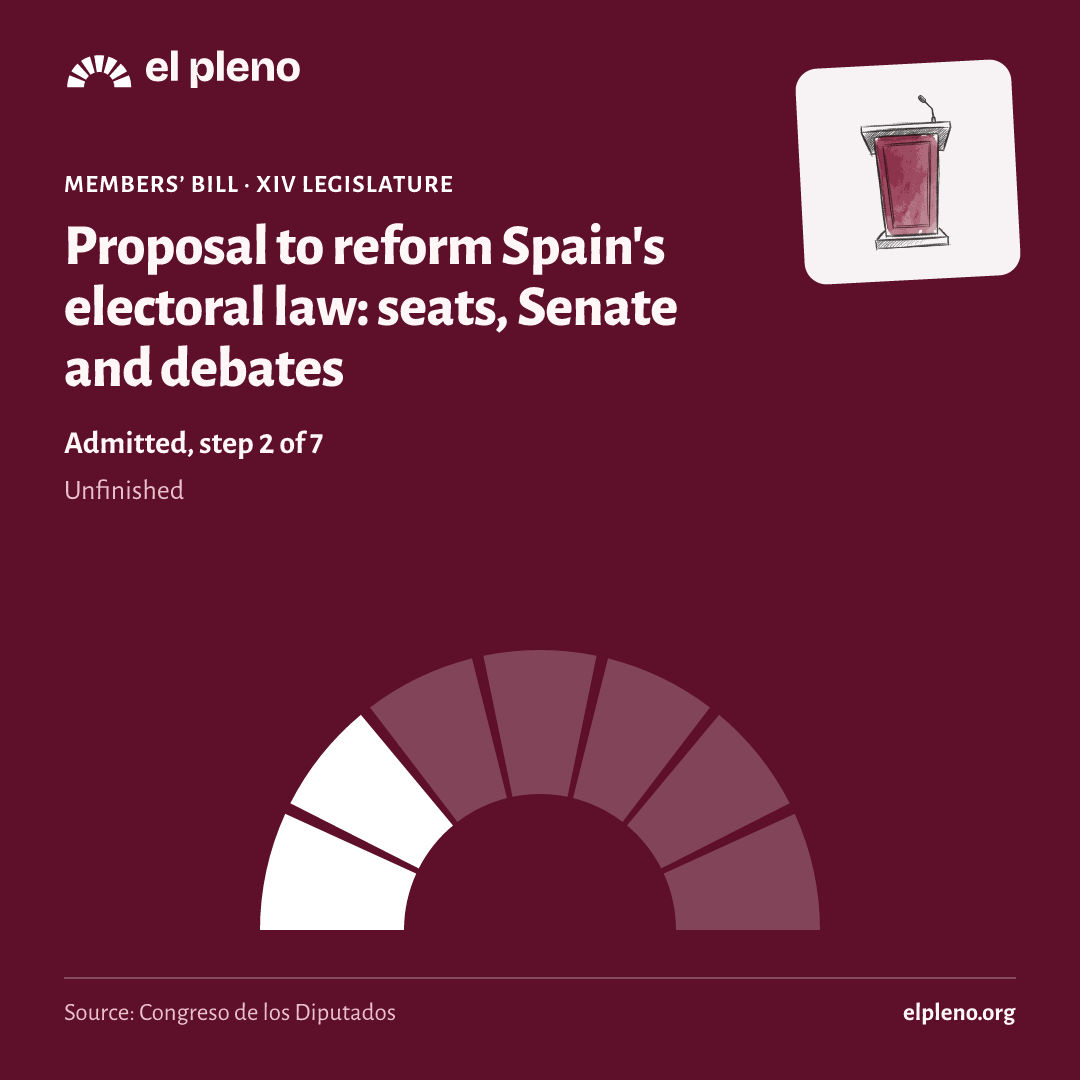
It took 2 of 7 steps. It reached Admitted, and today it is unfinished.
- Introduced31 October 2022Someone registers the text in the Congreso.
- Admitted14 November 2022The Bureau of the Congreso accepts it and, for a members’ bill, the plenary decides whether to consider it.
- Amendmentsnot reachedGroups propose changes.
- Committeenot reachedA committee goes through the text in detail.
- Plenarynot reachedAll 350 deputies vote.
- Senatenot reachedThe Senate can pass it, amend it or veto it.
- BOEnot reachedIt is published in the Official State Gazette (BOE) and comes into force.
See the 6 official steps on a timeline
Was there a plenary vote?
We have no plenary vote linked to this law in the Congreso’s data.
What happens next
What happens now?
The legislature ended before it finished. To go on, someone would have to introduce it again in the new Cortes.
It has not been presented again yet.
Presented before in:
- XII Legislature, Congreso de los Diputados· Unfinished Proposal to bar fugitives from justice from running in elections
Sources
Where does all this come from?
- Congreso de los Diputados, file 122/000265
Official title, type, author, dates and stage.
Retrieved 11 November 2026
- The data comes from the open files of the Congreso, the Senate and the BOE, unaltered.
- Each deputy’s province is the one of their seat on the day of the vote.
- We only say “passed” or “rejected” when the majority needed is certain; otherwise we say which side had more votes.