What it is
Bill to cut VAT on first home purchases to 4%
It is a members’ bill. Introduced by parliamentary groups, the Senate, regional governments or citizens. It was introduced on 13 October 2022. Introduced by: Grupo Parlamentario VOX.
Official title: Private member's bill amending Law 37/1992, of 28 December, on Value Added Tax, to facilitate access to the purchase of a first home.
Source: Congreso de los Diputados, file 122/000260· updated 11 Nov
Automatic summary, not yet reviewed
- The bill would apply the reduced 4% VAT rate to the purchase of a property that an individual buys to use as their first habitual home. The general rate has been 10% since 2013.
- The 4% rate would also cover annexes sold together with the home, such as garage spaces, with a maximum of two units.
- The law would take effect on January 1 of the year after its approval, so its budgetary impact would apply to the following fiscal year.
- The Government and the Ministry in charge of Finance could issue the regulatory rules needed to implement the law, in particular by amending Royal Decree 1624/1992.
Who it affects
- Individuals buying their first habitual home: They would pay 4% VAT instead of the current 10%.
- Buyers who purchase a garage space or annex with the home: The annex would also get the 4% rate, with a maximum of two garage spaces.
- The Government and the Finance Ministry: They would be empowered to issue the rules implementing the law.
Words worth knowing
- IVA
- Impuesto sobre el Valor Añadido: Spain's value added tax (VAT), a percentage added to the price of many goods and services.
- Tipo reducido
- Reduced rate: a lower VAT percentage applied to certain goods to make them cheaper.
- Proposición de ley
- A bill: a text introduced by members of Congress to create or change a law. It is not law until passed.
- Vivienda de protección oficial
- Officially protected housing: homes with publicly regulated prices, intended for people with fewer resources.
It summarizes the text as it was introduced. It is written by artificial intelligence and may contain mistakes: the official text is what counts. Read the official text · How we make summaries
Where it stands
How far did it get?
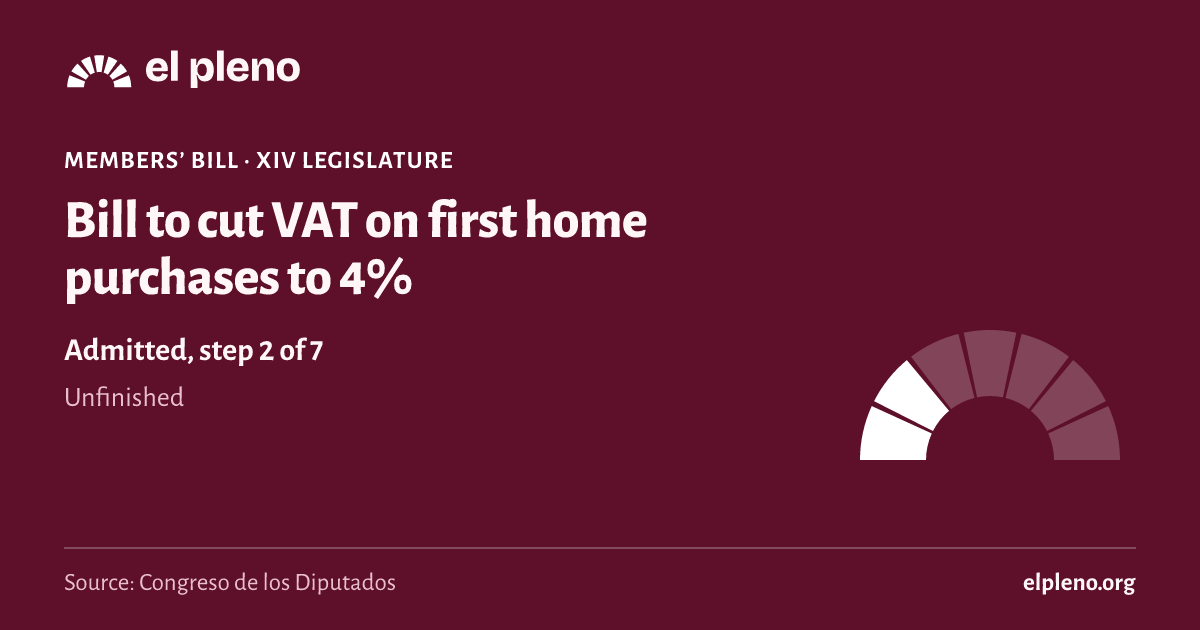
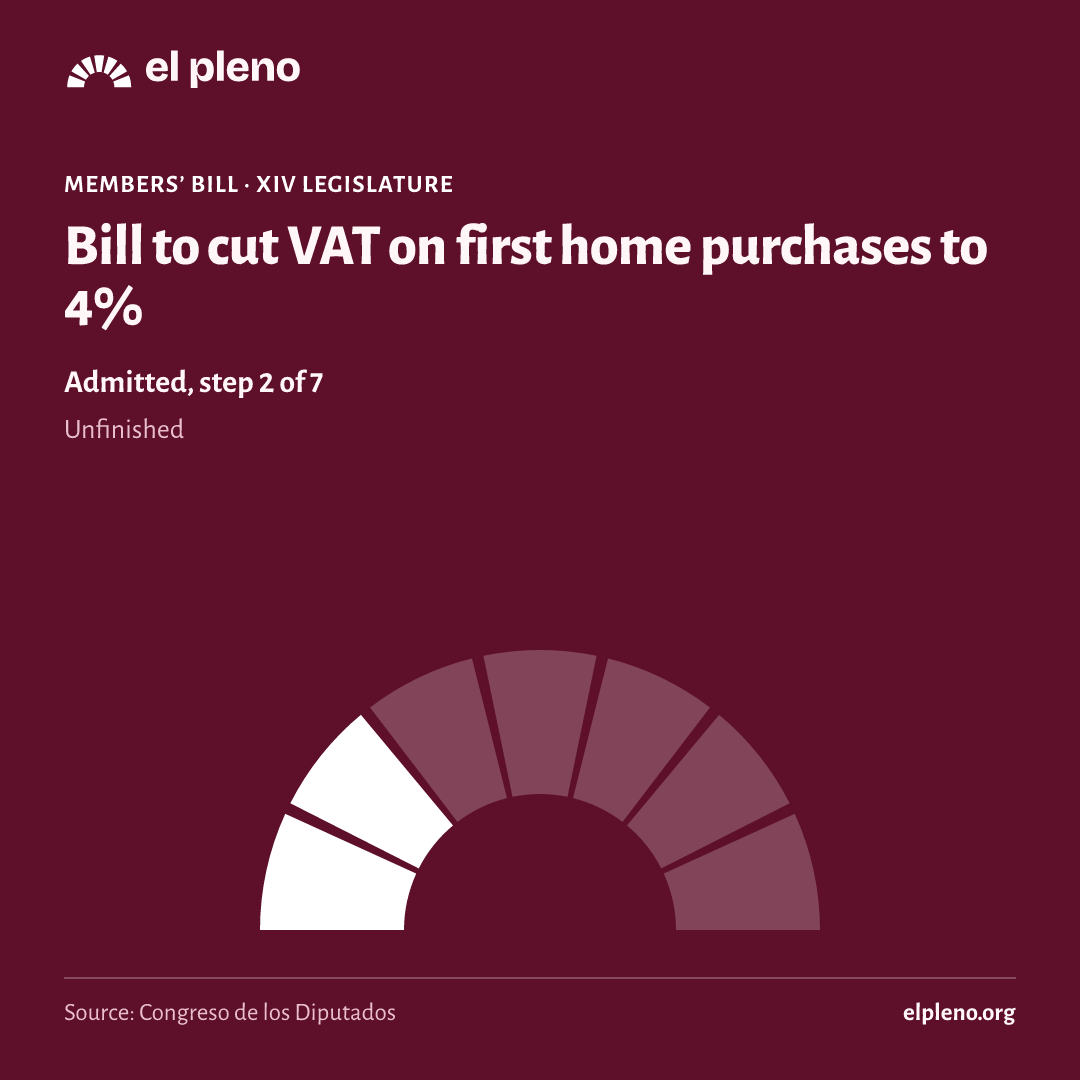
It took 2 of 7 steps. It reached Admitted, and today it is unfinished.
- Introduced13 October 2022Someone registers the text in the Congreso.
- Admitted18 October 2022The Bureau of the Congreso accepts it and, for a members’ bill, the plenary decides whether to consider it.
- Amendmentsnot reachedGroups propose changes.
- Committeenot reachedA committee goes through the text in detail.
- Plenarynot reachedAll 350 deputies vote.
- Senatenot reachedThe Senate can pass it, amend it or veto it.
- BOEnot reachedIt is published in the Official State Gazette (BOE) and comes into force.
See the 6 official steps on a timeline
Was there a plenary vote?
We have no plenary vote linked to this law in the Congreso’s data.
What happens next
What happens now?
The legislature ended before it finished. To go on, someone would have to introduce it again in the new Cortes.
It has not been presented again yet.
Sources
Where does all this come from?
- Congreso de los Diputados, file 122/000260
Official title, type, author, dates and stage.
Retrieved 11 November 2026
- The data comes from the open files of the Congreso, the Senate and the BOE, unaltered.
- Each deputy’s province is the one of their seat on the day of the vote.
- We only say “passed” or “rejected” when the majority needed is certain; otherwise we say which side had more votes.