What it is
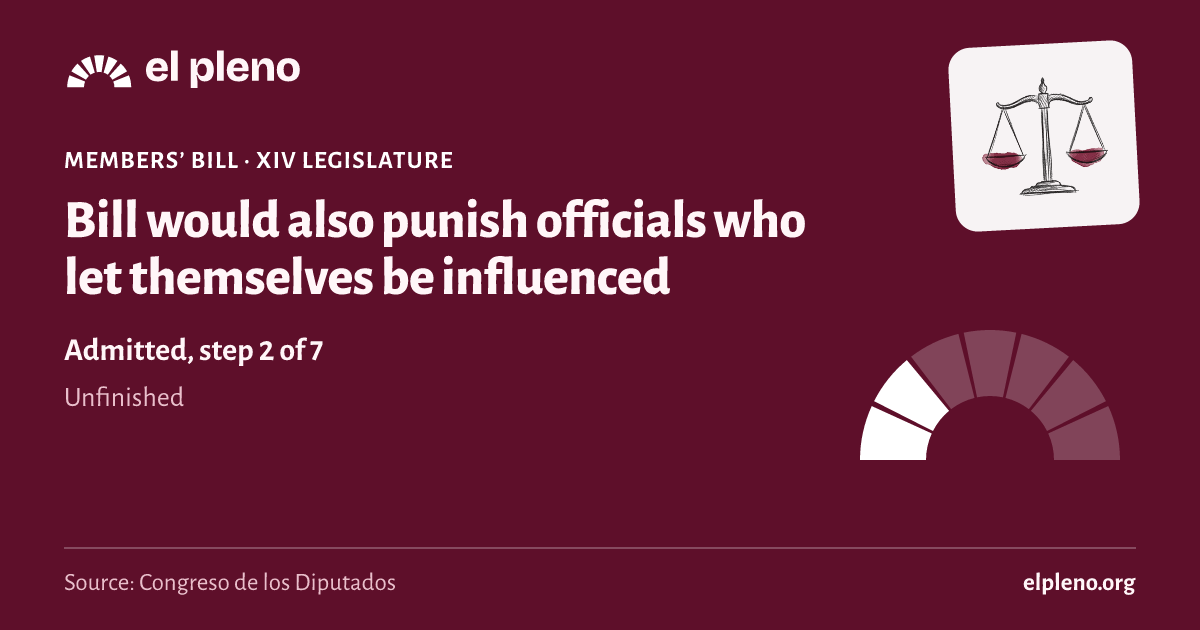
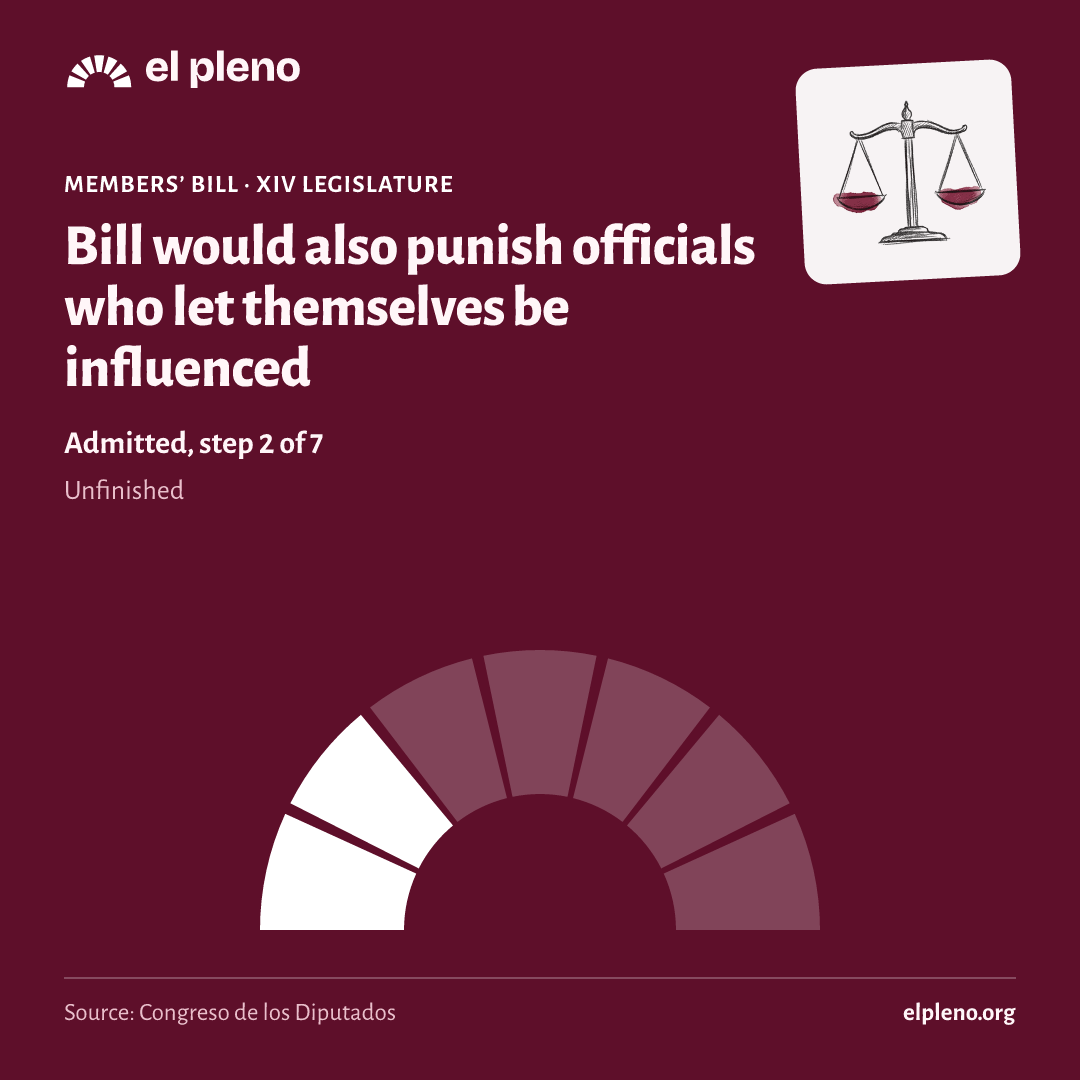
Bill would also punish officials who let themselves be influenced
It is a members’ bill. Introduced by parliamentary groups, the Senate, regional governments or citizens. It was introduced on 27 May 2022. Introduced by: Grupo Parlamentario Ciudadanos.
Official title: Private member's bill for the amendment of the offense of influence peddling in Organic Law 10/1995, of 23 November, the Penal Code (Organic).
Source: Congreso de los Diputados, file 122/000230· updated 11 Nov
Automatic summary, not yet reviewed
- The bill would amend Article 428 to punish a public official or authority who influences another official to obtain an act contrary to their duties, or to delay or speed it up, when it could produce an economic benefit. Penalties would rise to six months to two years in prison, a fine and disqualification.
- The new Article 428 would add a second section punishing, with the same penalties, the official or authority who lets themselves be influenced and agrees to those actions or omissions. Until now, only the influencer could be punished.
- The bill would amend Article 429 so that a private individual who influences an official would face six months to two years in prison, a fine, and a ban on contracting with the public sector and on receiving subsidies or tax benefits for six to ten years.
Who it affects
- Public officials and authorities who influence others or let themselves be influenced: They could face prison, fines and disqualification.
- Private individuals who influence officials: They could be punished with prison, fines and bans on contracting or receiving public aid.
- People who contract with the public sector or apply for subsidies: If they influence officials criminally, they could lose the ability to contract or receive aid for years.
Words worth knowing
- Tráfico de influencias (influence peddling)
- The crime of using a personal relationship or position to influence an official and obtain a favor or benefit.
- Inhabilitación especial (special disqualification)
- A penalty that bars someone from holding a public job or office for a period of time.
- Sufragio pasivo (passive suffrage)
- The right to run as a candidate in elections.
- Multa del tanto al duplo (fine of one to two times)
- A fine ranging from an amount equal to the benefit sought or obtained up to twice that amount.
It summarizes the text as it was introduced. It is written by artificial intelligence and may contain mistakes: the official text is what counts. Read the official text · How we make summaries
Where it stands
How far did it get?
It took 2 of 7 steps. It reached Admitted, and today it is unfinished.
- Introduced27 May 2022Someone registers the text in the Congreso.
- Admitted7 June 2022The Bureau of the Congreso accepts it and, for a members’ bill, the plenary decides whether to consider it.
- Amendmentsnot reachedGroups propose changes.
- Committeenot reachedA committee goes through the text in detail.
- Plenarynot reachedAll 350 deputies vote.
- Senatenot reachedThe Senate can pass it, amend it or veto it.
- BOEnot reachedIt is published in the Official State Gazette (BOE) and comes into force.
See the 6 official steps on a timeline
Was there a plenary vote?
We have no plenary vote linked to this law in the Congreso’s data.
What happens next
What happens now?
The legislature ended before it finished. To go on, someone would have to introduce it again in the new Cortes.
It has not been presented again yet.
Sources
Where does all this come from?
- Congreso de los Diputados, file 122/000230
Official title, type, author, dates and stage.
Retrieved 11 November 2026
- The data comes from the open files of the Congreso, the Senate and the BOE, unaltered.
- Each deputy’s province is the one of their seat on the day of the vote.
- We only say “passed” or “rejected” when the majority needed is certain; otherwise we say which side had more votes.