What it is
Bill to let state-funded private schools become public schools
It is a members’ bill. Introduced by parliamentary groups, the Senate, regional governments or citizens. It was introduced on 20 April 2022. Introduced by: Grupo Parlamentario Confederal de Unidas Podemos-En Comú Podem-Galicia en Común.
Official title: Private member's bill regulating the process of voluntary integration of certain private educational centers into the public network of educational centers.
Source: Congreso de los Diputados, file 122/000218· updated 11 Nov
Automatic summary, not yet reviewed
- The bill would allow state-funded private schools (concertados) offering preschool, primary and secondary education to voluntarily join the public school network, through an agreement between the Ministry of Education, the regional government, the local council and the school's owner.
- The process would start with a request from the school's owner, approved by the school council, along with documents about the building, the school's finances, its students and its staff. A commission made up of the administrations, workers and the school council would decide whether the request moves forward.
- Once approved, a timeline would be set and an individual agreement signed. While the school becomes public, the building would be purchased or rented, and the school would operate under the agreement until it gains public ownership.
- Staff would keep their jobs, and the workforce would have up to five years to adapt to public school rules. Teachers would have to apply for entry into the civil service teaching corps within that same period.
Who it affects
- Owners of state-funded private schools: They could voluntarily request that their schools join the public network.
- Families and students at those schools: Their schools could become public, with families taking part in the process.
- Teachers and administrative and service staff: They would not lose their jobs and would have five years to adapt to public sector rules.
- Ministry of Education, regional governments and local councils: They would take part in the agreements, take on buildings and hold calls at least every five years.
Words worth knowing
- Centro concertado
- A privately owned school funded with public money through an agreement called a 'concierto educativo'.
- Consejo Escolar
- The school council, a body where families, teachers and other representatives take part.
- Convenio
- An agreement signed by several administrations and the school's owner to carry out the integration.
- Cuerpo de funcionarios docentes
- The civil service corps of public school teachers, which is entered through a public call.
It summarizes the text as it was introduced. It is written by artificial intelligence and may contain mistakes: the official text is what counts. Read the official text · How we make summaries
Where it stands
How far did it get?
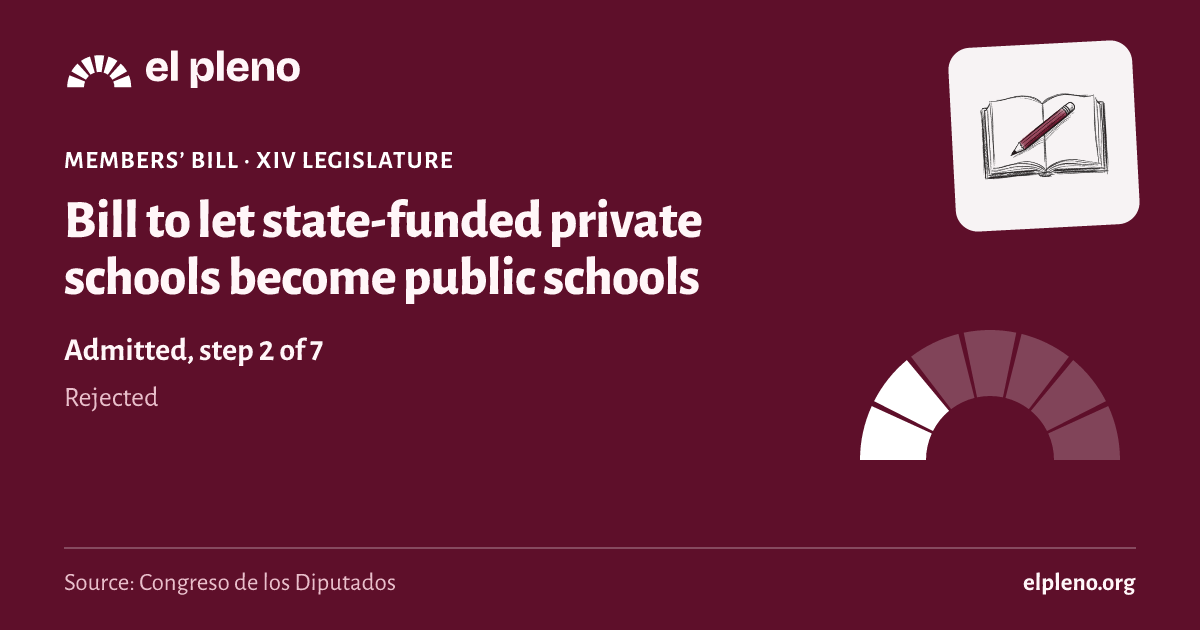
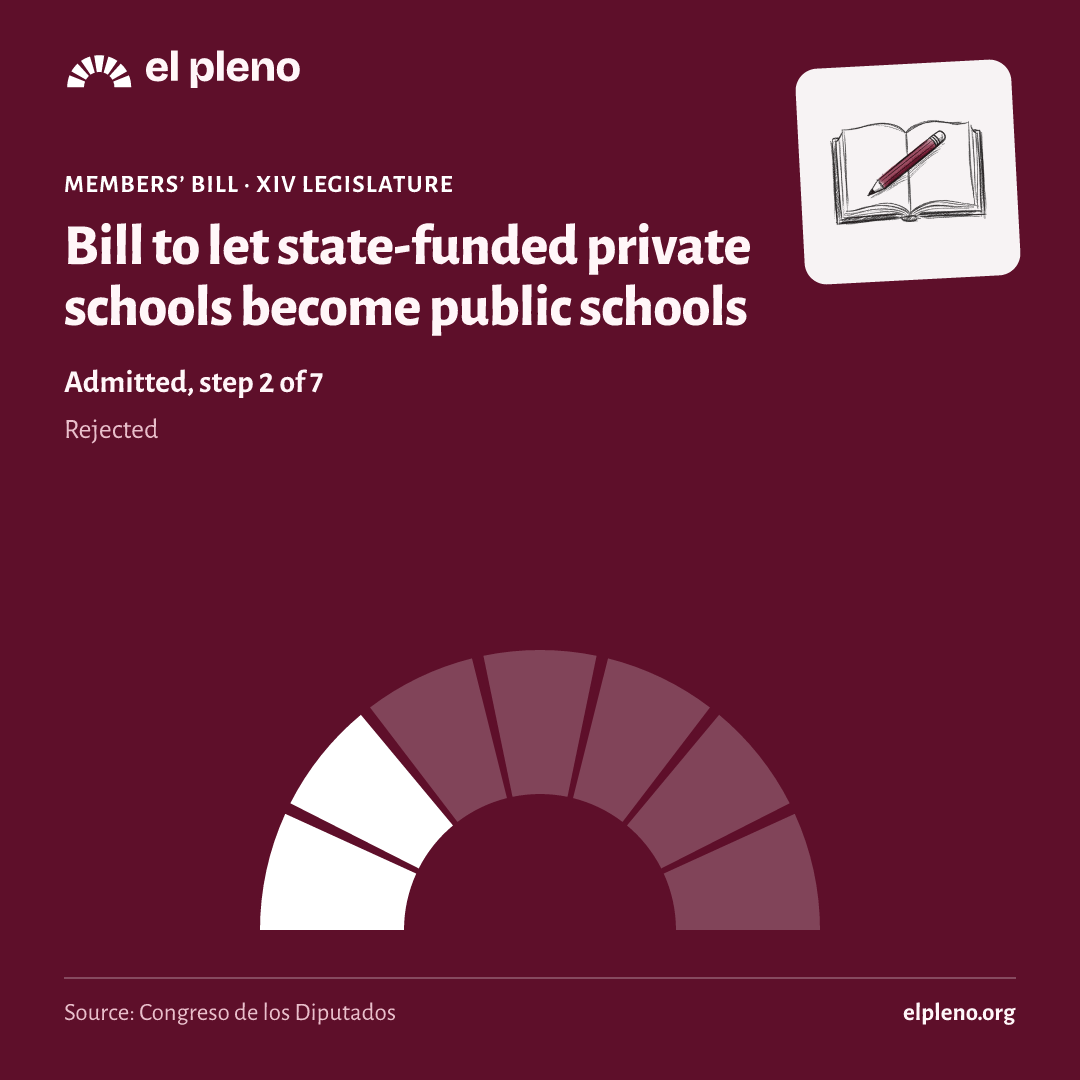
It took 2 of 7 steps. It reached Admitted, and today it is rejected.
- Introduced20 April 2022Someone registers the text in the Congreso.
- Admitted26 April 2022The Bureau of the Congreso accepts it and, for a members’ bill, the plenary decides whether to consider it.
- Amendmentsnot reachedGroups propose changes.
- Committeenot reachedA committee goes through the text in detail.
- Plenarynot reachedAll 350 deputies vote.
- Senatenot reachedThe Senate can pass it, amend it or veto it.
- BOEnot reachedIt is published in the Official State Gazette (BOE) and comes into force.
See the 6 official steps on a timeline
28 June 2022
How did the plenary vote?
Voted on: Private member's bill of the Confederal Parliamentary Group of Unidas Podemos-En Comú Podem-Galicia en Común, regulating the process of voluntary integration of certain private educational centers into the public network of educational centers.
Source: Congreso de los Diputados, vote 2 of sitting 190· updated 10 Nov
Each dot is a seat. Tap one, or use the arrow keys, to see who it is.
Your province
How did the deputies from your province vote?
And your senators: the Senate does not link its votes to this law in its open data, so we cannot put them side by side here.
Or see how most of each province voted
- A Coruña More votes against 2 yes · 6 no
- Albacete More votes against 0 yes · 4 no
- Alicante/Alacant More votes against 1 yes · 11 no
- Almería More votes against 0 yes · 6 no
- Araba/Álava More votes against 1 yes · 2 no · 1 abst.
- Asturias More votes against 1 yes · 6 no
- Ávila More votes against 0 yes · 3 no
- Badajoz More votes against 0 yes · 6 no
- Barcelona More votes against 12 yes · 17 no
- Bizkaia More votes against 1 yes · 6 no · 1 abst.
- Burgos More votes against 0 yes · 4 no
- Cáceres More votes against 0 yes · 4 no
- Cádiz More votes against 0 yes · 8 no
- Cantabria More votes against 0 yes · 5 no
- Castellón/Castelló More votes against 1 yes · 4 no
- Ceuta No count 0 yes · 0 no
- Ciudad Real More votes against 0 yes · 5 no
- Córdoba More votes against 1 yes · 4 no
- Cuenca More votes against 0 yes · 3 no
- Gipuzkoa More votes against 1 yes · 3 no · 2 abst.
- Girona Tie 3 yes · 3 no
- Granada More votes against 1 yes · 5 no
- Guadalajara More votes against 0 yes · 3 no
- Huelva More votes against 0 yes · 5 no
- Huesca More votes against 0 yes · 3 no
- Illes Balears More votes against 2 yes · 6 no
- Jaén More votes against 0 yes · 5 no
- La Rioja More votes against 0 yes · 4 no
- Las Palmas More votes against 0 yes · 6 no
- León More votes against 0 yes · 4 no
- Lleida Tie 2 yes · 2 no
- Lugo More votes against 0 yes · 4 no
- Madrid More votes against 7 yes · 28 no
- Málaga More votes against 1 yes · 10 no
- Melilla More votes against 0 yes · 1 no
- Murcia More votes against 1 yes · 9 no
- Navarra More votes against 0 yes · 3 no · 1 abst.
- Ourense More votes against 0 yes · 4 no
- Palencia More votes against 0 yes · 3 no
- Pontevedra More votes against 1 yes · 6 no
- Salamanca More votes against 0 yes · 4 no
- Santa Cruz de Tenerife More votes against 0 yes · 5 no
- Segovia More votes against 0 yes · 3 no
- Sevilla More votes against 1 yes · 9 no
- Soria More votes against 0 yes · 2 no
- Tarragona Tie 3 yes · 3 no
- Teruel More votes against 0 yes · 2 no · 1 abst.
- Toledo More votes against 0 yes · 6 no
- Valencia/València More votes against 3 yes · 12 no
- Valladolid More votes against 0 yes · 5 no
- Zamora More votes against 0 yes · 3 no
- Zaragoza More votes against 1 yes · 5 no
More details: how each group and each province voted
The groups
Who voted in favour and who against?
In favour, most of Republicano and Gcup-ec-gc. Against, most of Socialista, Vasco (EAJ-PNV), Mixto, Ciudadanos, GPlu, Popular en el Congreso and VOX. 6 deputies voted differently from their group.
By province: in 0 most voted in favour; in 48, against.
Coloured by how most of each province’s deputies voted.
- In favour: 0
- Against: 48
- Tie: 3
| Group | Seats | How it voted |
|---|---|---|
| Euskal Herria Bildu | 5 | 5 abst. |
| Republicano | 13 | 12 in favour · 1 did not vote |
| Socialista | 120 | 118 against · 2 did not vote |
| Vasco (EAJ-PNV) | 6 | 6 against |
| Mixto | 11 | 1 in favour · 4 against · 1 abst. · 5 did not vote |
| Ciudadanos | 9 | 9 against |
| Gcup-ec-gc | 32 | 30 in favour · 2 did not vote |
| GPlu | 12 | 4 in favour · 7 against · 1 did not vote |
| Popular en el Congreso | 88 | 87 against · 1 did not vote |
| VOX | 52 | 49 against · 3 did not vote |
What happens next
What happens now?
It goes no further. A similar one could be introduced later.
Sources
Where does all this come from?
- Congreso de los Diputados, file 122/000218
Official title, type, author, dates and stage.
Retrieved 11 November 2026
- Congreso de los Diputados, vote 2 of sitting 190
The count and every seat’s vote.
Retrieved 10 November 2026
- The data comes from the open files of the Congreso, the Senate and the BOE, unaltered.
- Each deputy’s province is the one of their seat on the day of the vote.
- We only say “passed” or “rejected” when the majority needed is certain; otherwise we say which side had more votes.