What it is
Bill to tighten environmental rules for mining in Spain
It is a members’ bill. Introduced by parliamentary groups, the Senate, regional governments or citizens. It was introduced on 20 April 2022. Introduced by: Grupo Parlamentario Confederal de Unidas Podemos-En Comú Podem-Galicia en Común.
Official title: Private member's bill to amend Law 22/1973, of July 21, on Mines.
Source: Congreso de los Diputados, file 122/000216· updated 11 Nov
Automatic summary, not yet reviewed
- The bill would make all natural deposits and geological resources public domain assets that must be protected, and would move mineral and thermal waters out of the Mining Law into water legislation.
- It would add public participation: permits and concessions would go through public information of at least 30 business days, with participation activities for affected people, and a provincial advisory body would be created.
- Permits would only be effective once all other required authorizations are obtained, and could only be granted together with restoration, dismantling and closure plans and complementary projects. Natura 2000 sites and other protected areas would be excluded from mining registration.
- Only companies that prove legal, technical and financial capacity could hold mining rights, with joint liability for entities that complete that capacity, and transfers could not reduce guarantees or conditions.
- It would create a 10% levy on the value of extracted materials, earmarked for protecting geological diversity, and raise fines: up to €10 million for very serious offenses.
- It would ban authorizing mining on or under the seabed under Spanish jurisdiction until technology and science can guarantee no damage to marine ecosystems, and would repeal the 1977 Mining Promotion Law.
Who it affects
- Mining companies: More procedures, required financial and technical guarantees, a 10% levy, and fines up to €10 million.
- Citizens and residents near mining areas: They could take part in procedures and receive information about projects.
- Environmental and water authorities: Their reports would be required beforehand and, in some cases, binding before permits are granted.
- Affected local councils: They would have to issue prior reports on mining projects.
Words worth knowing
- Dominio público (public domain)
- Assets that belong to everyone and are managed by the State; they cannot be privately owned.
- Permiso de investigación (exploration permit)
- Authorization to carry out studies and work to find mineral resources on a plot of land.
- Concesión de explotación (exploitation concession)
- Authorization to extract and use mineral resources for a period of time.
- Red Natura 2000 (Natura 2000 network)
- European Union network of protected natural areas.
- Informe vinculante (binding report)
- A report the administration must follow; it cannot decide against it.
It summarizes the text as it was introduced. It is written by artificial intelligence and may contain mistakes: the official text is what counts. Read the official text · How we make summaries
Where it stands
How far did it get?
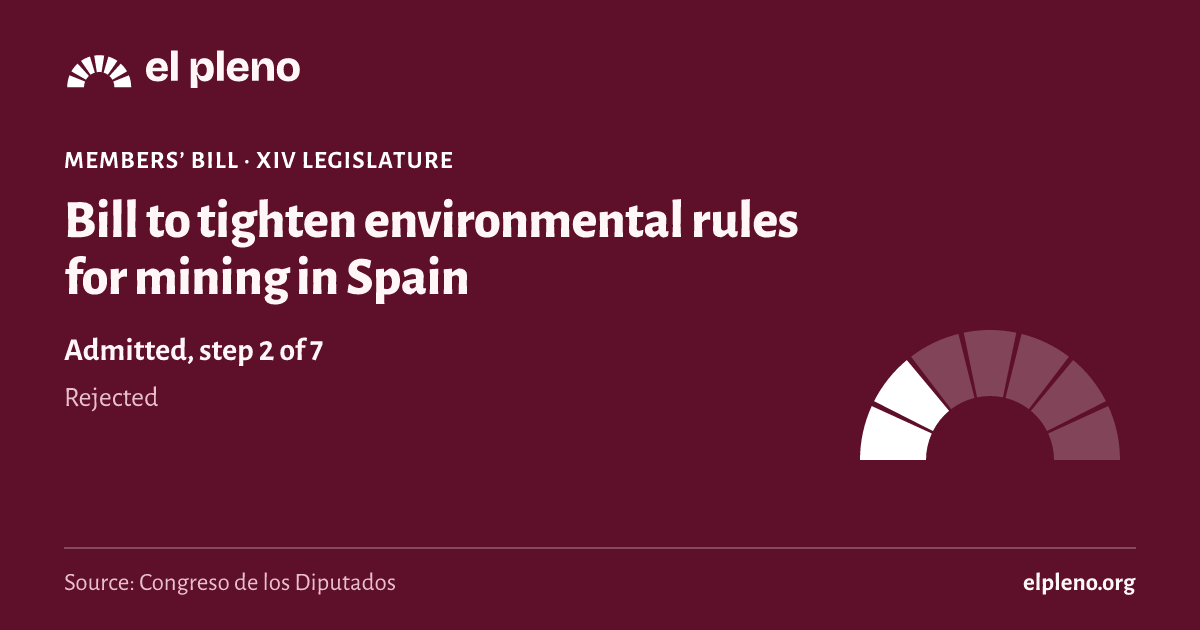
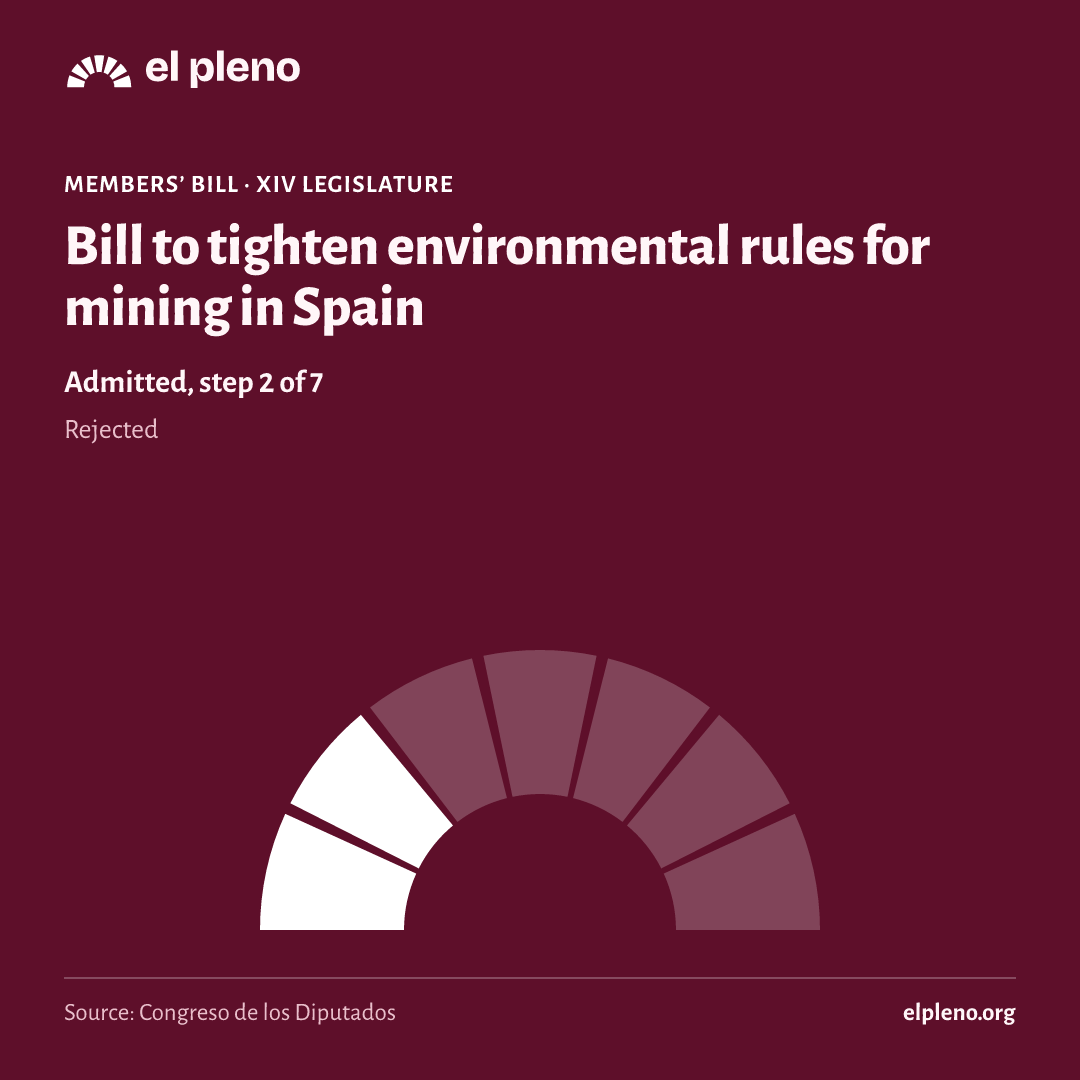
It took 2 of 7 steps. It reached Admitted, and today it is rejected.
- Introduced20 April 2022Someone registers the text in the Congreso.
- Admitted26 April 2022The Bureau of the Congreso accepts it and, for a members’ bill, the plenary decides whether to consider it.
- Amendmentsnot reachedGroups propose changes.
- Committeenot reachedA committee goes through the text in detail.
- Plenarynot reachedAll 350 deputies vote.
- Senatenot reachedThe Senate can pass it, amend it or veto it.
- BOEnot reachedIt is published in the Official State Gazette (BOE) and comes into force.
See the 6 official steps on a timeline
23 June 2022
How did the plenary vote?
Voted on: Private member's bill of the Confederal Parliamentary Group of Unidas Podemos-En Comú Podem-Galicia en Común, amending Law 22/1973, of July 21, on Mines.
Source: Congreso de los Diputados, vote 96 of sitting 189· updated 10 Nov
Each dot is a seat. Tap one, or use the arrow keys, to see who it is.
Your province
How did the deputies from your province vote?
And your senators: the Senate does not link its votes to this law in its open data, so we cannot put them side by side here.
Or see how most of each province voted
- A Coruña More votes against 2 yes · 6 no
- Albacete More votes against 0 yes · 4 no
- Alicante/Alacant More votes against 1 yes · 11 no
- Almería More votes against 0 yes · 6 no
- Araba/Álava More votes against 1 yes · 2 no · 1 abst.
- Asturias More votes against 1 yes · 6 no
- Ávila More votes against 0 yes · 3 no
- Badajoz More votes against 0 yes · 6 no
- Barcelona More votes against 4 yes · 18 no · 9 abst.
- Bizkaia More votes against 1 yes · 6 no · 1 abst.
- Burgos More votes against 0 yes · 4 no
- Cáceres More votes against 0 yes · 4 no
- Cádiz More votes against 0 yes · 8 no
- Cantabria More votes against 0 yes · 4 no · 1 abst.
- Castellón/Castelló More votes against 1 yes · 4 no
- Ceuta More votes against 0 yes · 1 no
- Ciudad Real More votes against 0 yes · 5 no
- Córdoba More votes against 1 yes · 5 no
- Cuenca More votes against 0 yes · 3 no
- Gipuzkoa More votes against 1 yes · 3 no · 2 abst.
- Girona More votes against 1 yes · 3 no · 2 abst.
- Granada More votes against 1 yes · 5 no
- Guadalajara More votes against 0 yes · 3 no
- Huelva More votes against 0 yes · 5 no
- Huesca More votes against 0 yes · 3 no
- Illes Balears More votes against 2 yes · 6 no
- Jaén More votes against 0 yes · 5 no
- La Rioja More votes against 0 yes · 4 no
- Las Palmas More votes against 1 yes · 5 no
- León More votes against 0 yes · 4 no
- Lleida More votes against 0 yes · 2 no · 2 abst.
- Lugo More votes against 0 yes · 4 no
- Madrid More votes against 7 yes · 29 no
- Málaga More votes against 1 yes · 10 no
- Melilla More votes against 0 yes · 1 no
- Murcia More votes against 1 yes · 8 no
- Navarra More votes against 1 yes · 3 no · 1 abst.
- Ourense More votes against 0 yes · 4 no
- Palencia More votes against 0 yes · 3 no
- Pontevedra More votes against 1 yes · 6 no
- Salamanca More votes against 0 yes · 3 no
- Santa Cruz de Tenerife More votes against 0 yes · 6 no
- Segovia More votes against 0 yes · 3 no
- Sevilla More votes against 2 yes · 10 no
- Soria More votes against 0 yes · 2 no
- Tarragona More votes against 1 yes · 3 no · 2 abst.
- Teruel More votes against 0 yes · 2 no · 1 abst.
- Toledo More votes against 0 yes · 6 no
- Valencia/València More votes against 3 yes · 12 no
- Valladolid More votes against 0 yes · 5 no
- Zamora More votes against 0 yes · 3 no
- Zaragoza More votes against 1 yes · 6 no
More details: how each group and each province voted
The groups
Who voted in favour and who against?
In favour, most of Gcup-ec-gc. Against, most of Socialista, Vasco (EAJ-PNV), Mixto, Ciudadanos, GPlu, Popular en el Congreso and VOX. 10 deputies voted differently from their group.
By province: in 0 most voted in favour; in 51, against.
Coloured by how most of each province’s deputies voted.
- In favour: 0
- Against: 51
- Tie: 1
| Group | Seats | How it voted |
|---|---|---|
| Euskal Herria Bildu | 5 | 5 abst. |
| Republicano | 13 | 13 abst. |
| Socialista | 120 | 120 against |
| Vasco (EAJ-PNV) | 6 | 6 against |
| Mixto | 11 | 1 in favour · 5 against · 4 abst. · 1 did not vote |
| Ciudadanos | 9 | 8 against · 1 did not vote |
| Gcup-ec-gc | 33 | 31 in favour · 1 against · 1 did not vote |
| GPlu | 12 | 4 in favour · 8 against |
| Popular en el Congreso | 88 | 86 against · 2 did not vote |
| VOX | 52 | 49 against · 3 did not vote |
What happens next
What happens now?
It goes no further. A similar one could be introduced later.
Sources
Where does all this come from?
- Congreso de los Diputados, file 122/000216
Official title, type, author, dates and stage.
Retrieved 11 November 2026
- Congreso de los Diputados, vote 96 of sitting 189
The count and every seat’s vote.
Retrieved 10 November 2026
- The data comes from the open files of the Congreso, the Senate and the BOE, unaltered.
- Each deputy’s province is the one of their seat on the day of the vote.
- We only say “passed” or “rejected” when the majority needed is certain; otherwise we say which side had more votes.