What it is
Proposed wealth tax on fortunes over 10 million euros
It is a members’ bill. Introduced by parliamentary groups, the Senate, regional governments or citizens. It was introduced on 4 April 2022. Introduced by: Grupo Parlamentario Confederal de Unidas Podemos-En Comú Podem-Galicia en Común.
Official title: Private member's bill on the Tax on the ownership, holding, availability, enjoyment or use of assets or rights by persons with large fortunes.
Source: Congreso de los Diputados, file 122/000213· updated 11 Nov
Automatic summary, not yet reviewed
- The bill would create a state tax for people with large fortunes, defined as net worth above 10 million euros counting exempt and non-exempt assets, minus deductible debts and charges. It would complement the existing Wealth Tax.
- It would limit the exemption for company shares and stakes to SMEs, meaning entities with fewer than 250 employees and annual revenue of up to 50 million euros or annual balance sheet total of up to 43 million euros.
- It would raise the taxable base reduction (the minimum exempt amount) to one million euros and set an eight-bracket scale with rates from 3.6% to 5% on total assets, minus deductible debts and charges.
- It would set a combined cap: the sum of this tax plus personal income tax The personal income tax (IRPF in Spain): what people pay on what they earn from work, business or savings. (IRPF) could not exceed a percentage of the IRPF taxable bases, ranging from 60% to 67% depending on income level, and the reduction from this cap could not exceed 70%.
- The tax would accrue on December 31 each year, and anyone with tax due or total assets above 10 million euros would have to file. Non-residents would have to appoint a representative in Spain, with a 3,000-euro fine if they fail to do so.
- The law would take effect on January 1, 2023, and future State Budget laws could change its exemptions, rates and other quantitative parameters.
Who it affects
- Individuals living in Spain with large fortunes, who would be taxed on their entire net worth.: They would pay this tax under the personal obligation.
- Non-resident individuals with assets or rights in Spain.: They would be taxed only on those assets, under the real obligation, and would have to appoint a representative in Spain.
- Holders of stakes in companies that are not SMEs.: They would lose the exemption for those stakes under this tax.
- Depositors or managers of non-residents' assets.: They would be jointly liable for payment of the tax debt.
Words worth knowing
- Devengo (accrual)
- The moment the tax is considered due, here December 31 each year.
- Base imponible (taxable base)
- The amount on which the tax is calculated, here the value of net worth.
- Cuota íntegra (gross tax liability)
- The result of applying the tax rate to the base, before deductions and caps.
- Obligación personal / obligación real (personal / real obligation)
- The personal obligation covers all assets of people living in Spain; the real obligation covers only assets located in Spain of people who do not live there.
- Beneficiario real (beneficial owner)
- The person who actually owns or controls an entity, even if someone else is listed.
- income tax
- The personal income tax (IRPF in Spain): what people pay on what they earn from work, business or savings.
It summarizes the text as it was introduced. It is written by artificial intelligence and may contain mistakes: the official text is what counts. Read the official text · How we make summaries
Where it stands
How far did it get?
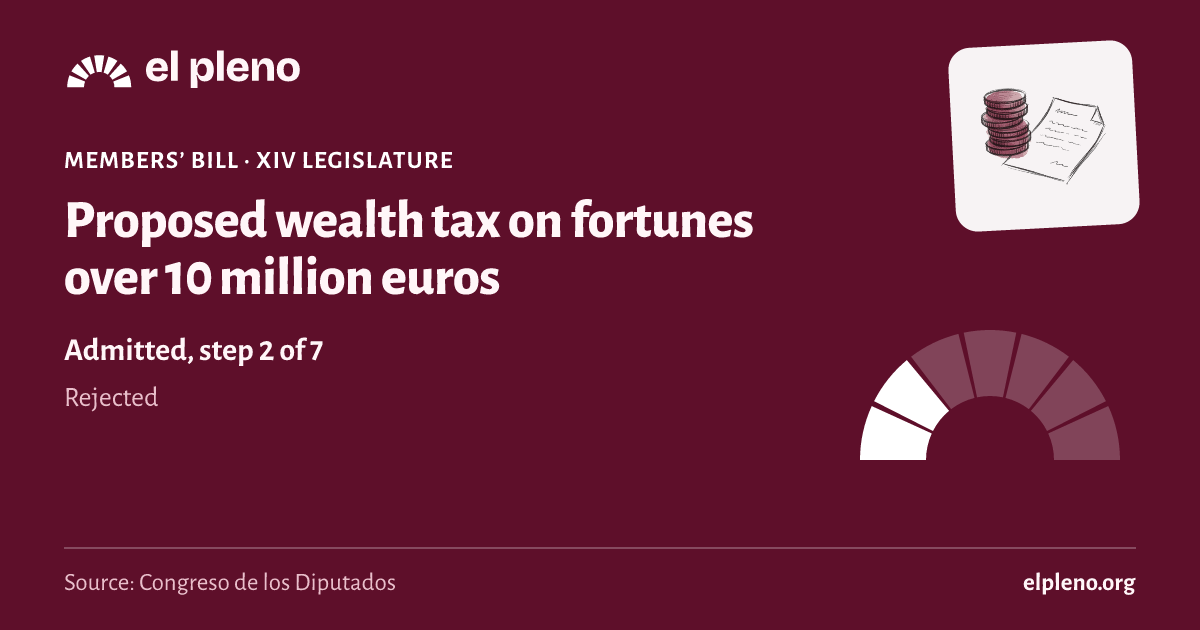
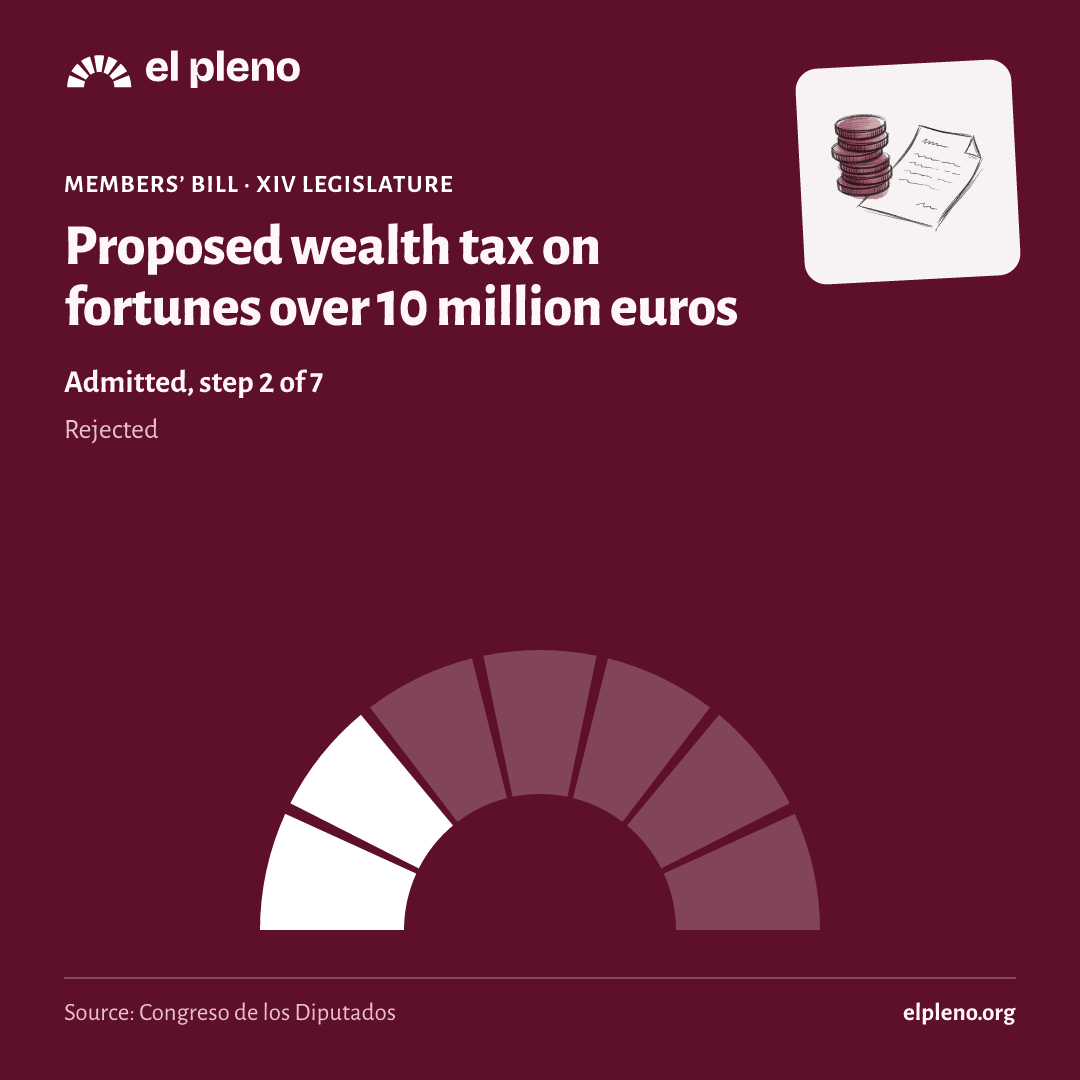
It took 2 of 7 steps. It reached Admitted, and today it is rejected.
- Introduced4 April 2022Someone registers the text in the Congreso.
- Admitted19 April 2022The Bureau of the Congreso accepts it and, for a members’ bill, the plenary decides whether to consider it.
- Amendmentsnot reachedGroups propose changes.
- Committeenot reachedA committee goes through the text in detail.
- Plenarynot reachedAll 350 deputies vote.
- Senatenot reachedThe Senate can pass it, amend it or veto it.
- BOEnot reachedIt is published in the Official State Gazette (BOE) and comes into force.
See the 6 official steps on a timeline
7 June 2022
How did the plenary vote?
Voted on: Private member's bill of the Confederal Parliamentary Group of Unidas Podemos-En Comú Podem-Galicia en Común, on the Tax on the ownership, holding, availability, enjoyment or use of assets or rights by persons with large fortunes.
Source: Congreso de los Diputados, vote 1 of sitting 184· updated 10 Nov
Each dot is a seat. Tap one, or use the arrow keys, to see who it is.
Your province
How did the deputies from your province vote?
And your senators: the Senate does not link its votes to this law in its open data, so we cannot put them side by side here.
Or see how most of each province voted
- A Coruña More votes against 2 yes · 5 no
- Albacete More votes against 0 yes · 4 no
- Alicante/Alacant More votes against 1 yes · 11 no
- Almería More votes against 0 yes · 6 no
- Araba/Álava Tie 2 yes · 2 no
- Asturias More votes against 1 yes · 6 no
- Ávila More votes against 0 yes · 3 no
- Badajoz More votes against 0 yes · 5 no
- Barcelona More votes against 14 yes · 15 no · 2 abst.
- Bizkaia More votes against 2 yes · 6 no
- Burgos More votes against 0 yes · 4 no
- Cáceres More votes against 0 yes · 4 no
- Cádiz More votes against 1 yes · 8 no
- Cantabria More votes against 0 yes · 5 no
- Castellón/Castelló More votes against 1 yes · 4 no
- Ceuta More votes against 0 yes · 1 no
- Ciudad Real More votes against 0 yes · 5 no
- Córdoba More votes against 1 yes · 5 no
- Cuenca More votes against 0 yes · 3 no
- Gipuzkoa Tie 3 yes · 3 no
- Girona More votes in favour 3 yes · 2 no · 1 abst.
- Granada More votes against 1 yes · 5 no
- Guadalajara More votes against 0 yes · 3 no
- Huelva More votes against 0 yes · 5 no
- Huesca More votes against 0 yes · 3 no
- Illes Balears More votes against 2 yes · 6 no
- Jaén More votes against 0 yes · 5 no
- La Rioja More votes against 0 yes · 4 no
- Las Palmas More votes against 1 yes · 6 no
- León More votes against 0 yes · 4 no
- Lleida Tie 2 yes · 2 no
- Lugo More votes against 0 yes · 4 no
- Madrid More votes against 7 yes · 28 no
- Málaga More votes against 1 yes · 10 no
- Melilla More votes against 0 yes · 1 no
- Murcia More votes against 1 yes · 8 no
- Navarra Tie 2 yes · 2 no
- Ourense More votes against 0 yes · 4 no
- Palencia More votes against 0 yes · 3 no
- Pontevedra More votes against 1 yes · 6 no
- Salamanca More votes against 0 yes · 4 no
- Santa Cruz de Tenerife More votes against 0 yes · 5 no
- Segovia More votes against 0 yes · 3 no
- Sevilla More votes against 2 yes · 10 no
- Soria More votes against 0 yes · 2 no
- Tarragona Tie 3 yes · 3 no
- Teruel More votes against 0 yes · 2 no · 1 abst.
- Toledo More votes against 0 yes · 6 no
- Valencia/València More votes against 3 yes · 12 no
- Valladolid More votes against 0 yes · 5 no
- Zamora More votes against 0 yes · 3 no
- Zaragoza More votes against 1 yes · 6 no
More details: how each group and each province voted
The groups
Who voted in favour and who against?
In favour, most of Euskal Herria Bildu, Republicano and Gcup-ec-gc. Against, most of Socialista, Vasco (EAJ-PNV), Mixto, Ciudadanos, Popular en el Congreso and VOX. 4 deputies voted differently from their group.
By province: in 1 most voted in favour; in 46, against.
Coloured by how most of each province’s deputies voted.
- In favour: 1
- Against: 46
- Tie: 5
| Group | Seats | How it voted |
|---|---|---|
| Euskal Herria Bildu | 5 | 5 in favour |
| Republicano | 13 | 13 in favour |
| Socialista | 120 | 117 against · 3 did not vote |
| Vasco (EAJ-PNV) | 6 | 6 against |
| Mixto | 11 | 3 in favour · 5 against · 1 abst. · 2 did not vote |
| Ciudadanos | 9 | 8 against · 1 did not vote |
| Gcup-ec-gc | 33 | 33 in favour |
| GPlu | 12 | 4 in favour · 4 against · 3 abst. · 1 did not vote |
| Popular en el Congreso | 88 | 87 against · 1 did not vote |
| VOX | 52 | 50 against · 2 did not vote |
What happens next
What happens now?
It goes no further. A similar one could be introduced later.
It was presented again:
- XV Legislature, Congreso de los Diputados· Withdrawn Private member's bill for a tax on the ownership, holding, availability, enjoyment or use of assets or rights by persons with large fortunes.
- XV Legislature, Congreso de los Diputados· Unfinished Proposed new wealth tax for fortunes over 10 million euros
Sources
Where does all this come from?
- Congreso de los Diputados, file 122/000213
Official title, type, author, dates and stage.
Retrieved 11 November 2026
- Congreso de los Diputados, vote 1 of sitting 184
The count and every seat’s vote.
Retrieved 10 November 2026
- The data comes from the open files of the Congreso, the Senate and the BOE, unaltered.
- Each deputy’s province is the one of their seat on the day of the vote.
- We only say “passed” or “rejected” when the majority needed is certain; otherwise we say which side had more votes.