What it is
Bill would make the State match regional funding for dependency care
It is a members’ bill. Introduced by parliamentary groups, the Senate, regional governments or citizens. It was introduced on 25 March 2022. Introduced by: Grupo Parlamentario Popular en el Congreso.
Official title: Private member's bill amending Law 39/2006, of 14 December, on the Promotion of Personal Autonomy and Care for Persons in a Situation of Dependence, regarding the financing of the System for Autonomy and Care for Dependence (SAAD) by Public Administrations.
Source: Congreso de los Diputados, file 122/000209· updated 11 Nov
Automatic summary, not yet reviewed
- The Popular Party group presents this bill because, it explains, the cost of the dependency care system has fallen mostly on the autonomous communities, even though the law intended the State and the communities to pay equal shares.
- The bill would amend Article 32 of Law 39/2006 so that the State fully covers the cost set in Article 9 and contributes each year the same amount as each autonomous community.
- Agreements between the State and each community would set how funding is shared, taking into account the dependent population, geographic dispersion, island status and returned migrants.
- The law would take effect the day after its publication in the Official State Gazette, except for measures that increase spending or reduce revenue, which would wait until the next budget year.
Who it affects
- People in situations of dependency and their families: They could receive benefits sooner if the system is better funded.
- Autonomous communities: They would no longer bear most of the cost of the dependency system.
- Central State Administration (Administración General del Estado): It would have to contribute each year the same amount as each autonomous community.
Words worth knowing
- SAAD
- Sistema para la Autonomía y Atención a la Dependencia: Spain's public system of services and benefits for people in situations of dependency.
- Grados I, II y III
- Levels used to classify dependency by intensity: grade I is the mildest and grade III the most severe.
- Proposición de ley
- A bill: a text a parliamentary group proposes as a law; it is not a law until passed.
It summarizes the text as it was introduced. It is written by artificial intelligence and may contain mistakes: the official text is what counts. Read the official text · How we make summaries
Where it stands
How far did it get?
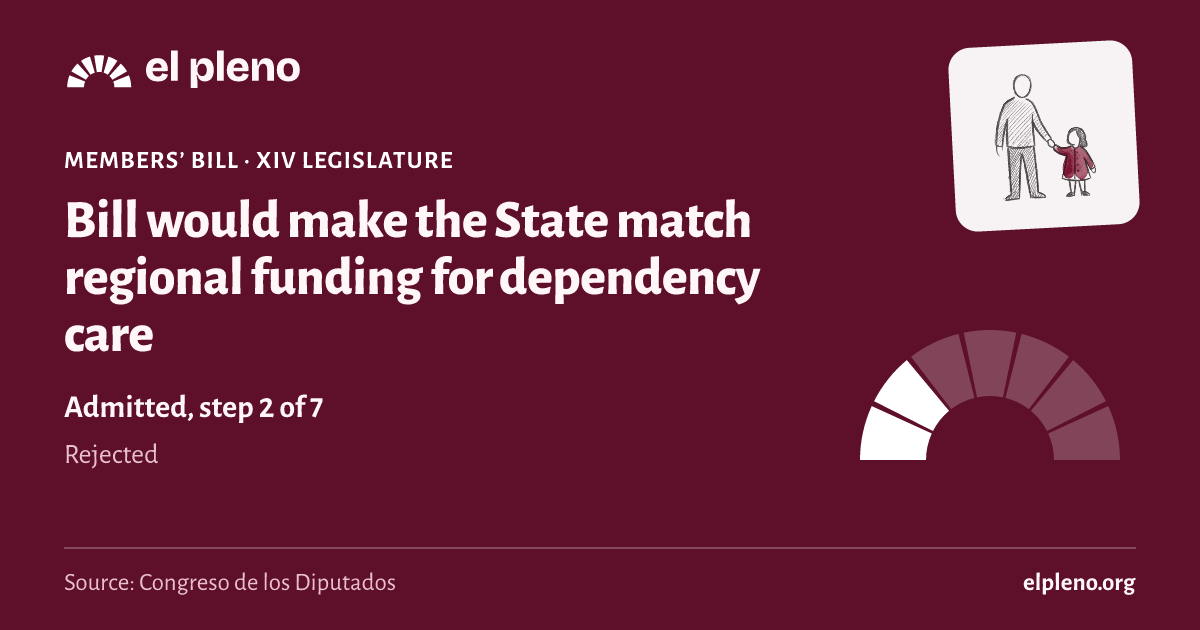
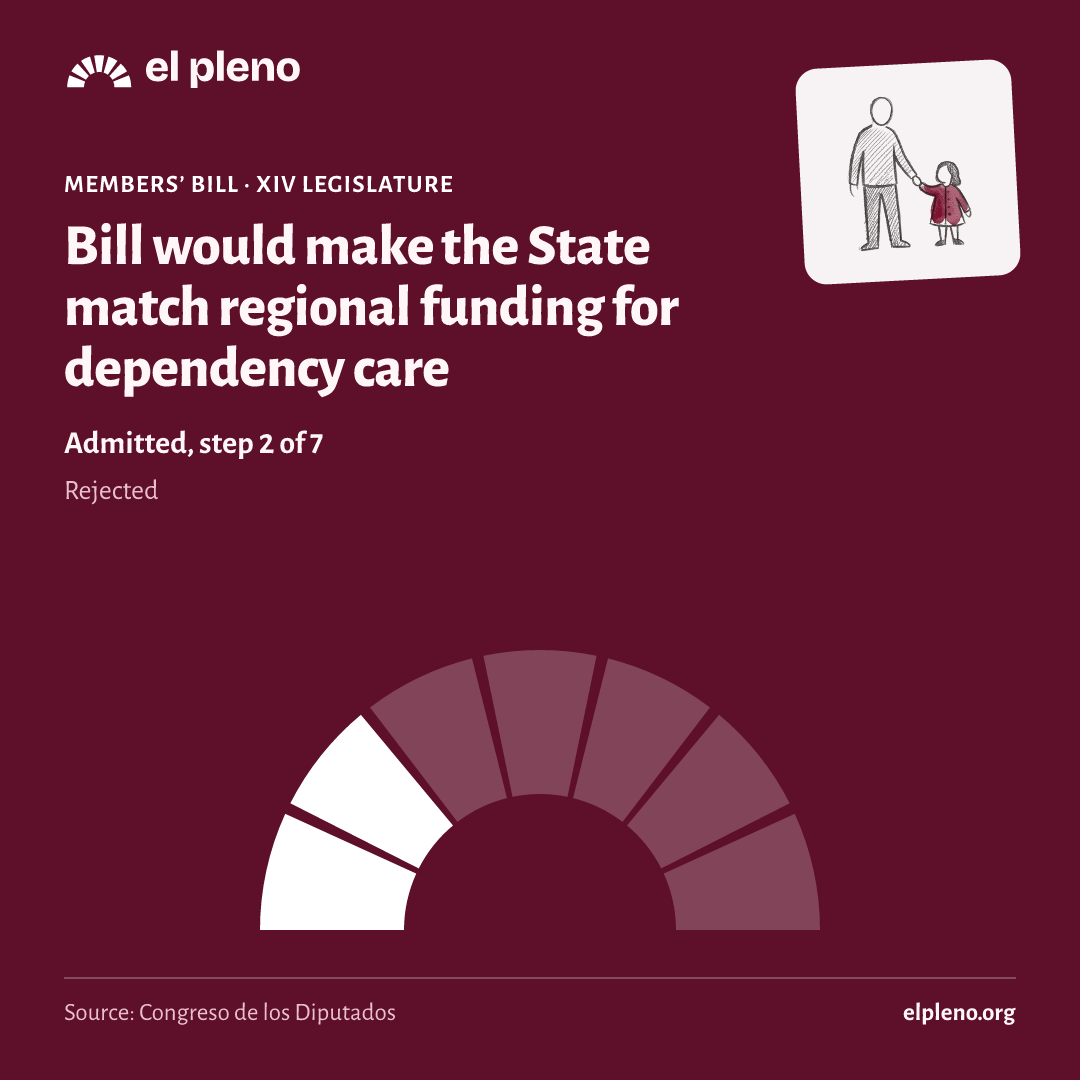
It took 2 of 7 steps. It reached Admitted, and today it is rejected.
- Introduced25 March 2022Someone registers the text in the Congreso.
- Admitted30 March 2022The Bureau of the Congreso accepts it and, for a members’ bill, the plenary decides whether to consider it.
- Amendmentsnot reachedGroups propose changes.
- Committeenot reachedA committee goes through the text in detail.
- Plenarynot reachedAll 350 deputies vote.
- Senatenot reachedThe Senate can pass it, amend it or veto it.
- BOEnot reachedIt is published in the Official State Gazette (BOE) and comes into force.
See the 6 official steps on a timeline
Was there a plenary vote?
We have no plenary vote linked to this law in the Congreso’s data.
What happens next
What happens now?
It goes no further. A similar one could be introduced later.
Sources
Where does all this come from?
- Congreso de los Diputados, file 122/000209
Official title, type, author, dates and stage.
Retrieved 11 November 2026
- The data comes from the open files of the Congreso, the Senate and the BOE, unaltered.
- Each deputy’s province is the one of their seat on the day of the vote.
- We only say “passed” or “rejected” when the majority needed is certain; otherwise we say which side had more votes.