What it is
How top State office holders would be chosen
It is a members’ bill. Introduced by parliamentary groups, the Senate, regional governments or citizens. It was introduced on 2 December 2021. Introduced by: Grupo Parlamentario Ciudadanos.
Official title: Private member's bill for the reform of the procedure for the appointment of members of constitutional bodies and bodies of constitutional relevance.

Source: Congreso de los Diputados, file 122/000186· updated 11 Nov
Automatic summary, not yet reviewed
- The bill would change how Constitutional Court (Tribunal Constitucional) judges are chosen: eight would come from an open competitive selection process, with an Evaluation Committee preselecting candidates, and the Congress of Deputies and the Senate would each pick four by a three-fifths majority. It would also add grounds for ineligibility for anyone who held political posts or leadership roles in parties or unions in the previous eight years.
- The Defensor del Pueblo (parliamentary ombudsman) would also be chosen through an open competitive selection process, with merit evaluation and candidate hearings. A three-fifths majority in the Congress and the Senate would be required, with votes repeated every thirty days if not reached, plus new ineligibility grounds for prior political posts.
- The twelve judicial members of the General Council of the Judiciary (Consejo General del Poder Judicial) would be elected directly by serving judges and magistrates, through open lists and in-person voting, with no delegated voting. The other eight jurist members would be elected by the Cortes by a three-fifths majority, and new ineligibility grounds would be added.
- Counselors of the Court of Auditors (Tribunal de Cuentas) would be elected by the Cortes from candidates preselected by an Evaluation Committee, requiring a three-fifths majority. If that fails in a second vote, vacant seats would be filled by lottery, and new ineligibility grounds for prior political posts would be added.
- The State Attorney General (Fiscal General del Estado) would still be proposed by the Government, but would need ratification by two thirds of the Congress after appearing before a committee. The term would be five years, non-renewable, with a closed list of removal grounds, plus new ineligibility grounds for prior political posts.
- The renewal of the members of the General Council of the Judiciary would follow this law and start 15 days after its publication in the Official State Gazette (Boletín Oficial del Estado). The law would take effect the day after its publication.
Who it affects
- Judges and magistrates: They would directly elect the twelve judicial members of the General Council of the Judiciary.
- Congress of Deputies and Senate: They would have to use open competitive selection processes and three-fifths majorities to appoint Constitutional Court judges, the Defensor del Pueblo and Court of Auditors counselors.
- Candidates for these offices: They would have to pass an Evaluation Committee review and could not have held political posts or leadership roles in parties or unions in the previous eight years.
- Government and State Attorney General: The Government would still propose the Attorney General, but would need ratification by two thirds of the Congress; the term would be five years, non-renewable.
Words worth knowing
- Selección competitiva abierta (open competitive selection)
- A process where anyone meeting the requirements can apply and candidates are judged on their merits and abilities.
- Comité Evaluador (Evaluation Committee)
- A panel of experts that reviews applicants, scores them and preselects candidates.
- Mayoría de tres quintos (three-fifths majority)
- At least three out of every five members of the chamber must vote in favor.
- Inelegibilidad (ineligibility)
- A bar from running for the office; here, for having held political posts or leadership roles in parties or unions in prior years.
- Consejero de Cuentas (Counselor of the Court of Auditors)
- A member of the Tribunal de Cuentas, the body that audits public accounts.
It summarizes the text as it was introduced. It is written by artificial intelligence and may contain mistakes: the official text is what counts. Read the official text · How we make summaries
Where it stands
How far did it get?
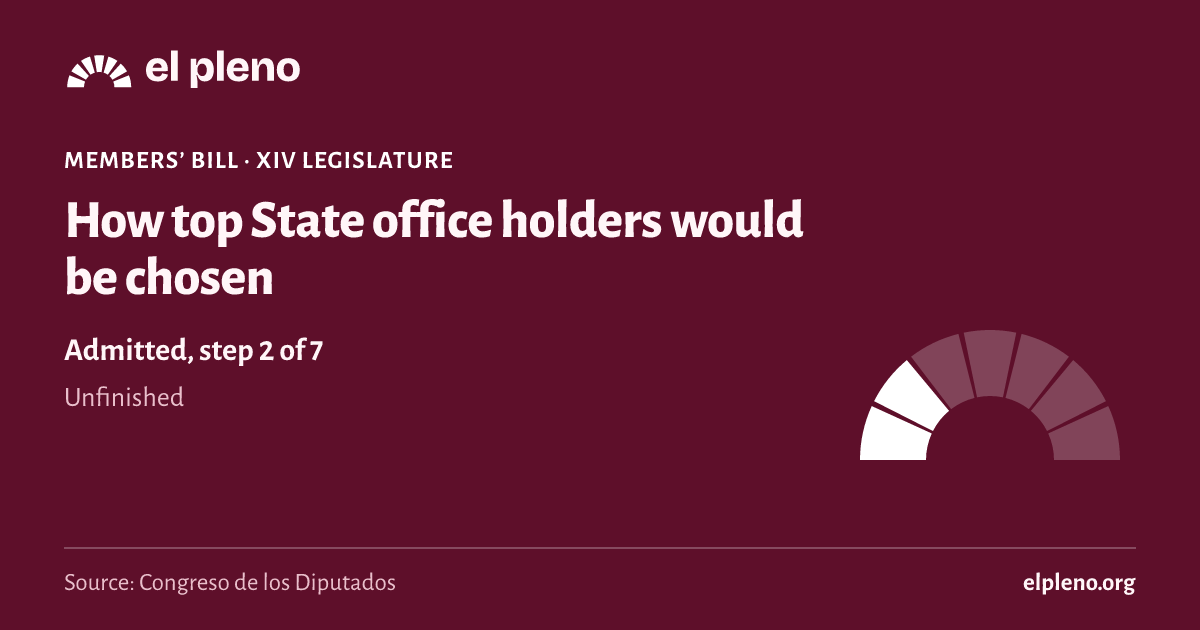
It took 2 of 7 steps. It reached Admitted, and today it is unfinished.
- Introduced2 December 2021Someone registers the text in the Congreso.
- Admitted14 December 2021The Bureau of the Congreso accepts it and, for a members’ bill, the plenary decides whether to consider it.
- Amendmentsnot reachedGroups propose changes.
- Committeenot reachedA committee goes through the text in detail.
- Plenarynot reachedAll 350 deputies vote.
- Senatenot reachedThe Senate can pass it, amend it or veto it.
- BOEnot reachedIt is published in the Official State Gazette (BOE) and comes into force.
See the 6 official steps on a timeline
Was there a plenary vote?
We have no plenary vote linked to this law in the Congreso’s data.
What happens next
What happens now?
The legislature ended before it finished. To go on, someone would have to introduce it again in the new Cortes.
It has not been presented again yet.
The same initiative in the other chamber:
- XIV Legislature, Senate Private member's bill for the reform of the procedure for the appointment of members of constitutional bodies and bodies of constitutional relevance.
- XIV Legislature, Senate Private member's bill for the reform of the procedure for the appointment of members of constitutional bodies and bodies of constitutional relevance.
- XIV Legislature, Senate Private member's bill for the reform of the procedure for the appointment of members of constitutional bodies and bodies of constitutional relevance.
Sources
Where does all this come from?
- Congreso de los Diputados, file 122/000186
Official title, type, author, dates and stage.
Retrieved 11 November 2026
- The data comes from the open files of the Congreso, the Senate and the BOE, unaltered.
- Each deputy’s province is the one of their seat on the day of the vote.
- We only say “passed” or “rejected” when the majority needed is certain; otherwise we say which side had more votes.