What it is
Proposal to legalize and regulate cannabis in Spain
It is a members’ bill. Introduced by parliamentary groups, the Senate, regional governments or citizens. It was introduced on 27 September 2021. Introduced by: Grupo Parlamentario Plural.
Official title: Private member's bill on a comprehensive cannabis law
Source: Congreso de los Diputados, file 122/000164· updated 11 Nov
Automatic summary, not yet reviewed
- The bill declares cannabis cultivation, self-cultivation and its uses free, within the limits and rules it sets.
- For personal use it sets limits presumed legal: 12 plants outdoors, 1,200 watts indoors, 3,650 grams of dried flower and 1,000 grams of derivatives. Anyone exceeding them must register their crop as personal use.
- Professional uses would require prior authorization and registration, with a unique code tracking the plant and its derivatives to the end user. Indoor crops would need at least 60% renewable energy.
- Medical use would require a doctor's prescription and prior registration, and would be subject to drug legislation. In addition, patenting discoveries related to the plant and its derivatives would be banned.
- It creates a Special Tax on Cannabis, with a maximum rate of 35% on the final retail price. 60% of the revenue would go to public health.
- Driving could not be punished merely for the presence of THC The psychoactive substance in cannabis, the one that alters mood. in the body, but driving under its influence could. Consumption during leisure time could not be punished at work. Rules on personal use would take effect the day after publication, the rest on January 1 of the following year.
Who it affects
- People who consume or grow cannabis for their own use: They could do so legally within the set limits, with limited transport in public.
- Farmers and cannabis businesses: They would need authorization, registration and traceability to grow or sell professionally.
- Medical cannabis patients: They could access cannabis treatments with a doctor's prescription.
- Shops and distributors: They would have to meet security, labeling and advertising restriction requirements.
- Minors and legally incapacitated people: The bill would not cover their recreational use.
Words worth knowing
- THC
- The psychoactive substance in cannabis, the one that alters mood.
- CBD
- Another cannabis substance with no psychoactive effects, used in products such as oils.
- Trazabilidad (traceability)
- Being able to track a product from its origin to the final consumer.
- Impuesto especial (special tax)
- A tax on specific products, like tobacco or alcohol.
- Silencio positivo (positive silence)
- If the administration does not reply within the deadline, the request is deemed approved.
It summarizes the text as it was introduced. It is written by artificial intelligence and may contain mistakes: the official text is what counts. Read the official text · How we make summaries
Where it stands
How far did it get?
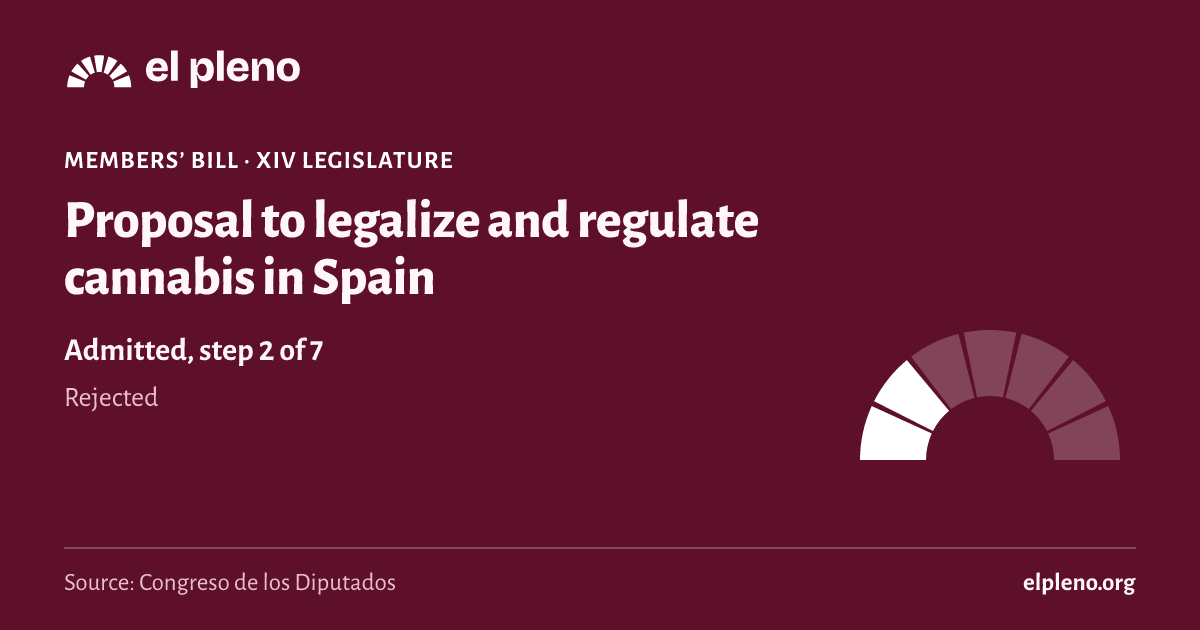
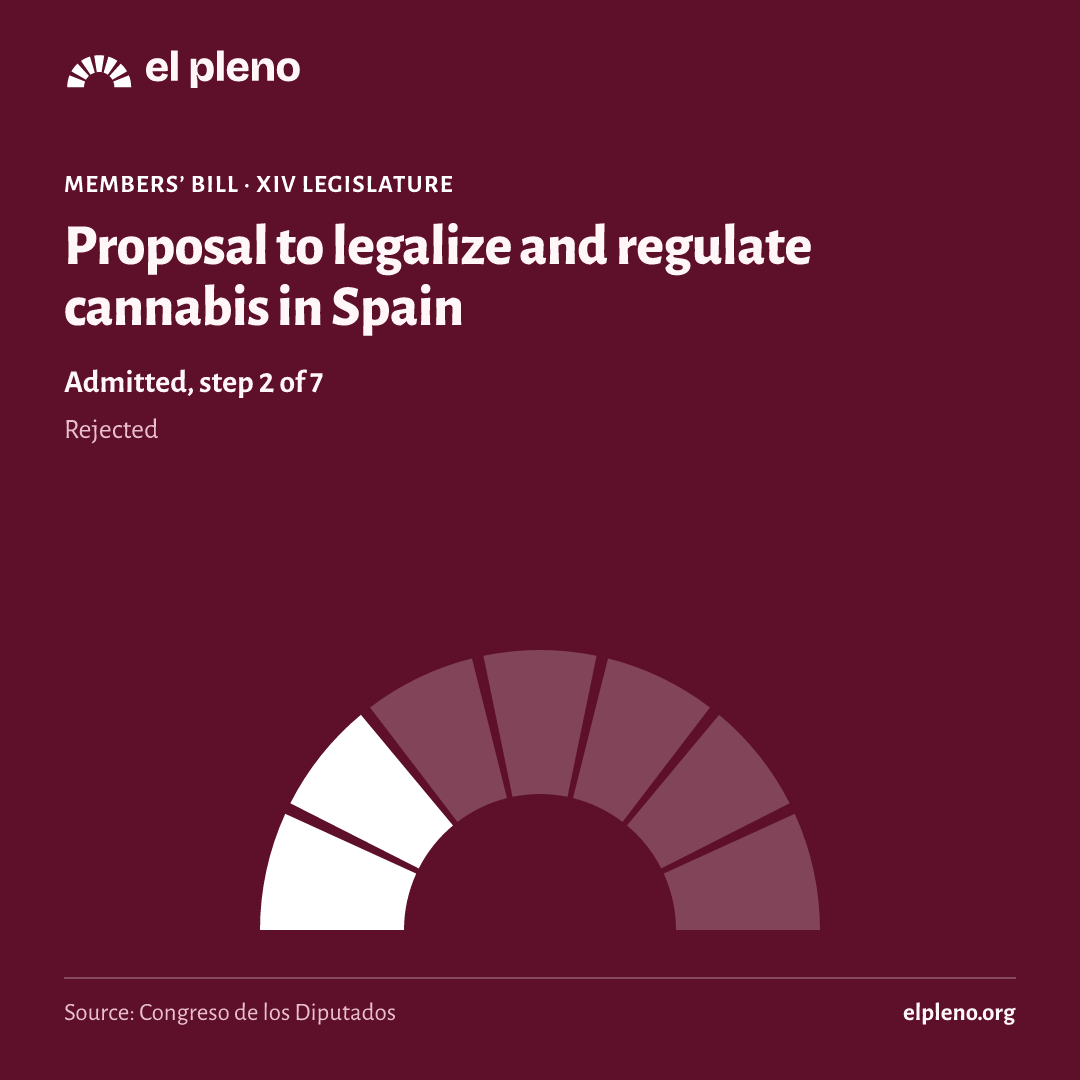
It took 2 of 7 steps. It reached Admitted, and today it is rejected.
- Introduced27 September 2021Someone registers the text in the Congreso.
- Admitted5 October 2021The Bureau of the Congreso accepts it and, for a members’ bill, the plenary decides whether to consider it.
- Amendmentsnot reachedGroups propose changes.
- Committeenot reachedA committee goes through the text in detail.
- Plenarynot reachedAll 350 deputies vote.
- Senatenot reachedThe Senate can pass it, amend it or veto it.
- BOEnot reachedIt is published in the Official State Gazette (BOE) and comes into force.
See the 6 official steps on a timeline
19 October 2021
How did the plenary vote?
Voted on: Private member's bill by the Plural Parliamentary Group, on the integral regulation of cannabis.
Source: Congreso de los Diputados, vote 2 of sitting 125· updated 11 Nov
Each dot is a seat. Tap one, or use the arrow keys, to see who it is.
Your province
How did the deputies from your province vote?
And your senators: the Senate does not link its votes to this law in its open data, so we cannot put them side by side here.
Or see how most of each province voted
- A Coruña More votes against 2 yes · 6 no
- Albacete More votes against 0 yes · 4 no
- Alicante/Alacant More votes against 2 yes · 10 no
- Almería More votes against 0 yes · 6 no
- Araba/Álava More votes in favour 2 yes · 1 no · 1 abst.
- Asturias More votes against 1 yes · 6 no
- Ávila More votes against 0 yes · 3 no
- Badajoz More votes against 0 yes · 6 no
- Barcelona More votes in favour 19 yes · 12 no
- Bizkaia More votes against 2 yes · 3 no · 3 abst.
- Burgos More votes against 0 yes · 4 no
- Cáceres More votes against 0 yes · 4 no
- Cádiz More votes against 2 yes · 7 no
- Cantabria More votes against 1 yes · 4 no
- Castellón/Castelló More votes against 1 yes · 4 no
- Ceuta More votes against 0 yes · 1 no
- Ciudad Real More votes against 0 yes · 5 no
- Córdoba More votes against 1 yes · 5 no
- Cuenca More votes against 0 yes · 3 no
- Gipuzkoa More votes in favour 3 yes · 1 no · 2 abst.
- Girona More votes in favour 5 yes · 1 no
- Granada More votes against 1 yes · 6 no
- Guadalajara More votes against 0 yes · 3 no
- Huelva More votes against 0 yes · 5 no
- Huesca More votes against 0 yes · 3 no
- Illes Balears More votes against 2 yes · 6 no
- Jaén More votes against 0 yes · 5 no
- La Rioja More votes against 0 yes · 4 no
- Las Palmas More votes against 2 yes · 6 no
- León More votes against 0 yes · 4 no
- Lleida More votes in favour 2 yes · 1 no · 1 abst.
- Lugo More votes against 0 yes · 4 no
- Madrid More votes against 10 yes · 26 no
- Málaga More votes against 2 yes · 9 no
- Melilla More votes against 0 yes · 1 no
- Murcia More votes against 1 yes · 9 no
- Navarra More votes against 2 yes · 3 no
- Ourense More votes against 0 yes · 4 no
- Palencia More votes against 0 yes · 3 no
- Pontevedra More votes against 1 yes · 6 no
- Salamanca More votes against 0 yes · 4 no
- Santa Cruz de Tenerife More votes against 2 yes · 5 no
- Segovia More votes against 0 yes · 3 no
- Sevilla More votes against 1 yes · 10 no
- Soria More votes against 0 yes · 2 no
- Tarragona More votes in favour 3 yes · 2 no · 1 abst.
- Teruel More votes against 0 yes · 2 no · 1 abst.
- Toledo More votes against 0 yes · 6 no
- Valencia/València More votes against 4 yes · 11 no
- Valladolid More votes against 0 yes · 5 no
- Zamora More votes against 0 yes · 3 no
- Zaragoza More votes against 1 yes · 6 no
More details: how each group and each province voted
The groups
Who voted in favour and who against?
In favour, most of Euskal Herria Bildu, Republicano, Ciudadanos, Gcup-ec-gc and GPlu. Against, most of Socialista, Popular en el Congreso and VOX. 2 deputies voted differently from their group.
By province: in 6 most voted in favour; in 45, against.
Coloured by how most of each province’s deputies voted.
- In favour: 6
- Against: 45
- Tie: 1
| Group | Seats | How it voted |
|---|---|---|
| Euskal Herria Bildu | 5 | 5 in favour |
| Republicano | 13 | 13 in favour |
| Socialista | 120 | 120 against |
| Vasco (EAJ-PNV) | 6 | 6 abst. |
| Mixto | 10 | 4 in favour · 4 against · 1 abst. · 1 did not vote |
| Ciudadanos | 9 | 9 in favour |
| Gcup-ec-gc | 35 | 34 in favour · 1 did not vote |
| GPlu | 12 | 10 in favour · 2 abst. |
| Popular en el Congreso | 88 | 87 against · 1 did not vote |
| VOX | 52 | 52 against |
What happens next
What happens now?
It goes no further. A similar one could be introduced later.
Sources
Where does all this come from?
- Congreso de los Diputados, file 122/000164
Official title, type, author, dates and stage.
Retrieved 11 November 2026
- Congreso de los Diputados, vote 2 of sitting 125
The count and every seat’s vote.
Retrieved 11 November 2026
- The data comes from the open files of the Congreso, the Senate and the BOE, unaltered.
- Each deputy’s province is the one of their seat on the day of the vote.
- We only say “passed” or “rejected” when the majority needed is certain; otherwise we say which side had more votes.