What it is
Bill to repeal the National Security Law
It is a members’ bill. Introduced by parliamentary groups, the Senate, regional governments or citizens. It was introduced on 20 July 2021. Introduced by: Grupo Parlamentario Republicano.
Official title: Private member's bill to repeal Law 36/2015, of September 28, on National Security.
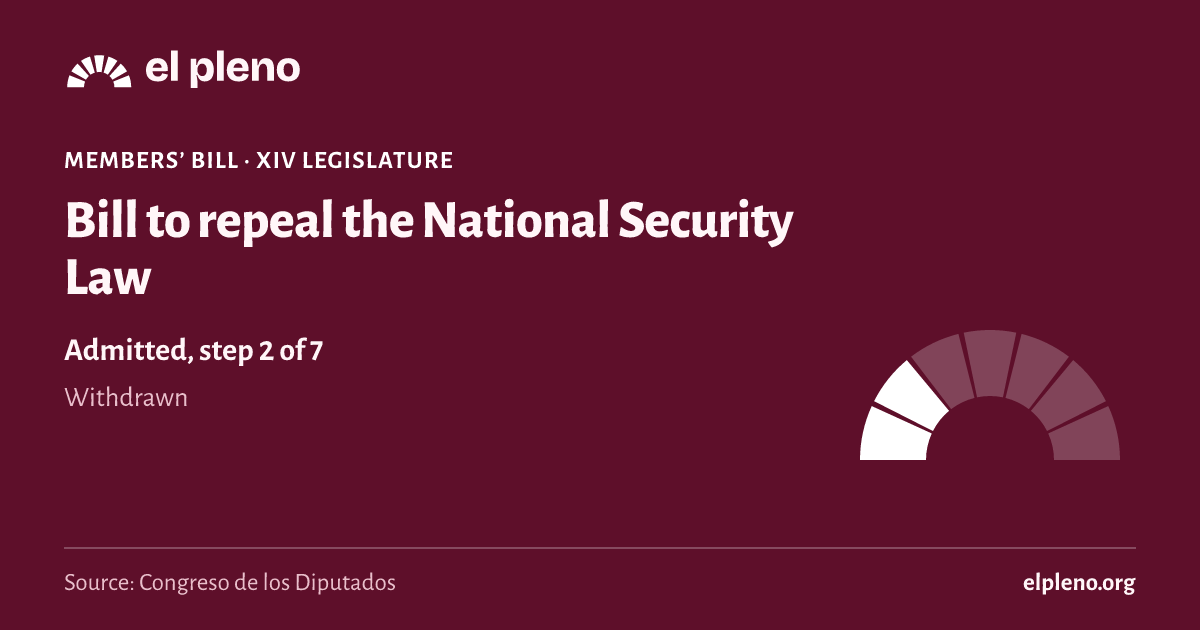
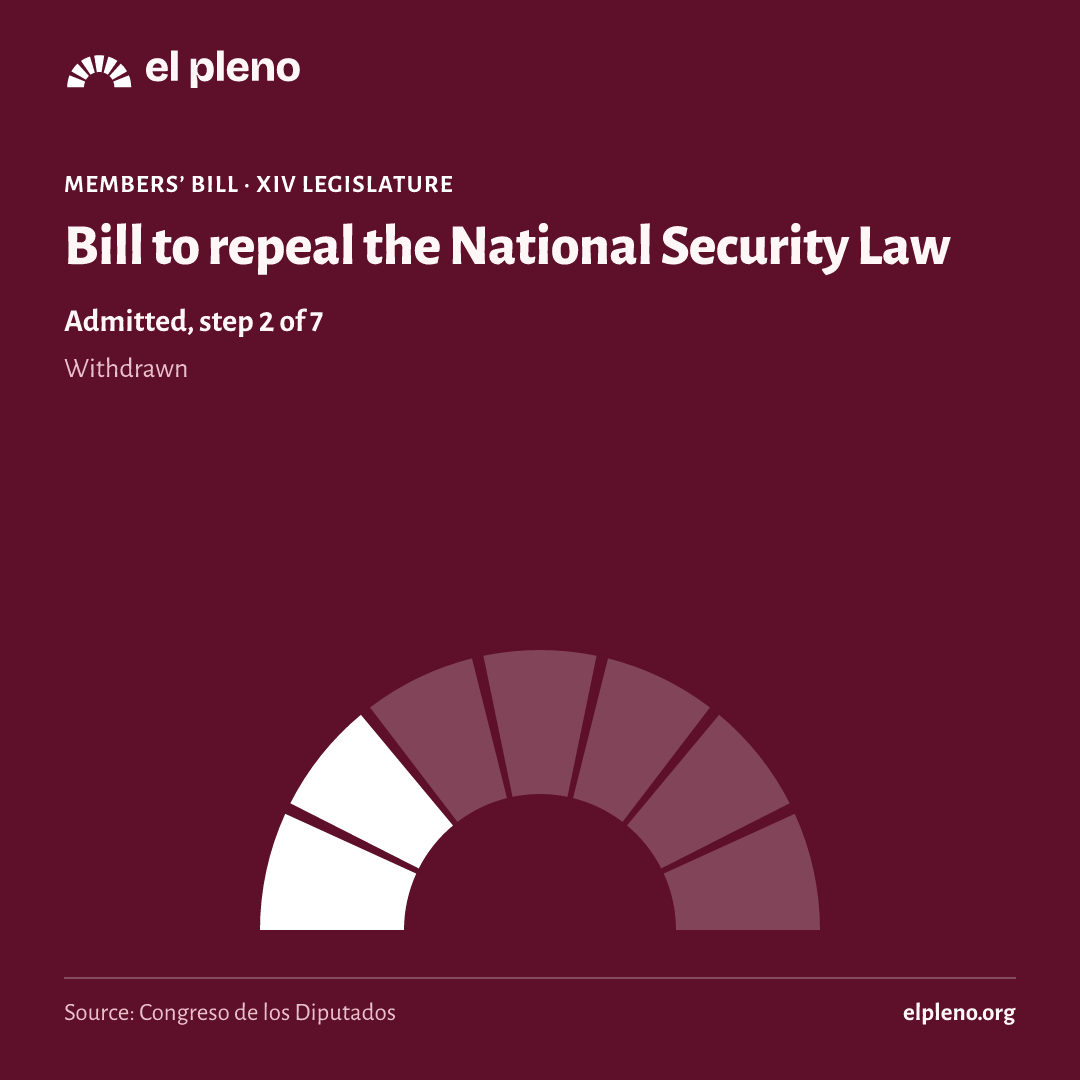
Source: Congreso de los Diputados, file 122/000152· updated 11 Nov
Automatic summary, not yet reviewed
- The bill would repeal Law 36/2015, of September 28, on National Security, in full.
- The sponsors argue that the concept of national security is vague and ambiguous, and that it does not appear in the 1978 Constitution, which creates legal uncertainty.
- They argue the law is unnecessary because specific rules already exist on defense, public safety and the State's foreign action.
- They also criticize that the law lets the central Government take over resources and powers of the autonomous communities during crises, through Royal Decrees and without the legislature's involvement.
Who it affects
- The Government and the Office of the Prime Minister: Would lose the framework that lets it centralize resources and powers in situations of interest for national security.
- The autonomous communities: Would regain the role that, according to the bill, the law took away by leaving them as spectators before the National Security Council.
- The regional police forces of Catalonia and the Basque Country: Would no longer depend on Royal Decrees and the National Security Council during crises, according to the explanatory statement.
- Public administrations in general: Would lose the legal framework governing their action on national security matters.
Words worth knowing
- Derogar (repeal)
- To end the validity of a law, as if it were erased from the legal system.
- Proposición de ley
- A bill introduced by a parliamentary group; it is not an approved law yet.
- Real Decreto (Royal Decree)
- A rule issued by the Government, without full parliamentary debate.
- Ley Orgánica (Organic Law)
- A law reserved for major matters, requiring a special majority in the Congress of Deputies.
It summarizes the text as it was introduced. It is written by artificial intelligence and may contain mistakes: the official text is what counts. Read the official text · How we make summaries
Where it stands
How far did it get?
It took 2 of 7 steps. It reached Admitted, and today it is withdrawn.
- Introduced20 July 2021Someone registers the text in the Congreso.
- Admitted25 August 2021The Bureau of the Congreso accepts it and, for a members’ bill, the plenary decides whether to consider it.
- Amendmentsnot reachedGroups propose changes.
- Committeenot reachedA committee goes through the text in detail.
- Plenarynot reachedAll 350 deputies vote.
- Senatenot reachedThe Senate can pass it, amend it or veto it.
- BOEnot reachedIt is published in the Official State Gazette (BOE) and comes into force.
See the 6 official steps on a timeline
Was there a plenary vote?
We have no plenary vote linked to this law in the Congreso’s data.
What happens next
What happens now?
Whoever introduced it withdrew it, or it was merged into another one. It goes no further.
Sources
Where does all this come from?
- Congreso de los Diputados, file 122/000152
Official title, type, author, dates and stage.
Retrieved 11 November 2026
- The data comes from the open files of the Congreso, the Senate and the BOE, unaltered.
- Each deputy’s province is the one of their seat on the day of the vote.
- We only say “passed” or “rejected” when the majority needed is certain; otherwise we say which side had more votes.