What it is
Bill to digitalize Spanish businesses, government and technology
It is a members’ bill. Introduced by parliamentary groups, the Senate, regional governments or citizens. It was introduced on 22 June 2021. Introduced by: Grupo Parlamentario Popular en el Congreso.
Official title: Private member's bill for the Digital Transformation of Spain.
Source: Congreso de los Diputados, file 122/000148· updated 11 Nov
Automatic summary, not yet reviewed
- The bill would set the foundations for digital transformation in Spain: helping companies go digital, regulating new technologies such as artificial intelligence or drones, and strengthening citizens' digital rights.
- It would create a "cien por cien digital" certificate for small and medium-sized businesses, with tax incentives attached. Within two years, public subsidies for SMEs would require holding it, and companies would need to submit a digitalization plan to get it.
- It would give tax breaks to startups: a 50% corporate tax rebate during the first two years, an income tax The personal income tax (IRPF in Spain): what people pay on what they earn from work, business or savings. exemption on capital gains if reinvested in another startup, and company setup or closure procedures completed within 48 hours.
- It would create a multisector Sandbox A controlled testing space where companies can experiment with new products without meeting all the usual rules, under supervision., a controlled space where companies can test innovative products and business models without meeting all the usual rules, under supervision. Not only in finance, but also in sectors like energy, health or logistics.
- It would lower the tax burden on telecom companies: it would merge the business tax categories into a single one called "Comunicaciones electrónicas", set the general operator fee at 0.5 per thousand, and set the numbering fee at €0.02.
- It would regulate drones: the State Aviation Safety Agency would produce, within twelve months, a National Airway Plan with exclusive air corridors, deliveries in urban and hard-to-reach areas would be allowed, and town councils could use drones for policing, emergencies and parcel delivery.
- It would organize the world of cryptocurrencies and Blockchain A shared, unchangeable record book where transactions are logged securely and without intermediaries.: cryptocurrencies could be accepted to pay private debts, initial coin offerings would be treated as negotiable securities, a National Council of Crypto-assets would be created, and blockchain would be accepted as evidence in court.
- It would strengthen citizen protection: guaranteeing internet access and digital rights, banning planned obsolescence of tech products, protecting minors online, and creating a Strategic Cybersecurity Talent Reserve made up of volunteer reservists.
Who it affects
- Small and medium-sized businesses: They would need to digitalize and obtain the "cien por cien digital" certificate to access public aid, with tax incentives in return.
- Entrepreneurs and startups: They would get tax breaks, 48-hour fast-track procedures and easier financing.
- Telecom operators: Their tax burden would be reduced so they can invest more in networks.
- Consumers and users: Their digital rights would be guaranteed, with protection against planned obsolescence and more security when shopping online.
- Families and minors: They would get campaigns, training and tools for safe internet use and protection against cyberbullying.
Words worth knowing
- Sandbox
- A controlled testing space where companies can experiment with new products without meeting all the usual rules, under supervision.
- Obsolescencia programada (planned obsolescence)
- Designing products to stop working or lose spare parts after a calculated time, forcing people to buy a new one.
- Blockchain
- A shared, unchangeable record book where transactions are logged securely and without intermediaries.
- ICO (Oferta Inicial de Moneda, initial coin offering)
- A way to fund projects by selling digital tokens, similar to cryptocurrencies.
- IAE
- Impuesto de Actividades Económicas, the Spanish business activity tax paid by companies.
- income tax
- The personal income tax (IRPF in Spain): what people pay on what they earn from work, business or savings.
It summarizes the text as it was introduced. It is written by artificial intelligence and may contain mistakes: the official text is what counts. Read the official text · How we make summaries
Where it stands
How far did it get?
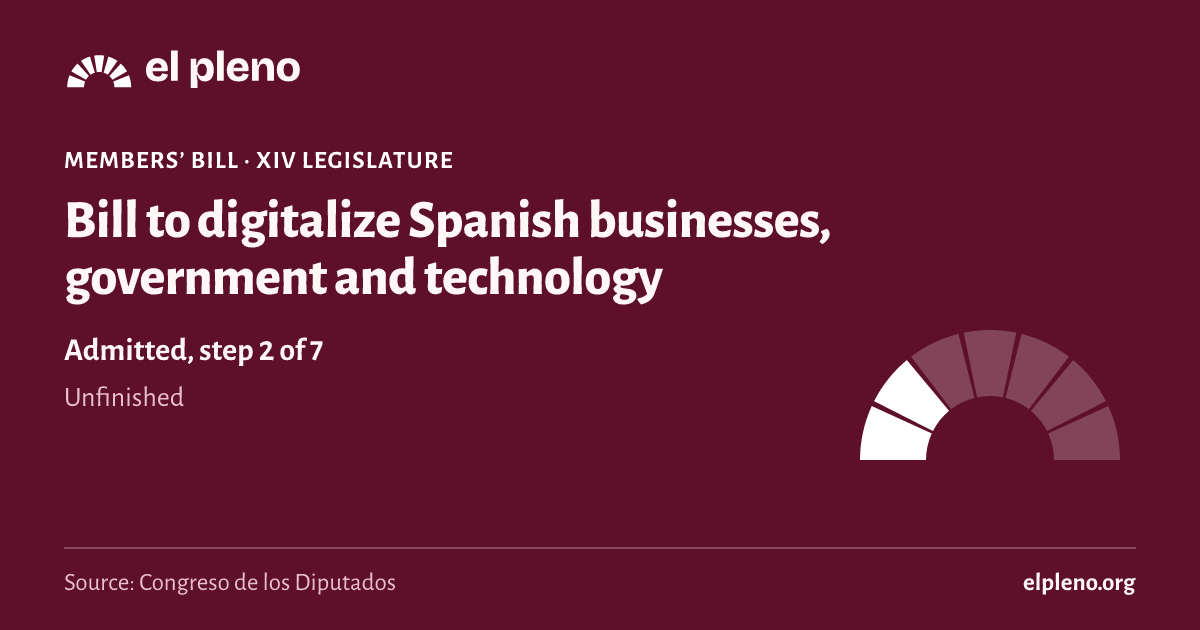
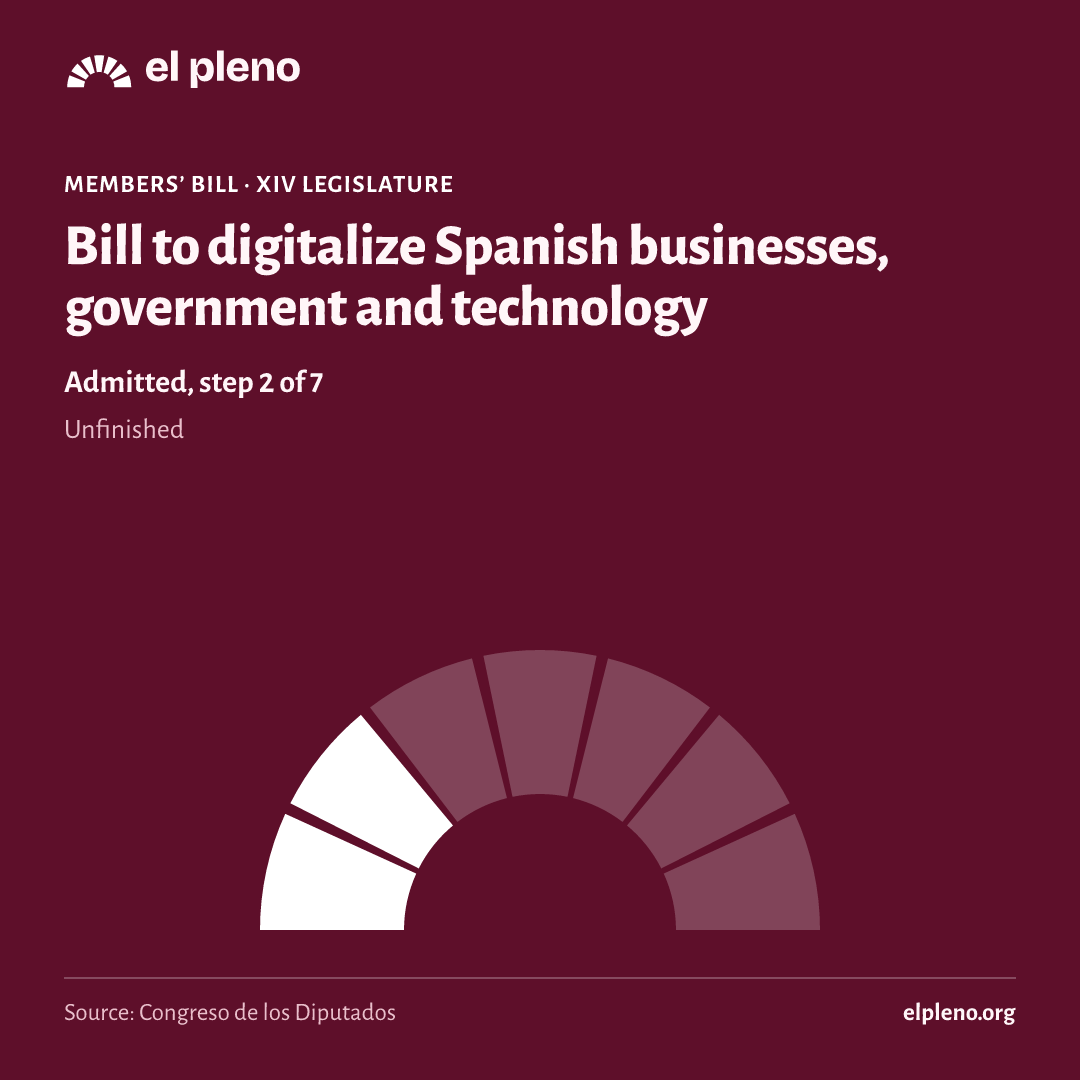
It took 2 of 7 steps. It reached Admitted, and today it is unfinished.
- Introduced22 June 2021Someone registers the text in the Congreso.
- Admitted20 July 2021The Bureau of the Congreso accepts it and, for a members’ bill, the plenary decides whether to consider it.
- Amendmentsnot reachedGroups propose changes.
- Committeenot reachedA committee goes through the text in detail.
- Plenarynot reachedAll 350 deputies vote.
- Senatenot reachedThe Senate can pass it, amend it or veto it.
- BOEnot reachedIt is published in the Official State Gazette (BOE) and comes into force.
See the 6 official steps on a timeline
Was there a plenary vote?
We have no plenary vote linked to this law in the Congreso’s data.
What happens next
What happens now?
The legislature ended before it finished. To go on, someone would have to introduce it again in the new Cortes.
It has not been presented again yet.
Sources
Where does all this come from?
- Congreso de los Diputados, file 122/000148
Official title, type, author, dates and stage.
Retrieved 11 November 2026
- The data comes from the open files of the Congreso, the Senate and the BOE, unaltered.
- Each deputy’s province is the one of their seat on the day of the vote.
- We only say “passed” or “rejected” when the majority needed is certain; otherwise we say which side had more votes.