What it is
Proposal to raise the IRPF Impuesto sobre la Renta de las Personas Físicas, the personal income tax individuals pay on their earnings. share that funds social organizations
It is a members’ bill. Introduced by parliamentary groups, the Senate, regional governments or citizens. It was introduced on 23 April 2021. Introduced by: Grupo Parlamentario Popular en el Congreso.
Official title: Private member's bill on the allocation of funds to activities of general interest considered to be of social interest.
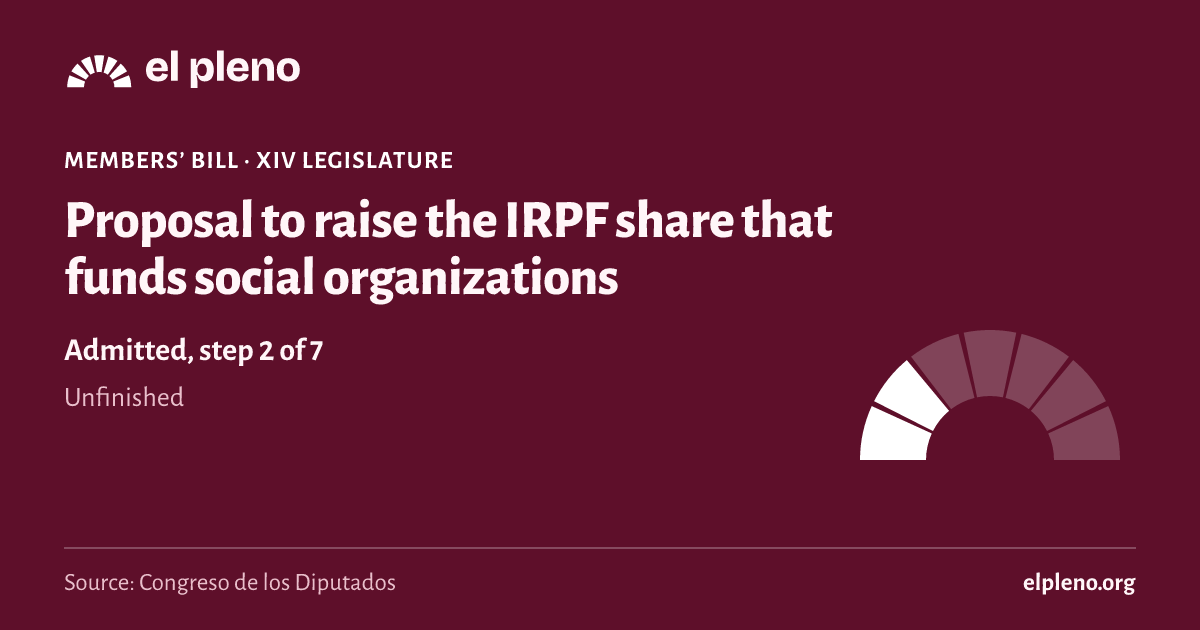
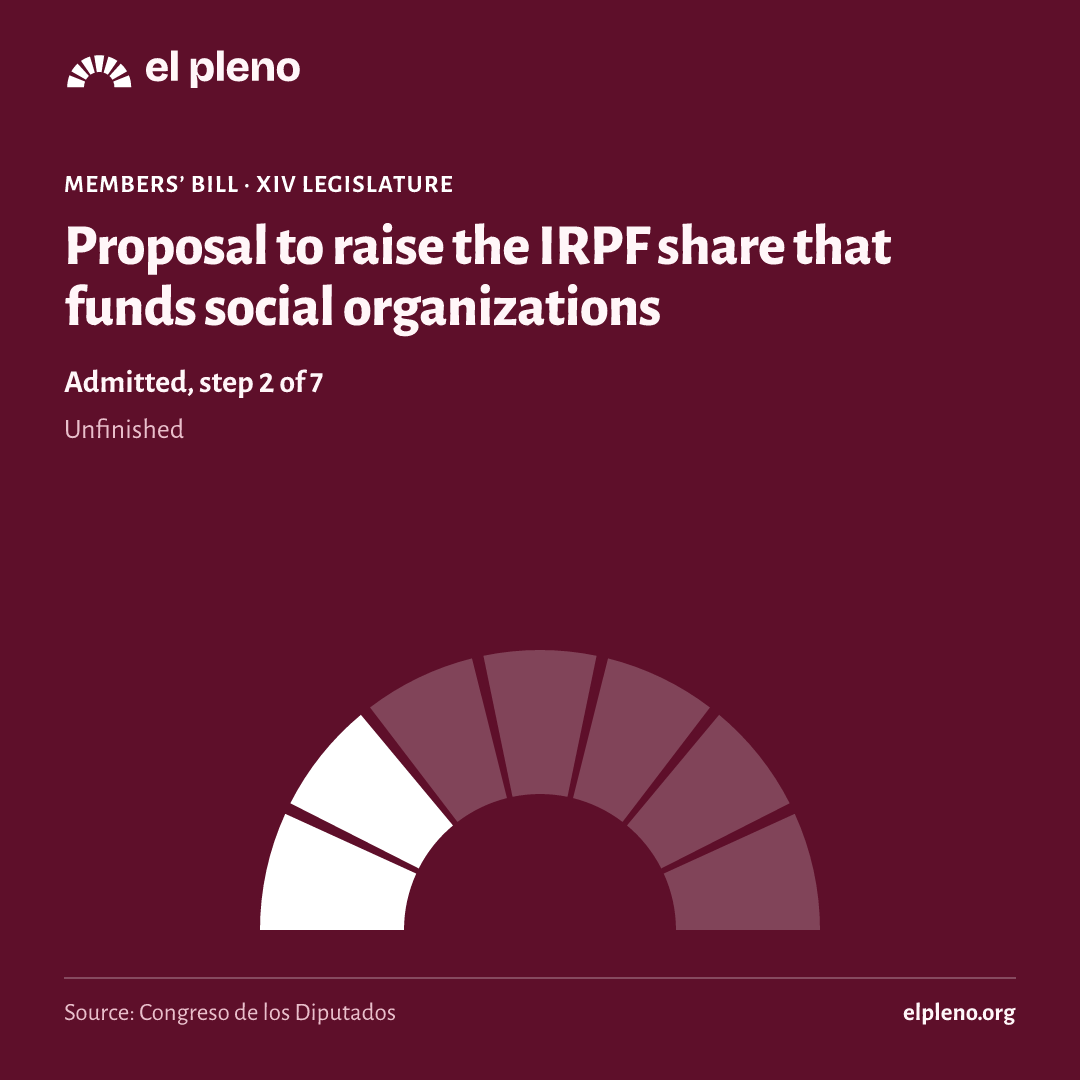
Source: Congreso de los Diputados, file 122/000142· updated 11 Nov
Automatic summary, not yet reviewed
- The bill would raise the share of personal income tax The personal income tax (IRPF in Spain): what people pay on what they earn from work, business or savings. (IRPF) earmarked for activities of general interest from 0.7% to 1%. It argues that social sector organizations are serving more people because of the COVID-19 crisis and risk losing funding.
- The bill would allocate 1% of the full tax liability of taxpayers who expressly request it to subsidizing activities of general interest considered of social interest. The money would be split among three ministries: 77.72% to Social Services, 19.43% to cooperation, and 2.85% to the Environment and Demographic Challenge.
- It would also allocate 0.7% of the full tax liability under the Corporate Income Tax of taxpayers who expressly request it to projects by state-wide social organizations. All of that money would go to the ministry responsible for Social Services.
- The law would take effect the day after its publication in the Official State Gazette, except for measures that increase spending or reduce budget revenue, which would wait until the following budget year.
Who it affects
- Personal income tax (IRPF) taxpayers: Taxpayers who check the box for social purposes: 1% of their full tax liability would go to these activities.
- Corporate Income Tax taxpayers: Taxpayers who expressly request it: 0.7% of their full tax liability would be allocated.
- State-wide Social Action Third Sector organizations: They would receive the subsidies to fund their social interest activities.
- Ministries responsible for Social Services, cooperation, and the Environment and Demographic Challenge: They would manage and award the subsidies according to the set percentages.
Words worth knowing
- Cuota íntegra
- The amount resulting from applying tax rates to income, before deductions and payments already made.
- Tercer Sector de Acción Social
- The group of nonprofit organizations that help people in vulnerable situations.
- IRPF
- Impuesto sobre la Renta de las Personas Físicas, the personal income tax individuals pay on their earnings.
- Concurrencia competitiva
- A grant system where organizations submit projects and the best-rated ones are selected.
- income tax
- The personal income tax (IRPF in Spain): what people pay on what they earn from work, business or savings.
It summarizes the text as it was introduced. It is written by artificial intelligence and may contain mistakes: the official text is what counts. Read the official text · How we make summaries
Where it stands
How far did it get?
It took 2 of 7 steps. It reached Admitted, and today it is unfinished.
- Introduced23 April 2021Someone registers the text in the Congreso.
- Admitted5 May 2021The Bureau of the Congreso accepts it and, for a members’ bill, the plenary decides whether to consider it.
- Amendmentsnot reachedGroups propose changes.
- Committeenot reachedA committee goes through the text in detail.
- Plenarynot reachedAll 350 deputies vote.
- Senatenot reachedThe Senate can pass it, amend it or veto it.
- BOEnot reachedIt is published in the Official State Gazette (BOE) and comes into force.
See the 6 official steps on a timeline
Was there a plenary vote?
We have no plenary vote linked to this law in the Congreso’s data.
What happens next
What happens now?
The legislature ended before it finished. To go on, someone would have to introduce it again in the new Cortes.
It has not been presented again yet.
Sources
Where does all this come from?
- Congreso de los Diputados, file 122/000142
Official title, type, author, dates and stage.
Retrieved 11 November 2026
- The data comes from the open files of the Congreso, the Senate and the BOE, unaltered.
- Each deputy’s province is the one of their seat on the day of the vote.
- We only say “passed” or “rejected” when the majority needed is certain; otherwise we say which side had more votes.