What it is
Bill to promote philanthropy with public recognition and tax breaks
It is a members’ bill. Introduced by parliamentary groups, the Senate, regional governments or citizens. It was introduced on 26 March 2021. Introduced by: Grupo Parlamentario Popular en el Congreso.
Official title: Private member's bill on the promotion of patronage.
Source: Congreso de los Diputados, file 122/000137· updated 11 Nov
Automatic summary, not yet reviewed
- The bill would define patronage (mecenazgo) as private contribution to general interest purposes, preferably cultural, social, sports or scientific, and would count as patronage activities ranging from donations to volunteering, corporate social responsibility, scholarships or grassroots sports.
- It would create social recognition measures: a National Patronage Award, an annual Patronage Day, a patron recognition card (automatic for companies in the UN Global Compact) and a public registry with voluntary enrollment.
- It would create an interministerial Patronage Commission, with private sector and civil society representatives, which would draft a National Patronage Strategy approved by the Council of Ministers and ratified by a qualified majority in both chambers.
- It would raise tax deductions for donations: under personal income tax The personal income tax (IRPF in Spain): what people pay on what they earn from work, business or savings., 80% on the first 175 euros of the deduction base and 50% on the rest (80% for repeat donors); under corporate tax, 60% (70% for repeat donors).
- Cash donations to state-owned museums would generate budget credit for the museums' activities, and the Government would have to adapt the rules so museums can receive and manage patronage funds.
- The law would take effect the day after its publication in the Official State Gazette, except for measures with budget impact, which would wait until the following fiscal year.
Who it affects
- Individuals and companies that donate or volunteer: They could be recognized as patrons, receive a card and apply larger tax deductions.
- Nonprofit entities and other beneficiary entities: They would receive donations eligible for tax deductions.
- State-owned museums: They would have to promote patronage and could receive cash donations that generate budget credit.
- Public administrations: They would have to foster a culture of patronage and support beneficiaries.
- Autonomous Communities (regional governments): They would receive the results of the National Patronage Strategy through sectoral conferences.
Words worth knowing
- Mecenazgo (patronage)
- Private support, with money or other means, for activities of general interest such as culture, science or sports.
- Deducción fiscal (tax deduction)
- An amount subtracted from the tax you owe because of an expense or donation.
- IRPF (personal income tax)
- Spain's personal income tax, paid by individuals on their income.
- Micromecenazgo (micro-patronage)
- Small cash donations made through participatory platforms, like crowdfunding.
- Generación de crédito (budget credit generation)
- A budget mechanism that allows money raised for a specific purpose to be spent without waiting for the next budget.
- income tax
- The personal income tax (IRPF in Spain): what people pay on what they earn from work, business or savings.
It summarizes the text as it was introduced. It is written by artificial intelligence and may contain mistakes: the official text is what counts. Read the official text · How we make summaries
Where it stands
How far did it get?
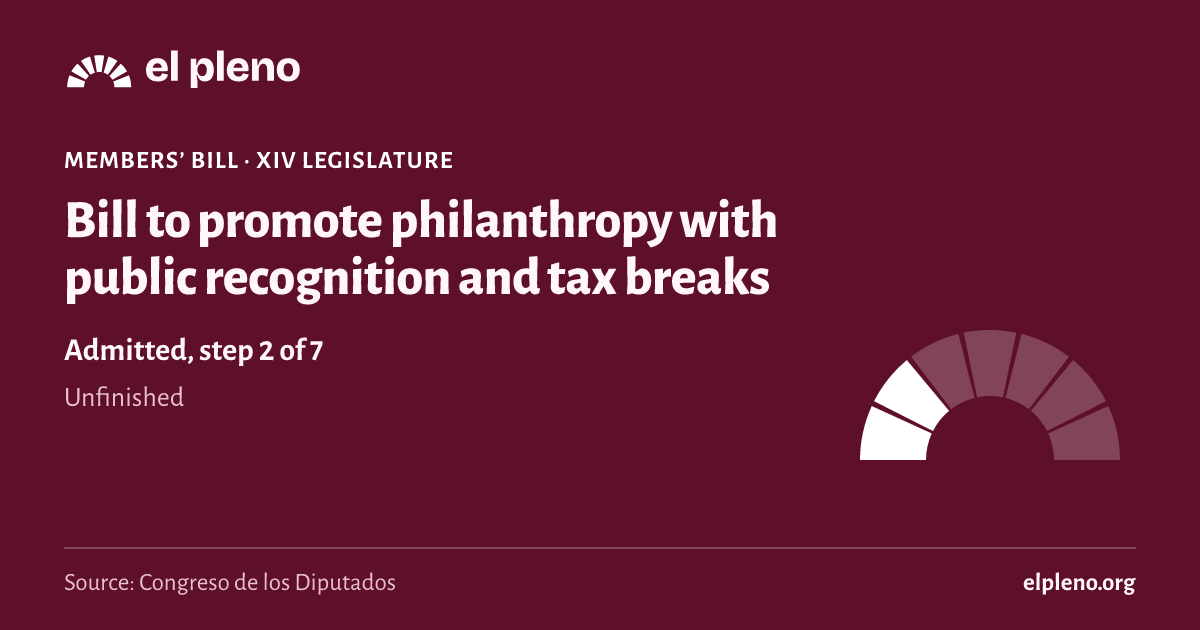
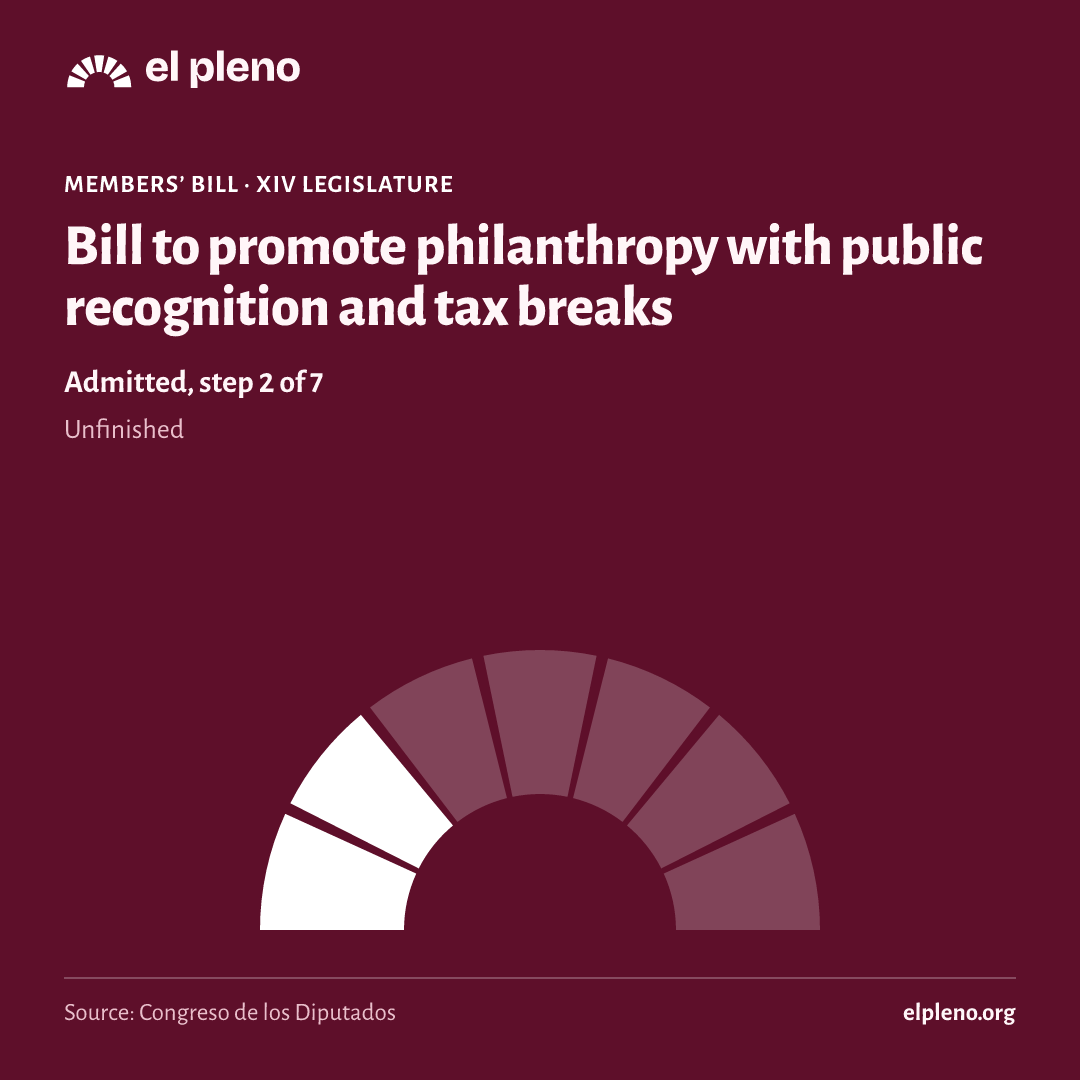
It took 2 of 7 steps. It reached Admitted, and today it is unfinished.
- Introduced26 March 2021Someone registers the text in the Congreso.
- Admitted6 April 2021The Bureau of the Congreso accepts it and, for a members’ bill, the plenary decides whether to consider it.
- Amendmentsnot reachedGroups propose changes.
- Committeenot reachedA committee goes through the text in detail.
- Plenarynot reachedAll 350 deputies vote.
- Senatenot reachedThe Senate can pass it, amend it or veto it.
- BOEnot reachedIt is published in the Official State Gazette (BOE) and comes into force.
See the 6 official steps on a timeline
Was there a plenary vote?
We have no plenary vote linked to this law in the Congreso’s data.
What happens next
What happens now?
The legislature ended before it finished. To go on, someone would have to introduce it again in the new Cortes.
It has not been presented again yet.
Presented before in:
- XII Legislature, Congreso de los Diputados· Unfinished Proposal to promote philanthropy with awards, recognition and tax breaks
Sources
Where does all this come from?
- Congreso de los Diputados, file 122/000137
Official title, type, author, dates and stage.
Retrieved 11 November 2026
- The data comes from the open files of the Congreso, the Senate and the BOE, unaltered.
- Each deputy’s province is the one of their seat on the day of the vote.
- We only say “passed” or “rejected” when the majority needed is certain; otherwise we say which side had more votes.