What it is
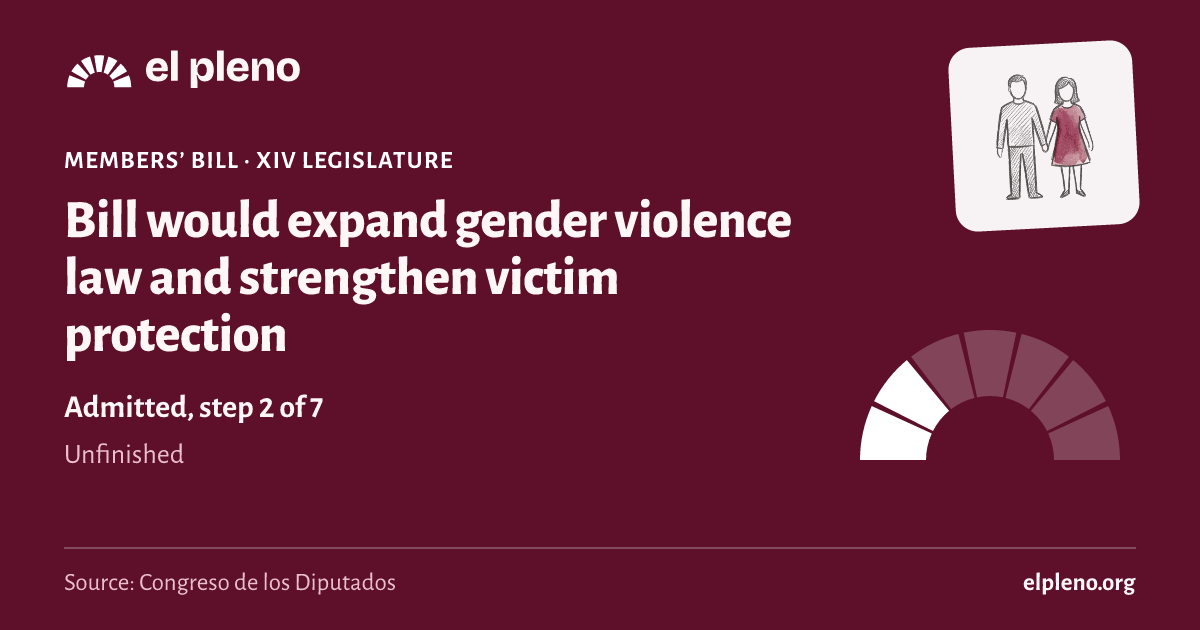
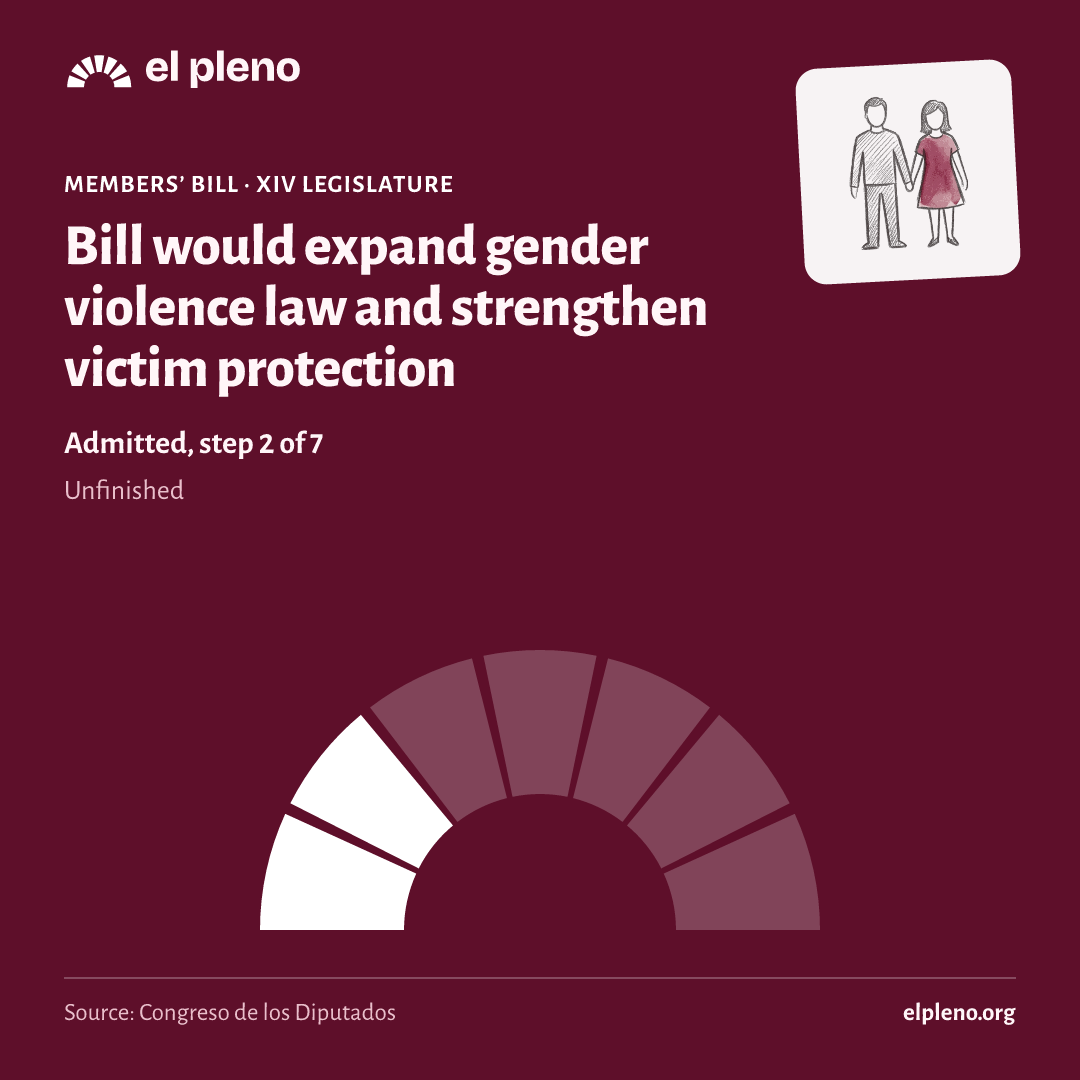
Bill would expand gender violence Violence a woman suffers from a current or former partner because she is a woman. law and strengthen victim protection
It is a members’ bill. Introduced by parliamentary groups, the Senate, regional governments or citizens. It was introduced on 26 November 2020. Introduced by: Grupo Parlamentario Ciudadanos.
Official title: Private member's bill on measures for the development of the State Pact against Gender-Based Violence.
Source: Congreso de los Diputados, file 122/000108· updated 11 Nov
Automatic summary, not yet reviewed
- The bill would expand the concept of gender-based violence to include other forms of violence against women, such as sexual violence, economic violence, trafficking, sexual exploitation, female genital mutilation and forced marriages, even without a partner relationship.
- Minor children and minors under the victim's custody would be recognized as victims of gender-based violence for all purposes, and their right to comprehensive social assistance would be extended to them.
- Women victims of gender-based violence would have the right to immediate access to public housing through social rental, both when there is risk and when they are in economic vulnerability.
- The exemption from testifying or reporting crimes would be removed for spouses and other relatives when the victim is a minor or a person with disabilities, so the exemption cannot shield the aggressor.
- The Criminal Code would be amended to aggravate penalties when several crimes are committed against the same person, extend restraining orders, and ban weapon possession in trafficking, sexual offense and coercion cases.
- In the workplace, equality plans would be reinforced, an equality representative would be created in companies and in government, and at least 2 percent of public sector jobs would be reserved for women victims of gender-based violence.
- Companies that fail to create or apply an equality plan when legally required could not sign public contracts or receive public subsidies.
- The Government would have twelve months to approve a bill on comprehensive protection for victims of human trafficking, and three months to set up a State Coordination Panel on Sexual Violence.
Who it affects
- Women victims of gender-based violence: They would gain more rights: emergency public housing, priority in social benefits, support and stronger protection.
- Minor children of victims: They would be considered victims for all purposes and entitled to comprehensive social assistance.
- Companies: They would have to comply with equality plans and anti-harassment protocols, and could lose public contracts and subsidies if they do not.
- Public sector workers: There would be job reservations for victims of gender-based violence and equality representatives.
- Families in criminal proceedings for violence: Relatives could not refuse to testify when the victim is a minor or a person with disabilities.
Words worth knowing
- Proposición de ley
- A bill introduced by a parliamentary group. While it is being processed, it is not an approved law.
- Alquiler social
- Social rental: public housing offered at an affordable price to people in need.
- Plan de igualdad
- Equality plan: a set of measures a company must apply to treat women and men equally at work.
- Violencia vicaria
- Vicarious violence: violence against a woman through third parties, for example her children, in order to hurt her.
- Pensión de viudedad
- Widow's pension: a public benefit paid to the partner of a deceased person.
- gender violence
- Violence a woman suffers from a current or former partner because she is a woman.
It summarizes the text as it was introduced. It is written by artificial intelligence and may contain mistakes: the official text is what counts. Read the official text · How we make summaries
Where it stands
How far did it get?
It took 2 of 7 steps. It reached Admitted, and today it is unfinished.
- Introduced26 November 2020Someone registers the text in the Congreso.
- Admitted30 November 2020The Bureau of the Congreso accepts it and, for a members’ bill, the plenary decides whether to consider it.
- Amendmentsnot reachedGroups propose changes.
- Committeenot reachedA committee goes through the text in detail.
- Plenarynot reachedAll 350 deputies vote.
- Senatenot reachedThe Senate can pass it, amend it or veto it.
- BOEnot reachedIt is published in the Official State Gazette (BOE) and comes into force.
See the 6 official steps on a timeline
Was there a plenary vote?
We have no plenary vote linked to this law in the Congreso’s data.
What happens next
What happens now?
The legislature ended before it finished. To go on, someone would have to introduce it again in the new Cortes.
It has not been presented again yet.
Sources
Where does all this come from?
- Congreso de los Diputados, file 122/000108
Official title, type, author, dates and stage.
Retrieved 11 November 2026
- The data comes from the open files of the Congreso, the Senate and the BOE, unaltered.
- Each deputy’s province is the one of their seat on the day of the vote.
- We only say “passed” or “rejected” when the majority needed is certain; otherwise we say which side had more votes.