What it is
Bill to suspend or limit public funding of parties with convicted members
It is a members’ bill. Introduced by parliamentary groups, the Senate, regional governments or citizens. It was introduced on 17 September 2020. Introduced by: Grupo Parlamentario Popular en el Congreso.
Official title: Private member's bill amending Organic Law 8/2007, of 4 July, on the financing of political parties, to suspend or limit state financing of political parties.
Source: Congreso de los Diputados, file 122/000086· updated 11 Nov
Automatic summary, not yet reviewed
- The bill would allow the Council of Ministers to temporarily suspend or partially limit the state public funding of a party when any of its leaders, candidates, elected officials or members has been convicted of crimes listed in Titles XXI to XXIV of the Criminal Code and the party has not taken steps to expel them.
- If the party has expelled the convicted person or taken disciplinary steps toward expulsion, its funding could not be reduced or suspended. The goal is to encourage parties to expel members who commit crimes.
- The Council of Ministers could adopt the measure at the proposal of the Minister of the Interior or at the request of the Congress or the Senate. The decision could be appealed in court.
- The list of crimes includes the most serious offenses against the Constitution, such as rebellion, sedition, terrorism, treason or genocide. The reform does not seek to outlaw parties, but to stop public money from funding criminal activity.
Who it affects
- Political parties receiving state public funding that have convicted members of these crimes without expulsion measures.: Their funding could be temporarily suspended or limited.
- Leaders, candidates, elected officials and members of parties convicted of crimes under Titles XXI to XXIV of the Criminal Code.: Staying in the party without expulsion could cost the party its funding.
- Minister of the Interior, Congress and Senate.: They could propose or request the suspension or limitation of funding.
- The general public.: The aim is to keep public money from funding criminal acts against the Constitution.
Words worth knowing
- Consejo de Ministros
- The Spanish government meeting as a whole, made up of the prime minister and the ministers.
- Código Penal
- Spain's Criminal Code, the law that defines crimes and their punishments.
- Condena penal
- A court ruling finding a person guilty of a crime.
- Ilegalización
- A court decision declaring a political party illegal and banning its activity.
- Proposición de Ley Orgánica
- A bill proposing to change an organic law (a special type of Spanish law), introduced by a parliamentary group and not yet passed.
It summarizes the text as it was introduced. It is written by artificial intelligence and may contain mistakes: the official text is what counts. Read the official text · How we make summaries
Where it stands
How far did it get?
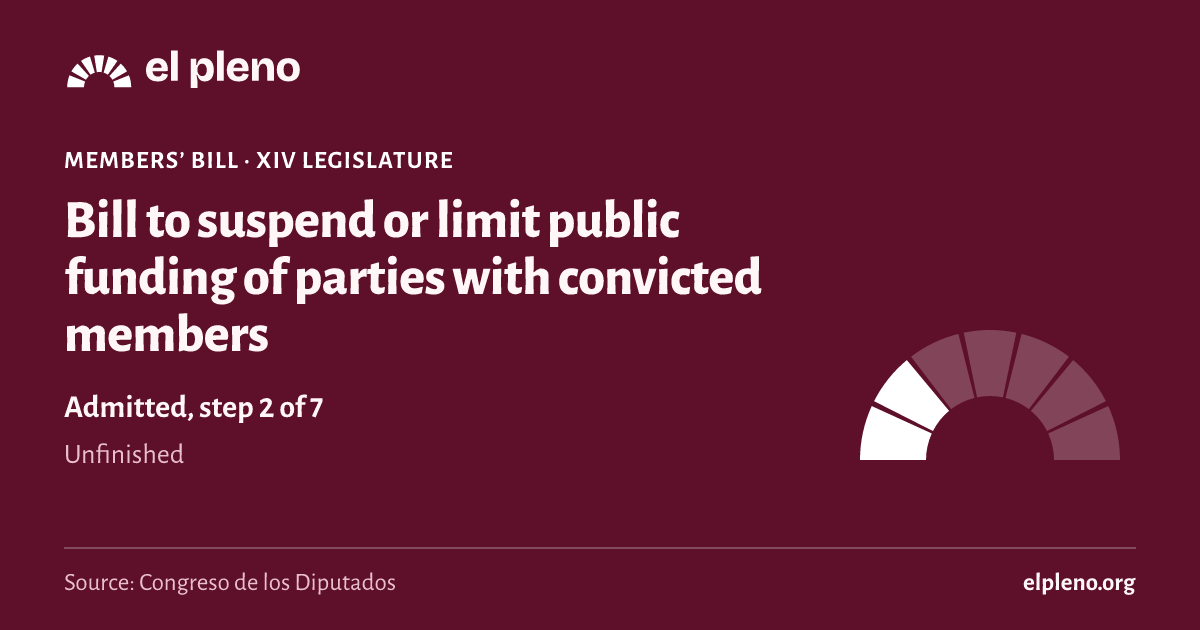
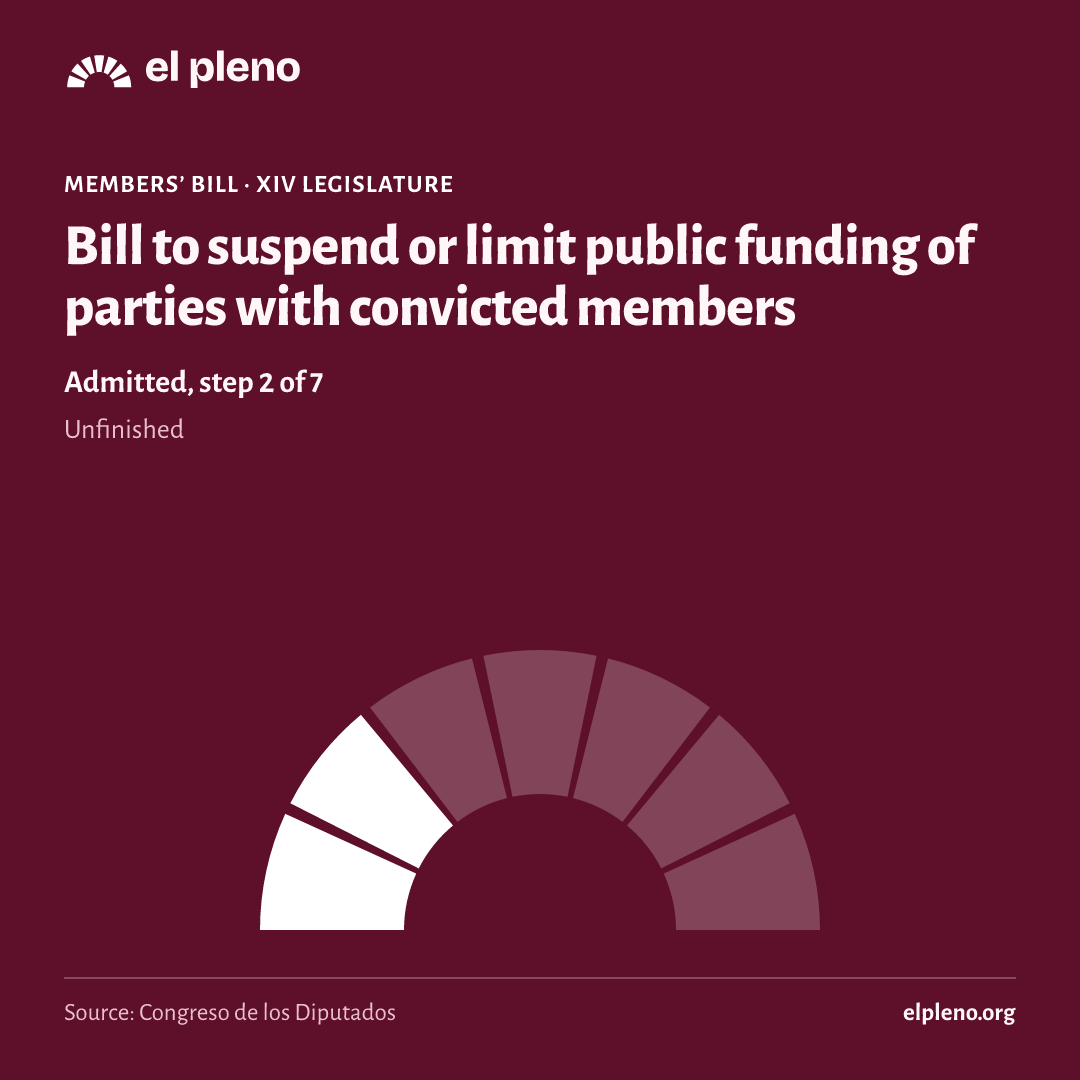
It took 2 of 7 steps. It reached Admitted, and today it is unfinished.
- Introduced17 September 2020Someone registers the text in the Congreso.
- Admitted22 September 2020The Bureau of the Congreso accepts it and, for a members’ bill, the plenary decides whether to consider it.
- Amendmentsnot reachedGroups propose changes.
- Committeenot reachedA committee goes through the text in detail.
- Plenarynot reachedAll 350 deputies vote.
- Senatenot reachedThe Senate can pass it, amend it or veto it.
- BOEnot reachedIt is published in the Official State Gazette (BOE) and comes into force.
See the 6 official steps on a timeline
Was there a plenary vote?
We have no plenary vote linked to this law in the Congreso’s data.
What happens next
What happens now?
The legislature ended before it finished. To go on, someone would have to introduce it again in the new Cortes.
It has not been presented again yet.
Presented before in:
- XII Legislature, Congreso de los Diputados· Unfinished· nearly the same title Bill to suspend public funding of parties whose members are convicted of serious crimes
Sources
Where does all this come from?
- Congreso de los Diputados, file 122/000086
Official title, type, author, dates and stage.
Retrieved 11 November 2026
- The data comes from the open files of the Congreso, the Senate and the BOE, unaltered.
- Each deputy’s province is the one of their seat on the day of the vote.
- We only say “passed” or “rejected” when the majority needed is certain; otherwise we say which side had more votes.