What it is
Bill to boost digital terrestrial radio in Spain
It is a members’ bill. Introduced by parliamentary groups, the Senate, regional governments or citizens. It was introduced on 14 July 2020. Introduced by: Grupo Parlamentario Plural.
Official title: Private member's bill on urgent measures to boost Digital Terrestrial Sound Broadcasting.
Source: Congreso de los Diputados, file 122/000067· updated 11 Nov
Automatic summary, not yet reviewed
- The bill would require digital terrestrial radio stations to cover at least 90% of the population in their area, with reception equal to FM, including indoors and tunnels. Public stations would have to reach 95%.
- The Government would have to update the national technical plan for digital radio within three months, setting DAB+ as the standard, requiring those coverage levels within three years, and repealing the previous provision on the introduction of digitalization.
- If within four years digital radio does not exceed 40% of the radio audience in its area, the Secretariat of State for Telecommunications would prepare a report, and the Minister would assess listening habits and adopt measures to ensure free-to-air digital radio reception.
- The bill would allow reducing the coverage of medium wave radio to save costs and focus investment on digital radio. RTVE and privately managed stations would have to state which stations they will keep operating and whether they will reduce their power.
- The Government would be authorized to issue the rules needed to develop the law and to guarantee the transition from analog to digital radio.
- The law would enter into force on the same day it is published in the Official State Gazette (Boletín Oficial del Estado).
Who it affects
- Private digital terrestrial radio stations: They would have to guarantee coverage of 90% of the population within three years, with quality equal to FM.
- Public digital radio stations: They would have to guarantee coverage of 95% of the population within three years.
- Medium wave stations: They could reduce their coverage and power to save costs and focus investment on digital radio.
- The Government: It would have to update the technical plans and issue the rules for the transition to digital radio.
- Listeners: They could get more stations and better sound quality, without paying for internet connection.
Words worth knowing
- DAB and DAB+
- European digital terrestrial radio technologies. DAB+ is the newer version and can carry three times as many programs at the same audio quality.
- Ondas medias (medium wave)
- A traditional radio band, now in decline, different from FM.
- Plan técnico nacional
- A rule that organizes how and where radio services can broadcast, with which technology and coverage.
- Gestión directa e indirecta
- Direct management is run by a public entity; indirect management is run by a private company holding a license or concession.
- Proposición de ley
- A bill introduced by members of Congress that still needs to be debated and passed.
It summarizes the text as it was introduced. It is written by artificial intelligence and may contain mistakes: the official text is what counts. Read the official text · How we make summaries
Where it stands
How far did it get?
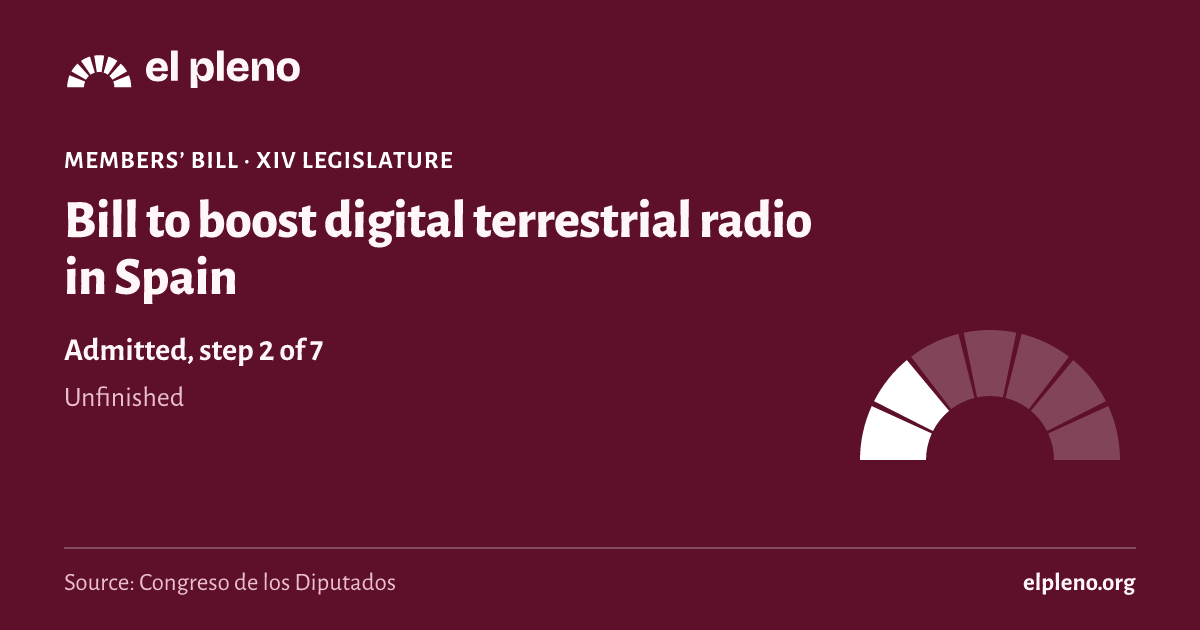
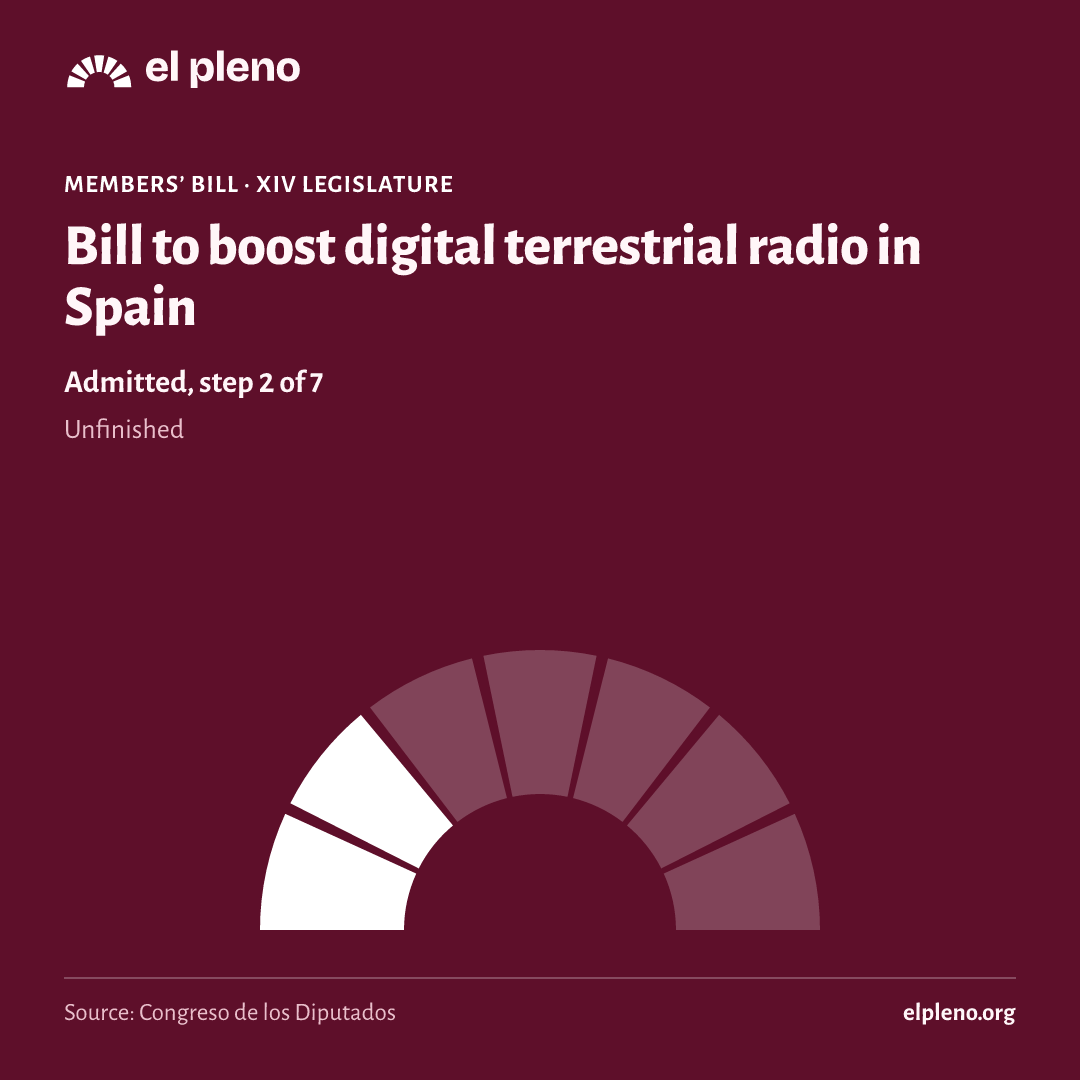
It took 2 of 7 steps. It reached Admitted, and today it is unfinished.
- Introduced14 July 2020Someone registers the text in the Congreso.
- Admitted2 September 2020The Bureau of the Congreso accepts it and, for a members’ bill, the plenary decides whether to consider it.
- Amendmentsnot reachedGroups propose changes.
- Committeenot reachedA committee goes through the text in detail.
- Plenarynot reachedAll 350 deputies vote.
- Senatenot reachedThe Senate can pass it, amend it or veto it.
- BOEnot reachedIt is published in the Official State Gazette (BOE) and comes into force.
See the 7 official steps on a timeline
Was there a plenary vote?
We have no plenary vote linked to this law in the Congreso’s data.
What happens next
What happens now?
The legislature ended before it finished. To go on, someone would have to introduce it again in the new Cortes.
It has not been presented again yet.
The same initiative in the other chamber:
- XIV Legislature, Senate Private member's bill on urgent measures to promote digital terrestrial sound broadcasting.
Sources
Where does all this come from?
- Congreso de los Diputados, file 122/000067
Official title, type, author, dates and stage.
Retrieved 11 November 2026
- The data comes from the open files of the Congreso, the Senate and the BOE, unaltered.
- Each deputy’s province is the one of their seat on the day of the vote.
- We only say “passed” or “rejected” when the majority needed is certain; otherwise we say which side had more votes.