What it is
Bill would limit who can fact-check fake news
It is a members’ bill. Introduced by parliamentary groups, the Senate, regional governments or citizens. It was introduced on 26 June 2020. Introduced by: Grupo Parlamentario VOX.
Official title: Private member's bill on the partial regulation of the verification of fake news on social networks, blogs, websites in general, and print, digital, and audiovisual media.
Source: Congreso de los Diputados, file 122/000064· updated 11 Nov
Automatic summary, not yet reviewed
- The bill would ban fact-checking of fake news on social networks, blogs, websites, the press and audiovisual media by people or entities dependent on governments or with political ties, unless the owner publicly and visibly declares that condition.
- It would ban any fact-checking of fake news carried out by government authorities.
- It would ban any fact-checking of opinions, whether done by the owners of media and platforms or by the government.
- It would reserve the final say on any decision about fake news fact-checking to the courts.
- Social networks, blogs, websites, the press and audiovisual media would be civilly liable if their fact-checking violates freedom of opinion or freedom of information, and affected people could go to court, including for preliminary injunctions.
- It would repeal, where they conflict with this law, the Information Society Services Act, the Press and Printing Act and the General Audiovisual Communication Act. The law would take effect the day after its publication in the official state gazette (BOE).
Who it affects
- Social networks, blogs and websites: They could not assign fake news fact-checking to partisan or government-dependent entities unless they publicly declare it, and they would face civil liability for violations.
- Print, digital and audiovisual media: The same rules on fact-checking and civil liability would apply to them as to digital platforms.
- Government and public authorities: They would be banned from fact-checking fake news and from fact-checking opinions.
- Users, readers, listeners and viewers: They could go to court if their freedom of opinion or information is violated.
- Judges and courts: They would be the only ones with authority to decide on fake news fact-checking.
Words worth knowing
- Verificación de noticias falsas (fact-checking)
- Checking whether a news story is true before or after it is published.
- Ley orgánica (organic law)
- A type of Spanish law that, under the Constitution, is required to develop fundamental rights and needs special majorities in Congress.
- Censura previa (prior censorship)
- When authorities block or control something before it is published. The Spanish Constitution bans it, unless a judge orders it.
- Responsabilidad civil (civil liability)
- The obligation to pay compensation or repair damage caused to another person.
- Justicia cautelar (interim relief)
- Urgent measures a judge can order to protect a right while the case is ongoing.
It summarizes the text as it was introduced. It is written by artificial intelligence and may contain mistakes: the official text is what counts. Read the official text · How we make summaries
Where it stands
How far did it get?
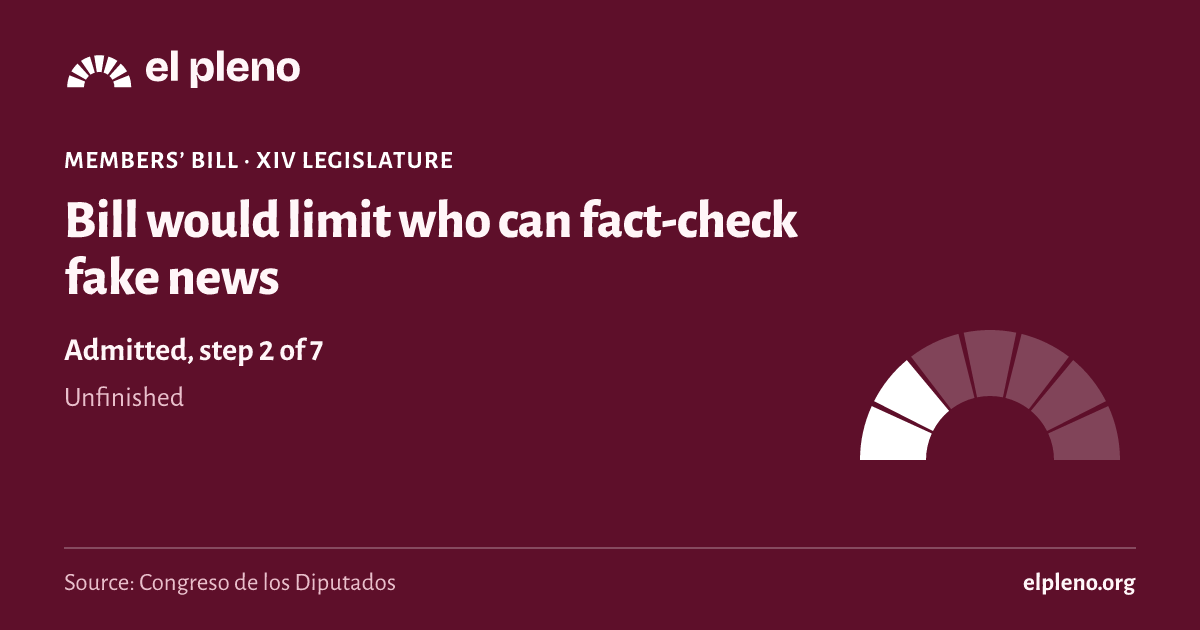
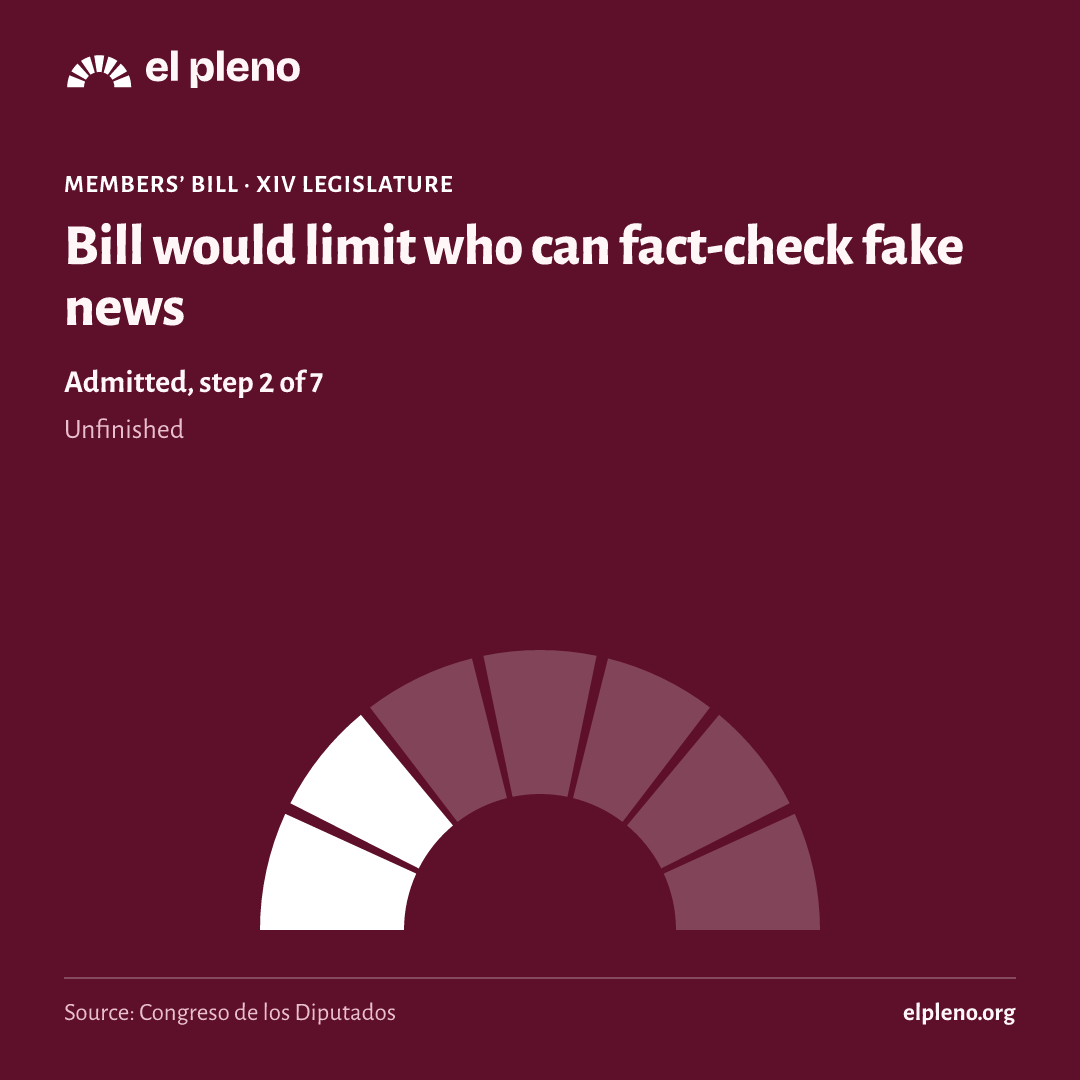
It took 2 of 7 steps. It reached Admitted, and today it is unfinished.
- Introduced26 June 2020Someone registers the text in the Congreso.
- Admitted14 July 2020The Bureau of the Congreso accepts it and, for a members’ bill, the plenary decides whether to consider it.
- Amendmentsnot reachedGroups propose changes.
- Committeenot reachedA committee goes through the text in detail.
- Plenarynot reachedAll 350 deputies vote.
- Senatenot reachedThe Senate can pass it, amend it or veto it.
- BOEnot reachedIt is published in the Official State Gazette (BOE) and comes into force.
See the 6 official steps on a timeline
Was there a plenary vote?
We have no plenary vote linked to this law in the Congreso’s data.
What happens next
What happens now?
The legislature ended before it finished. To go on, someone would have to introduce it again in the new Cortes.
It has not been presented again yet.
Sources
Where does all this come from?
- Congreso de los Diputados, file 122/000064
Official title, type, author, dates and stage.
Retrieved 11 November 2026
- The data comes from the open files of the Congreso, the Senate and the BOE, unaltered.
- Each deputy’s province is the one of their seat on the day of the vote.
- We only say “passed” or “rejected” when the majority needed is certain; otherwise we say which side had more votes.