What it is
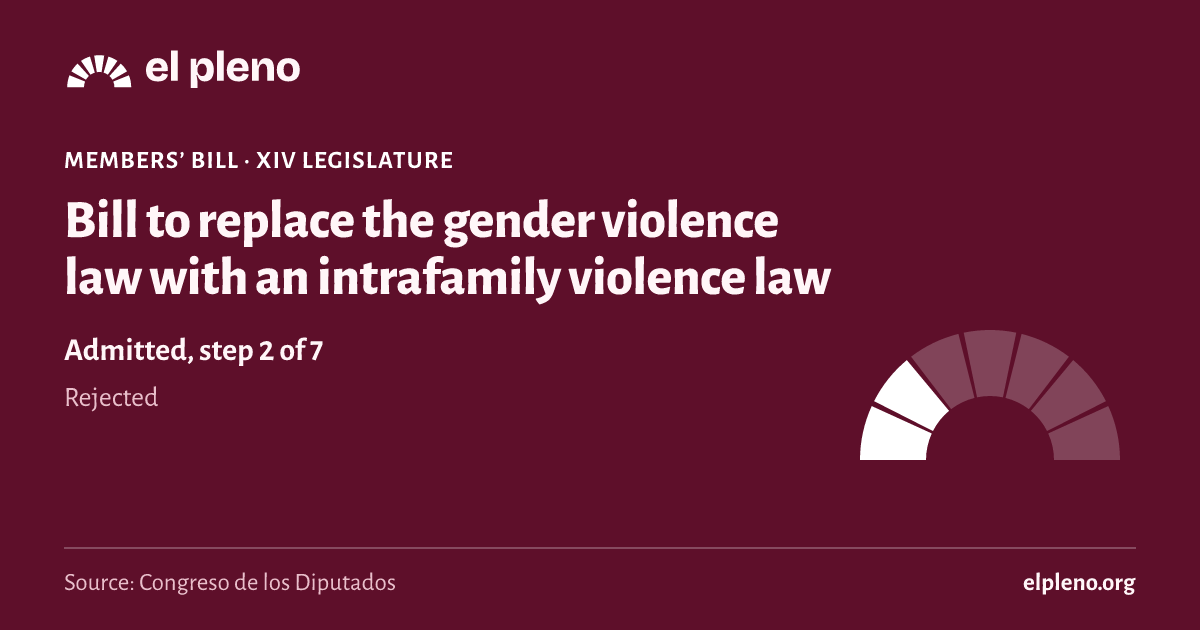
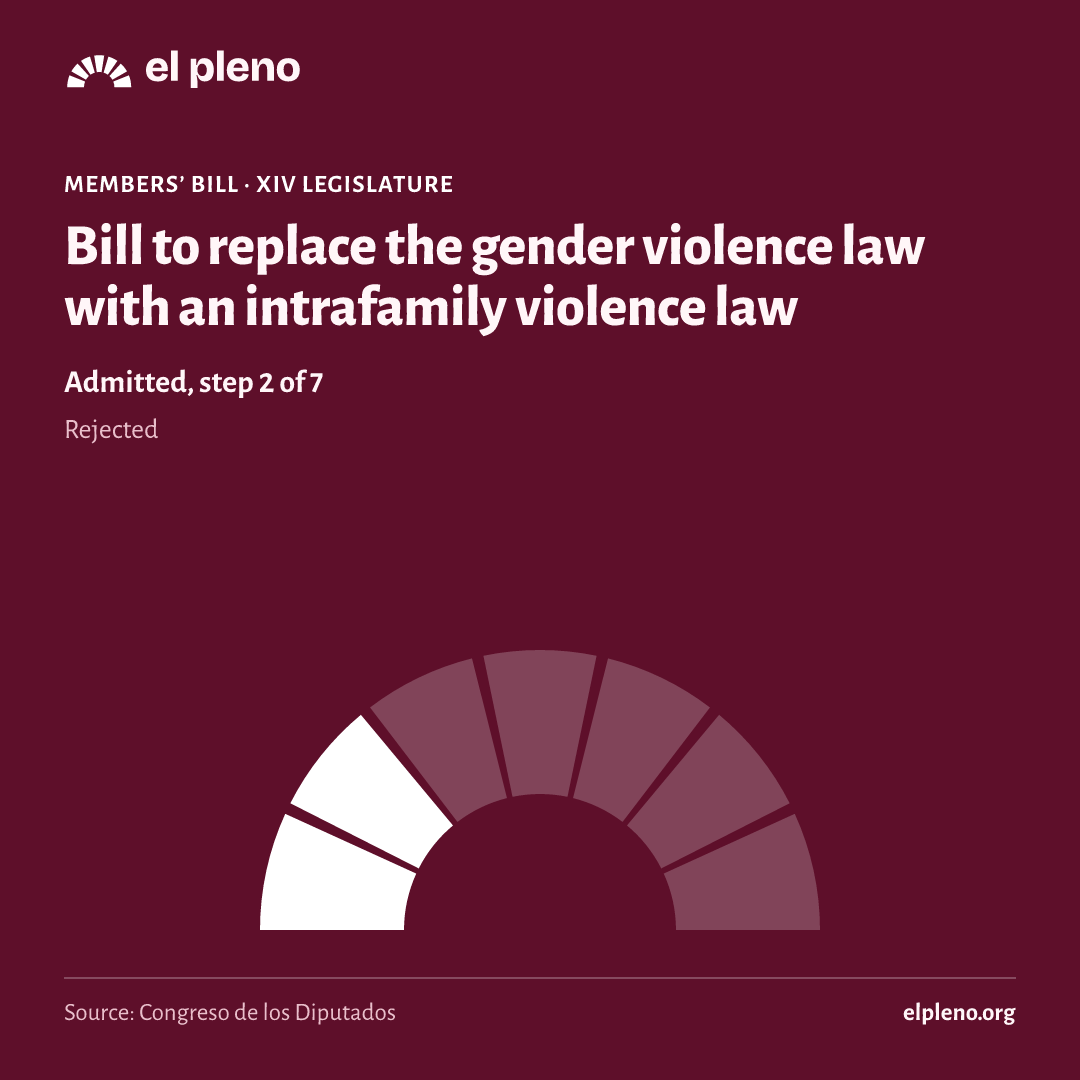
Bill to replace the gender violence Violence a woman suffers from a current or former partner because she is a woman. law with an intrafamily violence law
It is a members’ bill. Introduced by parliamentary groups, the Senate, regional governments or citizens. It was introduced on 21 May 2020. Introduced by: Grupo Parlamentario VOX.
Official title: Organic Private member's bill on Domestic Violence.
Source: Congreso de los Diputados, file 122/000060· updated 11 Nov
Automatic summary, not yet reviewed
- The bill proposes repealing organic law A law on fundamental rights, the electoral system or other matters the Constitution reserves. It needs an absolute majority in the Congreso: 176 votes. 1/2004 on gender violence and replacing it with a law that addresses all violence within the family, regardless of the victim's sex or age.
- It defines intrafamily violence as any physical, sexual, psychological or economic violence between people linked by family relationships, and recognizes as victims both those who suffer it directly and those who live with them.
- The rights under the law would be proven only with a conviction, a protection order or other court rulings, or with a report from the Public Prosecutor's Office. If the complaint is dismissed, the rights are lost and aid must be repaid.
- It extends to all victims of intrafamily violence the rights that current law gives to women: information, social assistance, free legal aid, labor rights and financial aid.
- It toughens penalties for crimes committed within the family, including threats, coercion and assault, and provides for reviewable permanent imprisonment for the murder of people protected by the law.
- It abolishes the Courts of Violence against Women and moves these cases to ordinary first instance and investigating courts, under the general jurisdiction rules.
- It abolishes the State Observatory of Violence against Women and renames the Government delegation and the specialized prosecutor so they refer to intrafamily violence.
- Organizations receiving public funds to help victims would have to spend at least 90% on direct aid and account for its use quarterly.
Words worth knowing
- Ley Orgánica (Organic Law)
- A Spanish law that requires a special majority in the Congress of Deputies and is reserved for major matters such as fundamental rights.
- Prisión permanente revisable (reviewable permanent imprisonment)
- The most severe prison sentence in Spanish law: the convicted person may request a review after a long period, but no release date is set.
- Orden de protección (protection order)
- A court ruling that recognizes a person as a victim and grants them security measures and aid.
- Patria potestad (parental authority)
- The set of rights and duties parents have over their minor children.
- Ministerio Fiscal (Public Prosecutor's Office)
- The public institution that acts in court to defend the law and citizens' rights.
- gender violence
- Violence a woman suffers from a current or former partner because she is a woman.
- organic law
- A law on fundamental rights, the electoral system or other matters the Constitution reserves. It needs an absolute majority in the Congreso: 176 votes.
It summarizes the text as it was introduced. It is written by artificial intelligence and may contain mistakes: the official text is what counts. Read the official text · How we make summaries
Where it stands
How far did it get?
It took 2 of 7 steps. It reached Admitted, and today it is rejected.
- Introduced21 May 2020Someone registers the text in the Congreso.
- Admitted26 May 2020The Bureau of the Congreso accepts it and, for a members’ bill, the plenary decides whether to consider it.
- Amendmentsnot reachedGroups propose changes.
- Committeenot reachedA committee goes through the text in detail.
- Plenarynot reachedAll 350 deputies vote.
- Senatenot reachedThe Senate can pass it, amend it or veto it.
- BOEnot reachedIt is published in the Official State Gazette (BOE) and comes into force.
See the 6 official steps on a timeline
23 February 2021
How did the plenary vote?
Voted on: Private member's bill from the VOX Parliamentary Group, Organic Law on Domestic Violence.
Source: Congreso de los Diputados, vote 1 of sitting 77· updated 11 Nov
Each dot is a seat. Tap one, or use the arrow keys, to see who it is.
Your province
How did the deputies from your province vote?
And your senators: the Senate does not link its votes to this law in its open data, so we cannot put them side by side here.
Or see how most of each province voted
- A Coruña More votes against 0 yes · 8 no
- Albacete More votes against 1 yes · 3 no
- Alicante/Alacant More votes against 3 yes · 9 no
- Almería More votes against 2 yes · 4 no
- Araba/Álava More votes against 0 yes · 4 no
- Asturias More votes against 1 yes · 6 no
- Ávila More votes against 1 yes · 2 no
- Badajoz More votes against 1 yes · 4 no
- Barcelona More votes against 2 yes · 28 no
- Bizkaia More votes against 0 yes · 7 no
- Burgos More votes against 0 yes · 4 no
- Cáceres More votes against 1 yes · 3 no
- Cádiz More votes against 2 yes · 7 no
- Cantabria More votes against 1 yes · 4 no
- Castellón/Castelló More votes against 1 yes · 4 no
- Ceuta More votes in favour 1 yes · 0 no
- Ciudad Real More votes against 1 yes · 4 no
- Córdoba More votes against 1 yes · 5 no
- Cuenca More votes against 0 yes · 3 no
- Gipuzkoa More votes against 0 yes · 5 no
- Girona More votes against 0 yes · 6 no
- Granada More votes against 1 yes · 6 no
- Guadalajara More votes against 1 yes · 2 no
- Huelva More votes against 1 yes · 4 no
- Huesca More votes against 0 yes · 3 no
- Illes Balears More votes against 2 yes · 6 no
- Jaén More votes against 1 yes · 4 no
- La Rioja More votes against 0 yes · 4 no
- Las Palmas More votes against 1 yes · 6 no
- León More votes against 1 yes · 3 no
- Lleida More votes against 0 yes · 4 no
- Lugo More votes against 0 yes · 4 no
- Madrid More votes against 7 yes · 30 no
- Málaga More votes against 2 yes · 9 no
- Melilla More votes against 0 yes · 1 no
- Murcia More votes against 3 yes · 7 no
- Navarra More votes against 0 yes · 5 no
- Ourense More votes against 0 yes · 4 no
- Palencia More votes against 0 yes · 3 no
- Pontevedra More votes against 0 yes · 7 no
- Salamanca More votes against 1 yes · 3 no
- Santa Cruz de Tenerife More votes against 1 yes · 6 no
- Segovia More votes against 1 yes · 2 no
- Sevilla More votes against 2 yes · 10 no
- Soria More votes against 0 yes · 2 no
- Tarragona More votes against 0 yes · 6 no
- Teruel More votes against 0 yes · 3 no
- Toledo More votes against 2 yes · 4 no
- Valencia/València More votes against 3 yes · 11 no
- Valladolid More votes against 1 yes · 4 no
- Zamora More votes against 1 yes · 2 no
- Zaragoza More votes against 1 yes · 6 no
More details: how each group and each province voted
The groups
Who voted in favour and who against?
In favour, most of VOX. Against, most of Euskal Herria Bildu, Republicano, Socialista, Vasco (EAJ-PNV), Mixto, Ciudadanos, Gcup-ec-gc, GPlu and Popular en el Congreso.
By province: in 1 most voted in favour; in 51, against.
Coloured by how most of each province’s deputies voted.
- In favour: 1
- Against: 51
| Group | Seats | How it voted |
|---|---|---|
| Euskal Herria Bildu | 5 | 3 against · 2 did not vote |
| Republicano | 13 | 13 against |
| Socialista | 120 | 120 against |
| Vasco (EAJ-PNV) | 6 | 6 against |
| Mixto | 9 | 7 against · 2 did not vote |
| Ciudadanos | 10 | 10 against |
| Gcup-ec-gc | 35 | 34 against · 1 did not vote |
| GPlu | 12 | 11 against · 1 did not vote |
| Popular en el Congreso | 88 | 87 against · 1 did not vote |
| VOX | 52 | 52 in favour |
What happens next
What happens now?
It goes no further. A similar one could be introduced later.
Sources
Where does all this come from?
- Congreso de los Diputados, file 122/000060
Official title, type, author, dates and stage.
Retrieved 11 November 2026
- Congreso de los Diputados, vote 1 of sitting 77
The count and every seat’s vote.
Retrieved 11 November 2026
- The data comes from the open files of the Congreso, the Senate and the BOE, unaltered.
- Each deputy’s province is the one of their seat on the day of the vote.
- We only say “passed” or “rejected” when the majority needed is certain; otherwise we say which side had more votes.