What it is
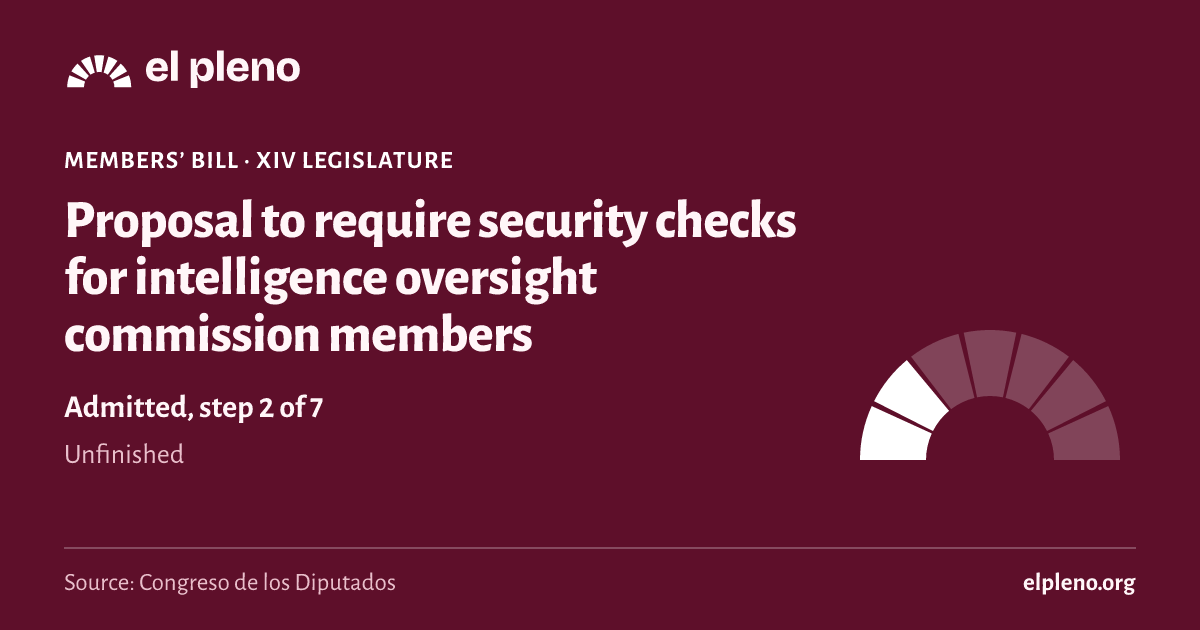
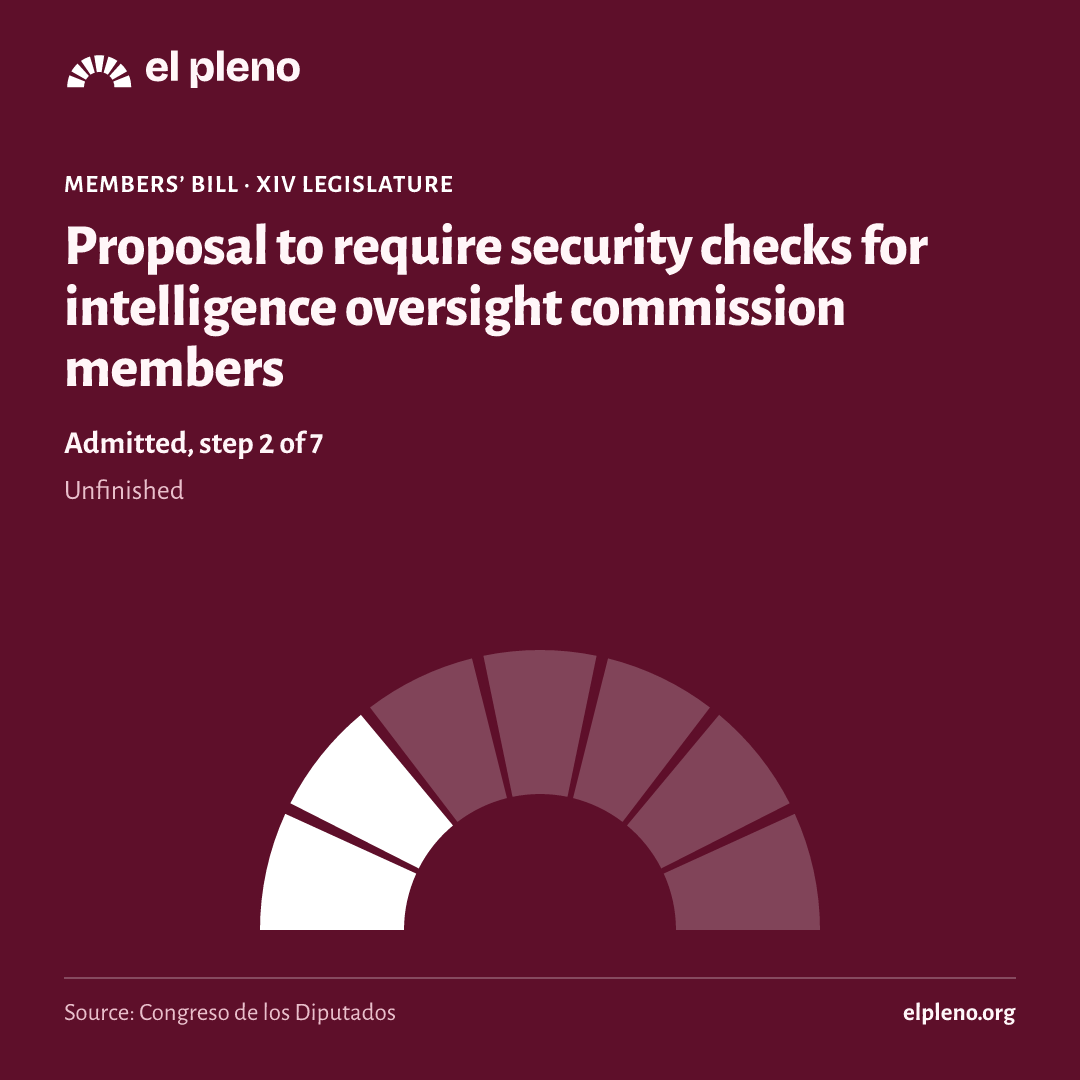
Proposal to require security checks for intelligence oversight commission members
It is a members’ bill. Introduced by parliamentary groups, the Senate, regional governments or citizens. It was introduced on 24 April 2020. Introduced by: Grupo Parlamentario VOX.
Official title: Private member's bill amending Law 11/2002, of 6 May, regulating the National Intelligence Center.
Source: Congreso de los Diputados, file 122/000053· updated 11 Nov
Automatic summary, not yet reviewed
- The bill starts from the fact that current law sets no specific requirements for people joining the Government's Delegated Commission for Intelligence Affairs, the body that oversees the CNI Centro Nacional de Inteligencia, Spain's public intelligence agency.. The text explains the current rules on access to classified information: personal security clearance, need to know, and security training.
- The bill would add two sections to Article 6 of Law 11/2002. The National Security Office would run a prior security investigation on each candidate for the Delegated Commission, and anyone without a favorable report could not join it.
- That investigation would include the conditions in Standard NS-02 on requirements for access to classified information, such as a person's loyalty, honesty, and reliability.
- If approved, the law would take effect the day after its publication in the Official State Gazette (Boletín Oficial del Estado).
Who it affects
- Current and future members of the Delegated Commission for Intelligence Affairs: They would have to pass a prior security investigation to serve on it.
- The Government: It could not appoint candidates to the Commission without a favorable report from the National Security Office.
- The National Security Office (Oficina Nacional de Seguridad): It would be in charge of carrying out these security investigations.
Words worth knowing
- CNI
- Centro Nacional de Inteligencia, Spain's public intelligence agency.
- Comisión Delegada del Gobierno para Asuntos de Inteligencia
- Body made up of deputy prime ministers and ministers that oversees and coordinates the CNI's activities.
- Información clasificada
- Classified information: information whose disclosure to unauthorized people could harm national security or state defense.
- Habilitación personal de seguridad (HPS)
- Personal security clearance: an official decision recognizing that a person is trustworthy enough to access classified information, after a security investigation.
- Necesidad de conocer
- Need to know: the rule that someone may only access classified information if they need it for their job, not just because of their position.
It summarizes the text as it was introduced. It is written by artificial intelligence and may contain mistakes: the official text is what counts. Read the official text · How we make summaries
Where it stands
How far did it get?
It took 2 of 7 steps. It reached Admitted, and today it is unfinished.
- Introduced24 April 2020Someone registers the text in the Congreso.
- Admitted28 April 2020The Bureau of the Congreso accepts it and, for a members’ bill, the plenary decides whether to consider it.
- Amendmentsnot reachedGroups propose changes.
- Committeenot reachedA committee goes through the text in detail.
- Plenarynot reachedAll 350 deputies vote.
- Senatenot reachedThe Senate can pass it, amend it or veto it.
- BOEnot reachedIt is published in the Official State Gazette (BOE) and comes into force.
See the 6 official steps on a timeline
Was there a plenary vote?
We have no plenary vote linked to this law in the Congreso’s data.
What happens next
What happens now?
The legislature ended before it finished. To go on, someone would have to introduce it again in the new Cortes.
It has not been presented again yet.
Sources
Where does all this come from?
- Congreso de los Diputados, file 122/000053
Official title, type, author, dates and stage.
Retrieved 11 November 2026
- The data comes from the open files of the Congreso, the Senate and the BOE, unaltered.
- Each deputy’s province is the one of their seat on the day of the vote.
- We only say “passed” or “rejected” when the majority needed is certain; otherwise we say which side had more votes.