What it is
Bill to allow remote voting in local government bodies
It is a members’ bill. Introduced by parliamentary groups, the Senate, regional governments or citizens. It was introduced on 25 March 2020. Introduced by: Grupo Parlamentario Popular en el Congreso.
Official title: Private member's bill reforming the Law Regulating the Bases of Local Regime, to allow the participation and voting of members of the collegiate bodies of local entities through teleprocedures in cases of sick leave, maternity or paternity leave, or when other exceptional circumstances prevent their physical presence in the sessions of said bodies.
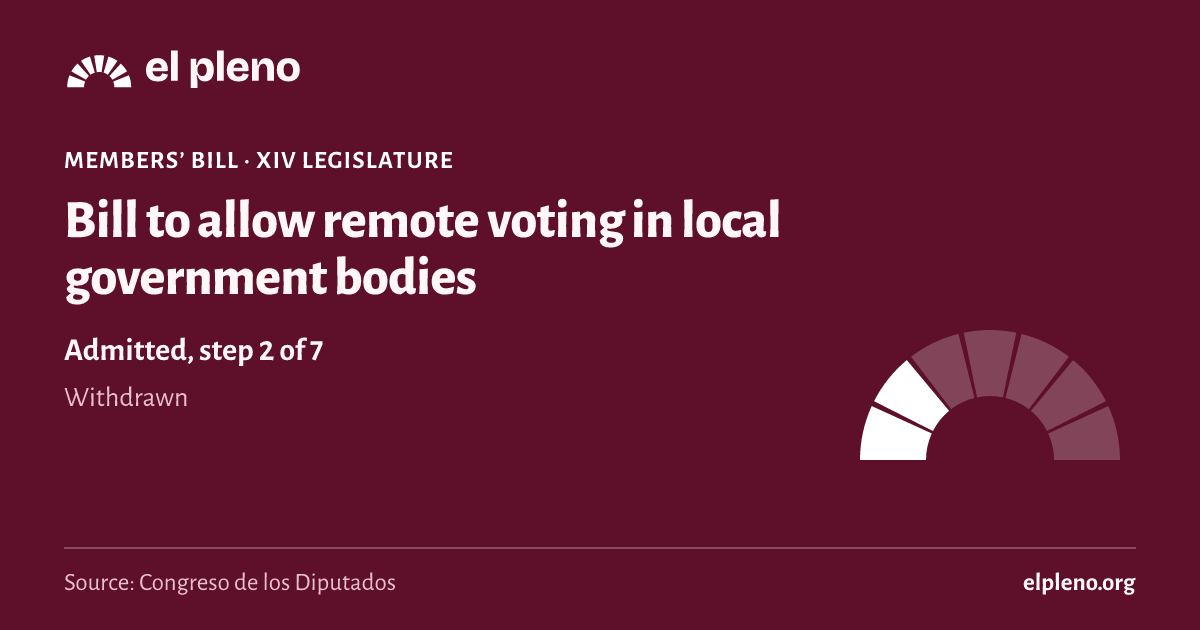
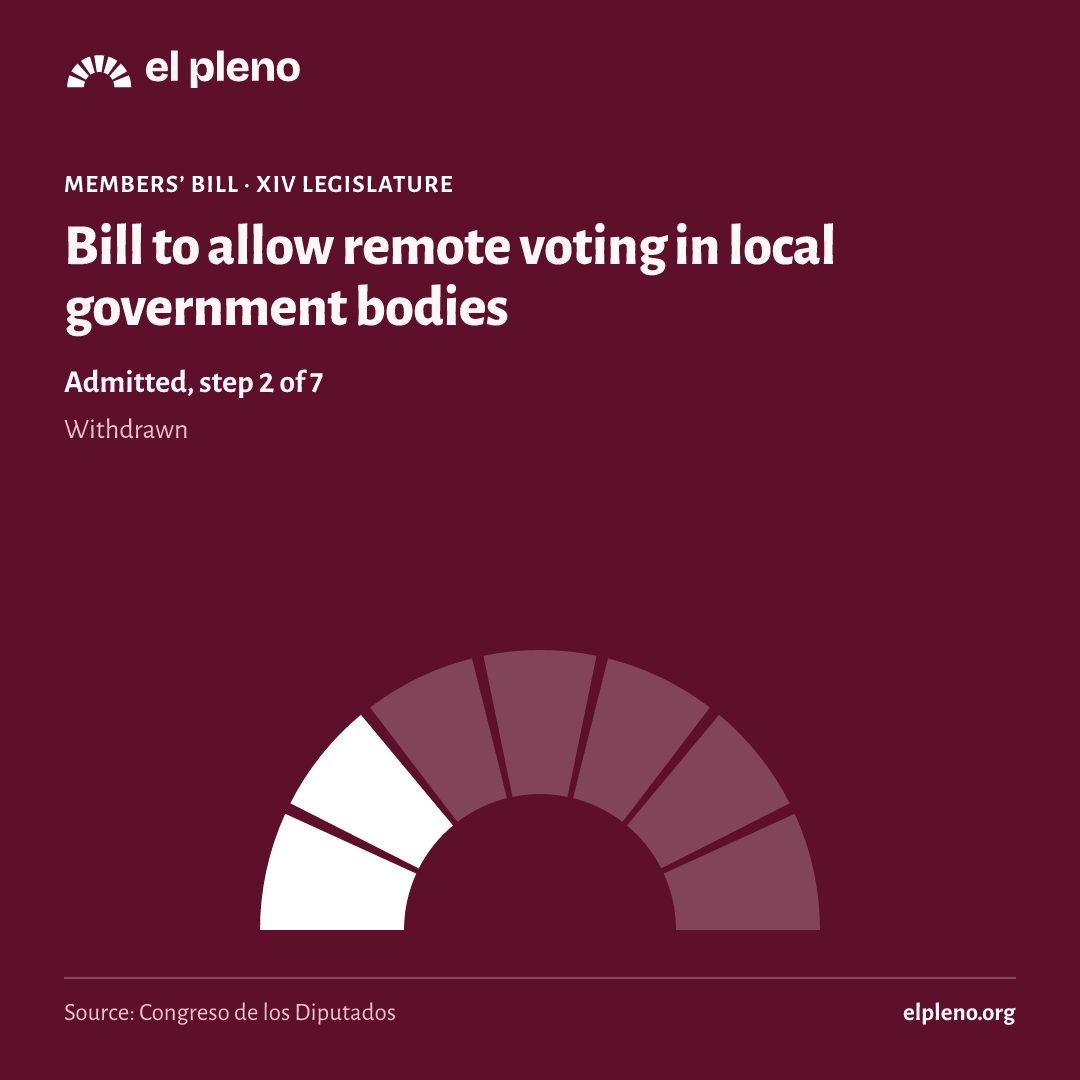
Source: Congreso de los Diputados, file 122/000049· updated 11 Nov
Automatic summary, not yet reviewed
- The bill would allow local government collegiate bodies (such as the Pleno The body of a town council made up of all councilors, where key matters are debated and approved. or the Governing Board) to meet, deliberate and vote remotely through electronic means when exceptional circumstances prevent most members from attending in person.
- Corporation members could vote by electronic procedure in case of pregnancy, maternity, paternity or serious illness preventing them from attending the Pleno in person, and also when the session is held remotely.
- Those voting electronically in the cases provided for would count as present for the majorities needed to adopt decisions.
- If passed, the law would take effect six months after publication in the Official State Gazette for municipalities over 10,000 residents, provincial councils, cabildos and island councils; for smaller municipalities, one year after publication.
Who it affects
- Town councilors, provincial council members and members of cabildos and island councils: They could participate and vote remotely if on sick, maternity or paternity leave, or in exceptional circumstances.
- Municipalities over 10,000 residents, provincial councils, cabildos and island councils: They would have to adapt their rules and set up the necessary means in the six months before the law takes effect.
- Municipalities under 10,000 residents: They would have one year from publication to apply the law.
- Residents and citizens: It would prevent the inability to meet in person from stalling local contracting, payments or public services.
Words worth knowing
- Órganos colegiados
- Governing bodies made up of several people who make decisions together, such as a town council's Pleno.
- Pleno
- The body of a town council made up of all councilors, where key matters are debated and approved.
- Entidades locales
- Local administrations closest to citizens: municipalities, provincial councils, cabildos and island councils.
- Voto de calidad
- The chairperson's deciding vote when a vote ends in a tie.
- Proposición de ley
- A bill introduced by a parliamentary group; it is not law until passed.
It summarizes the text as it was introduced. It is written by artificial intelligence and may contain mistakes: the official text is what counts. Read the official text · How we make summaries
Where it stands
How far did it get?
It took 2 of 7 steps. It reached Admitted, and today it is withdrawn.
- Introduced25 March 2020Someone registers the text in the Congreso.
- Admitted30 March 2020The Bureau of the Congreso accepts it and, for a members’ bill, the plenary decides whether to consider it.
- Amendmentsnot reachedGroups propose changes.
- Committeenot reachedA committee goes through the text in detail.
- Plenarynot reachedAll 350 deputies vote.
- Senatenot reachedThe Senate can pass it, amend it or veto it.
- BOEnot reachedIt is published in the Official State Gazette (BOE) and comes into force.
See the 6 official steps on a timeline
Was there a plenary vote?
We have no plenary vote linked to this law in the Congreso’s data.
What happens next
What happens now?
Whoever introduced it withdrew it, or it was merged into another one. It goes no further.
Sources
Where does all this come from?
- Congreso de los Diputados, file 122/000049
Official title, type, author, dates and stage.
Retrieved 11 November 2026
- The data comes from the open files of the Congreso, the Senate and the BOE, unaltered.
- Each deputy’s province is the one of their seat on the day of the vote.
- We only say “passed” or “rejected” when the majority needed is certain; otherwise we say which side had more votes.